About Otocyon megalotis (Desmarest, 1822)
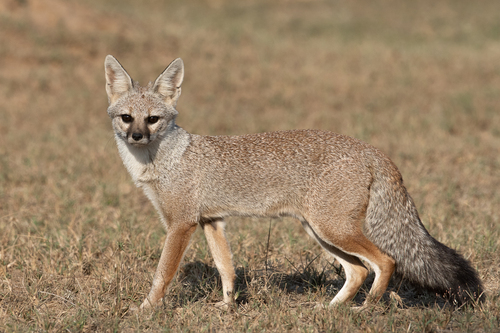
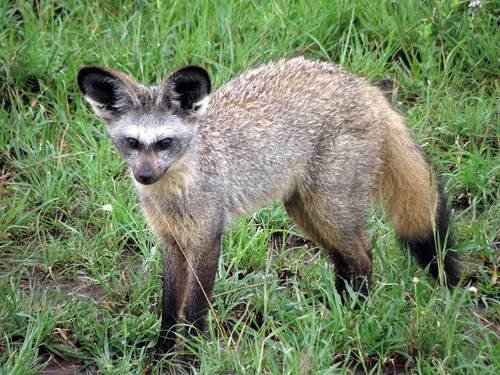
Bat-eared fox (Otocyon megalotis, Desmarest, 1822) adults weigh between 3 and 5.3 kg (6.6 to 11.7 lb). Head and body length measures 46–66 cm (18–26 in), tail length measures 23–34 cm (9.1–13 in), shoulder height measures 30–40 cm (12–16 in), and their characteristic large ears are 11–13 cm (4.3–5.1 in) long. This species shows sexual dimorphism, with females generally being larger and heavier than males. Their coat is typically tan, with agouti gray guard hairs; the throat and underparts are pale, while the limbs are dark, turning dark brown or black at the tips. The muzzle, facial mask, and both the tip and upper surface of the tail are black, and the inner sides of the ears are white. The East African subspecies O. m. virgatus typically has a buff coat with dark brown markings, unlike the nominate subspecies O. m. megalotis which has black markings. The species' proportionally large ears, a trait seen in many animals that live in hot, arid climates, help dissipate heat and also aid in locating prey.
The bat-eared fox has a separated disjunct distribution across arid and semi-arid regions of Eastern and Southern Africa, with two geographically isolated allopatric populations that correspond to the two recognized subspecies, separated by roughly 1,000 km (620 mi). Subspecies O. m. virgatus ranges from southern Sudan, Ethiopia, and Somalia through Uganda and Kenya to southwestern Tanzania. Subspecies O. m. megalotis occurs in southern Africa, ranging from Angola through Namibia and Botswana to South Africa, extending east to Mozambique and Zimbabwe, and reaching as far as the Cape Peninsula and Cape Agulhas. Individual home ranges vary in size from 0.3 to 3.5 km² (0.12 to 1.35 sq mi). The two separate ranges of O. megalotis were likely connected during the Pleistocene epoch.
Bat-eared foxes are adapted to arid or semi-arid environments. They are most commonly found in short grasslands, arid savanna regions, along woodland edges, and in open acacia woodlands. They prefer areas with bare ground and short grass maintained by grazing ungulates, and typically hunt in these short grass and low shrub habitats. When threatened, they will move into areas with taller grass and thicker shrubs to hide. They dig their own dens, which they use not only to raise young but also to shelter from extreme temperatures and winds. In South Africa, they also rest under acacia trees during the day to stay cool.
Bat-eared foxes are social animals that live in pairs or larger groups depending on their subspecies. In southern Africa, for the subspecies O. m. megalotis, groups are made of monogamous pairs with their pups. In eastern Africa, for O. m. virgatus, they may live in pairs or in stable family groups that include one male and up to three closely related females with their pups. Group members forage, play, and rest together, which helps protect the group from predators. They frequently engage in long allogrooming sessions that strengthen group bonds, most often between mature adults, but also between young and mature adults.
Visual signals are an important part of bat-eared fox communication. When focusing intently on something, an individual holds its head high, keeps its eyes open, holds its ears erect and facing forward, and keeps its mouth closed. When threatened or showing submission, the ears are pulled back to lie against the head and the head is held low. The tail also functions in communication: when asserting dominance or aggression, feeling threatened, playing, or sexually aroused, the tail is curved into an inverted U shape. When facing extreme threat, individuals can use piloerection (standing their hairs straight up) to appear larger. When running, chasing, or fleeing, the tail is held straight and horizontal. Bat-eared foxes can recognize other individuals from up to 30 m (98 ft) away, following a three-step process: first ignoring the other individual, then staring intently, then either approaching or attacking without additional displays. When greeting another individual, the approaching individual shows symbolic submission, and the receiving individual responds by holding its head high and keeping its tail down.
Bat-eared foxes use few vocalizations for communication, though they do produce contact calls and warning calls, mostly during winter. Other than scent marking to form pair bonds, they do not use glandular secretions or non-digging scratching in communication. In the northern part of their range, around the Serengeti, they are nocturnal 85% of the time. In South Africa, they are only nocturnal in summer, and diurnal in winter.
Bat-eared foxes are mostly socially monogamous, though polygynous groups have been observed. Unlike most other canids, bat-eared foxes have reversed parental roles: the male provides most of the care for offspring. Gestation lasts 60–70 days, and females give birth to litters of one to six pups. After the 14 to 15 week lactation period ends, males take over grooming, defending, huddling, chaperoning, and moving pups between den sites. Higher rates of male care and den attendance directly correlate with higher pup survival rates. While pups are young, females forage to maintain milk production, which the pups depend on heavily; females do not bring foraged food back to pups or regurgitate food to feed them. Pups are born between September and November in the Kalahari region, and between October and December in Botswana. Young bat-eared foxes disperse and leave their family groups at 5–6 months old, and reach sexual maturity at 8–9 months. The maximum recorded lifespan is over 14 to 17 years for captive individuals, and up to 9 years for wild individuals.
Bat-eared foxes have some limited commercial use for humans. They help control populations of harvester termites, which are considered pests. Native people in Botswana also hunt bat-eared foxes for their fur. Captive bat-eared foxes are held in zoos across North America, South America, Europe, and Asia.