About Otis tarda Linnaeus, 1758
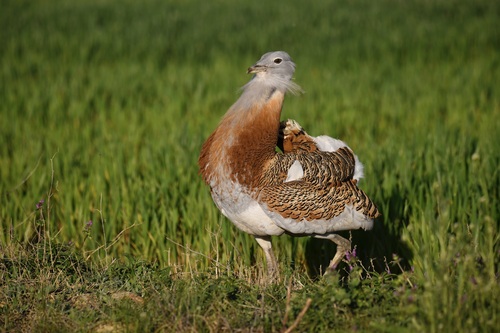
This species is scientifically named Otis tarda Linnaeus, 1758, commonly known as the great bustard. The adult male great bustard is among the heaviest living flying birds. A typical male measures 90–105 cm (2 ft 11 in – 3 ft 5 in) tall, around 115 cm (3 ft 9 in) in length, and has a wingspan of 2.1–2.7 m (6 ft 11 in – 8 ft 10 in). Male weight ranges from 5.8 to 18 kg (13 to 40 lb). The heaviest verified specimen, collected in Manchuria, was approximately 21 kg (46 lb), which holds the world record for the heaviest flying bird. A study in Spain recorded one male weighing as much as 19 kg (42 lb). Larger specimens have been reported but remain unverified. Reported average male weights vary considerably: in Russia, the median weight of males was 9.2 kg (20 lb); in Spain, males had a mean weight of 11.62 kg (25.6 lb) during the breeding season and 9.65 kg (21.3 lb) outside of breeding; in Germany, the mean male weight was 11.97 kg (26.4 lb); Guinness World Records indicates that male bustards in Great Britain have an average weight of 13.5 kg (30 lb). The average weight of male great bustards is almost exactly the same as that of male kori bustards. Among all flying animals and land birds, male Andean condors (Vultur gryphus) may match or exceed the mean body mass of these male bustards, but do not exceed their maximum weights. Male trumpeter and mute swans, the two largest swan species, may reach a similar average mass depending on season and region. Among both bustards and all living birds, the maximum reported mass of the great bustard is matched by that of the kori bustard (Ardeotis kori), which is on average longer and taller due to its relatively longer tarsi and tail, and is less sexually dimorphic. By reported weight ranges, the great Indian bustard (Ardeotis nigriceps) lags only slightly behind these two species. The great bustard is the most sexually dimorphic living bird species in terms of size difference between males and females. In Spanish populations, adult male great bustards weighed an average of 2.48 times more than females. Females are around a third smaller in linear dimensions, typically measuring 75 to 85 cm (2 ft 6 in to 2 ft 9 in) in height, around 90 cm (2 ft 11 in) in length, and 180 cm (5 ft 11 in) across the wings. Overall, female weight ranges from 3.1 to 8 kg (6.8 to 17.6 lb). Like male weights, reported female weights are quite variable: in Germany, females had a mean weight of 3.82 kg (8.4 lb); in Spain, females had a mean weight of 4.35 kg (9.6 lb); in Russia, the reported median female weight was 6 kg (13 lb). This last figure suggests that eastern birds (presumably the subspecies O. t. dybowskii) have considerably less sexual dimorphism in body mass than other great bustard populations. Possibly due to this physical sexual dimorphism, the species has a skewed sex ratio of roughly 1.5 females to 1 male. An adult male has brown plumage with blackish barring on its upperparts, white underparts, and a long grey neck and head. Its breast and lower neck sides are chestnut, and there is a golden tint to the back. The extent of these bright colorations tends to increase as the male ages. During the breeding season, males grow long white neck bristles that reach up to 12–15 cm (4.7–5.9 in) in length, and continue growing from the third to the sixth year of the male's life. In flight, the long wings are mostly white, with brown visible along the edges of the lower primary and secondary feathers, and a dark brown streak along the upper edge of the wing. The female's breast and neck are buff, with brown and pale plumage over the rest of its body that provides effective camouflage in open habitats. Immature great bustards resemble females. The eastern subspecies (O. t. dybowskii) has more extensive grey colouration in both sexes, with more extensive barring on the back. The great bustard has long legs, a long neck, and a heavy, barrel-chested body. Its overall shape and habitat preferences are fairly typical for the bustard family. Three other bustard species overlap in range with the great bustard: MacQueen's bustard (Chlamydotis macqueenii), houbara bustard (Chlamydotis undulata), and little bustard (Tetrax tetrax). None of these species match the great bustard's plumage colouration or approach its body size, so the great bustard is essentially unmistakable. Great bustards inhabit grassland or steppe, defined by open, flat or gently rolling landscapes. They can also be found on undisturbed cultivated land, and seem to prefer areas with wild or cultivated crops including cereals, vineyards, and fodder plants. However, during the breeding season they actively avoid areas with regular human activity, and can be disturbed by agricultural practices. Great bustards are often drawn to areas with substantial insect activity. The current breeding range of the great bustard extends from Portugal to Manchuria; historically, the species bred even further east in Russian Primorsky Krai. Due to population declines across most of its range, over half of the global population is now found in central Spain, with around 30,000 individuals. The Spanish region of Castile and Leon hosts around 30% of the global great bustard population. Smaller populations are located in southern Russia and the Great Hungarian Plain. In Iran, the species only survives in a small area of the Boukan region in West Azerbaijan province, where a January 2025 census recorded just 19 remaining individuals. In 2024, conservation work in Boukan resulted in the successful hatching of the first captive great bustard chick in Iran. As of 2008, the global population counted between 44,000 and 51,000 birds (Palacin & Alonso 2008), with approximately 38,000 to 47,000 in Europe and more than half of those (30,000) in Spain. Hungary had the next largest great bustard population, with about 1,555 individuals in 2012, followed by Ukraine and Austria. Between 4,200 and 4,500 great bustards were found in east Asia. In recent times, steep population declines have occurred across eastern and central Europe and in Asia, particularly in Kazakhstan and Mongolia. Sizeable populations exist in Spain (23,055 birds), Russia (8,000 birds), Turkey (800–3,000 birds), Portugal (1,435 birds) and Mongolia (1,000 birds). In Germany and Austria, populations are small (232 birds in Germany in 2016; 335 birds in Austria in 2012) but have been growing steadily for roughly two decades. Throughout the rest of the species' range, populations are declining due to habitat loss. A sizeable population of 1,100–1,300 birds also exists in Hungary, where the Eastern European steppe zone ends, near Dévaványa town, and in the Hortobágy National Park, Nagykunság and Nagy-Sárrét regions. The population is down from 10,000–12,000 individuals before the Second World War. Agri-environment schemes such as growing unirrigated legumes have supported a population increase of great bustards in Castilla y Leon, central Spain. The great bustard is gregarious, especially in winter when gatherings of several dozen birds may form. Male and female groups do not mix outside of the breeding season. The great bustard has a stately slow walking gait, but tends to run rather than fly when disturbed. Running speeds have not been measured, but adult females have been recorded outrunning red foxes (Vulpes vulpes), which can trot at 48 km/h (30 mph). Both sexes are usually silent, but can produce deep grunts when alarmed or angered. Displaying adult males may make booming, grunting, and raucous noises. Females may utter guttural calls at the nest, and brooded young produce a soft, trilling call to communicate with their mother. The great bustard breeds in March, and a single male may mate with up to five females. Before mating, males moult into their breeding plumage around January. Males establish dominance in their groups during winter, clashing violently by ramming into and hitting each other with their bills. Like other bustards, male great bustards display and compete for female attention on a mating ground called a lek. For this species, the male's flamboyant display begins with the strutting male inflating his throat to the size of a football. He then tilts forward and pulls his head in, so that the long whiskery chin feathers point upwards and the head is no longer visible. Next he cocks his tail flat along his back, exposing the normally hidden bright white plumage, then lowers his wings, with the primary flight feathers folded and the white secondaries fanned out. Displaying males, who may walk around for several minutes at a time with feathers flared and head hidden waiting for females, have been described as looking like a "foam-bath" due to their appearance. The female lays one to three olive or tan glossy eggs (with two eggs being average) in May or June. Nests are shallow scrapes dug by the female on dry, soft slopes and plains, and are usually located close to the lek where mating occurred. Nests are found in sparse clusters; a study in Inner Mongolia found nests were a minimum of 9 m (30 ft) apart from each other. In the same study, nests were placed at mid-elevation on a hill, around 190 to 230 m (620 to 750 ft). Nesting sites are typically in dense grassy vegetation about 15 to 35 cm (5.9 to 13.8 in) tall, likely for protection against predation, with extensive exposure to sunlight. Eggs weigh about 150 g (5.3 oz) and average 79.4 mm (3.13 in) in height by 56.8 mm (2.24 in) in width. The female incubates the eggs alone for 21 to 28 days. The chicks leave the nest almost immediately after hatching, but do not move far from their mother until they are at least 1 year old. Young great bustards begin developing their adult plumage at around 2 months old, and begin developing flying skills at the same time. They practice by stretching, running, flapping, and making small hops and jumps to become airborne. By three months old they can fly reasonable distances. When threatened, young great bustards stand still, using their downy plumage—mainly sepia with paler buffy streaks—as camouflage. Juveniles become independent by their first winter, but normally stay with their mother until the next breeding season. Males usually begin mating at 5 to 6 years of age, though they may engage in breeding display behaviour at a younger age. Females usually breed for the first time at 2 to 3 years old.