About Osyris compressa (P.J.Bergius) A.DC.
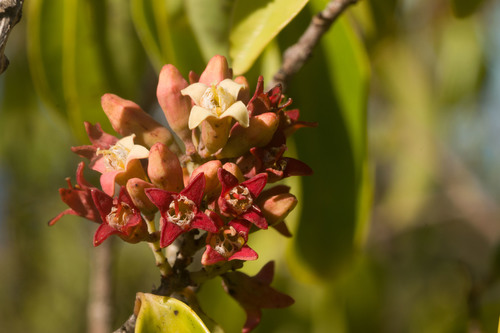
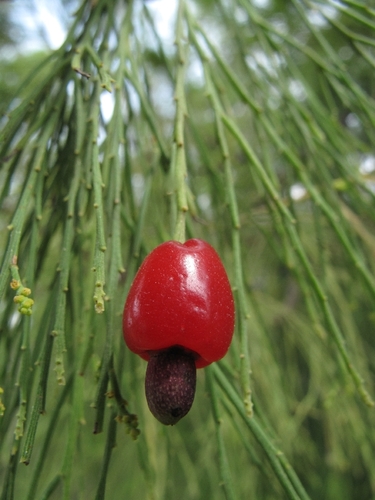
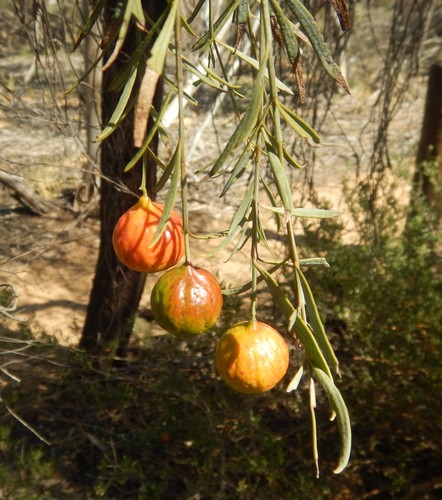
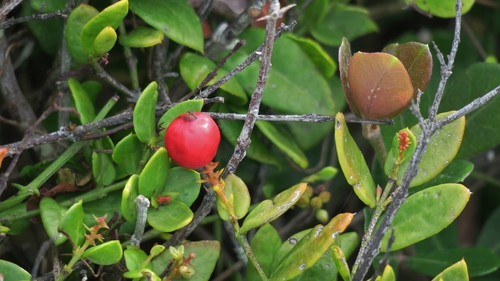
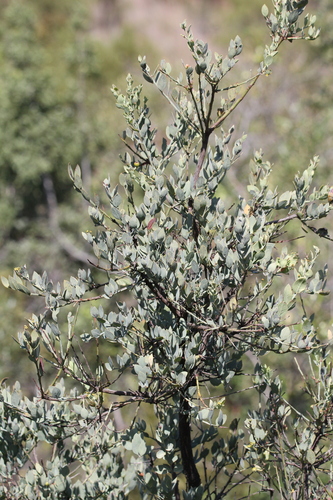
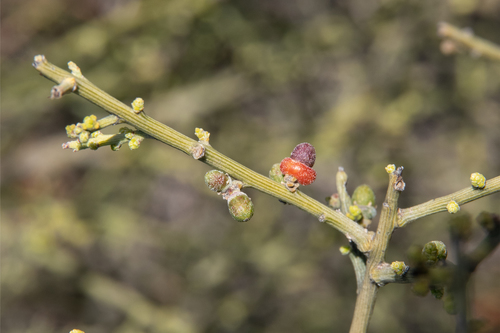
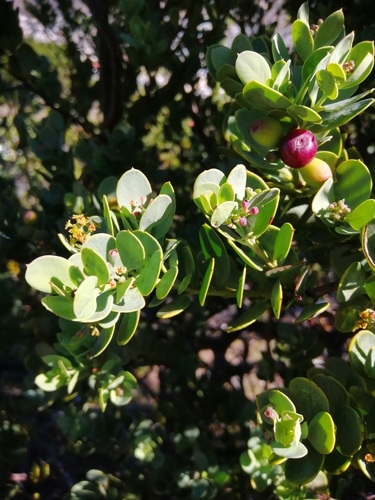
Osyris compressa, commonly known as Cape sumach, is a shrub or small tree that reaches a maximum height of 5 m; plants growing in open areas typically reach 2 to 3 m. Its leaves are opposite, decussate, blue-green with a greyish bloom, elliptical, smooth, and stiff. They generally measure 20–50 mm long, with thickened, entire margins. Its inflorescence is a terminal panicle that holds small, slightly fragrant bisexual flowers. The flowers are creamy-green and unspectacular, but they bloom through most of the year, attracting many types of pollinating insects. The ovary holds four ovules, but the fruit develops into a single-seeded drupe shaped like a prolate spheroid. Drupes are about 15 to 25 mm long and 10 to 15 mm across. They are fleshy with smooth skin, crowned by a ring of perianth lobes at the tip. By the time the fruit ripens, usually only a circular groove remains of the perianth. The drupes are colourful, changing from greenish blue to bright red, then to glossy purple or black as they mature. Fruit matures at different rates, so the combination of successive colours can be quite showy. This species is distributed mainly across South Africa, ranging from the coastal fynbos of the western Cape Peninsula along the south coast, and extending north into tropical East Africa. Osyris compressa is a tough, adaptable plant that can tolerate frost, heat, and wind. It grows quickly and survives in poor, sandy soils, even growing in coastal dunes where it acts as an effective windbreak and helps bind sand. As a monoecious species with bisexual flowers, it is both cross-pollinating and self-fertile, and produces large numbers of fertile seeds prolifically. It begins bearing fruit when it is still young, and produces abundant seeds nearly year-round. The fruit attracts a range of birds and mammals that disperse its seeds effectively. Like many members of the Santalaceae family, Osyris compressa uses a facultative hemiparasitic strategy to supplement its nutrient intake, especially in dry conditions or poor soils. Its roots form haustoria that attach to the roots of nearby plants to draw out sap. While this species can grow without a host, this habit helps it thrive in relatively poor coastal sands, and it requires hosts to reach its full growth potential. In this trait, Osyris compressa resembles other hemiparasites in related families, such as Nuytsia floribunda in the Loranthaceae. Being parasitic does not protect Osyris compressa from parasitism by other species. Several mistletoe species in the genus Viscum, which is currently placed in the same family as Osyris, often parasitize its branches. Additionally, as a root parasite, Osyris compressa can act as a host for another root parasite in the same family, Thesidium fragile, and possibly other related species. It is not known whether either of these competing root parasites gains a benefit from the other when their roots make contact. As a densely leaved shrub with abundant, if inconspicuous flowers and edible fruit, Osyris compressa provides valuable shelter and food for many animals. The best-known of these is likely the butterfly Mylothris agathina, a member of the Pieridae family. This plant is popular as an ornamental in coastal gardens. It naturally grows in coastal dunes, and its vigorous, compact growth habit allows it to be shaped into a dense hedge. It also produces attractive multicoloured berries year-round that add ornamental value and attract frugivorous birds. Osyris compressa has been used in programs to stabilize coastal dunes. Its leaves and bark were historically valued for tanning. It produces high-quality, fine-grained wood, but the plant rarely grows trunks or branches large enough for most commercial uses. While it is not widely actively cultivated, it is considered of interest as a source of incense and essential oil, similar to sandalwood. The fleshy berry flesh is edible, and was part of the traditional diet of the local Khoikhoi people, who ate it fresh and preserved it as dried pulp. It has not shown much promise as a popular fruit for western consumers; some reports describe it as having a tingly sour taste, while others describe it as plum-like. The Afrikaans common name pruimbos translates to "plum bush" in reference to this taste. An extract made from boiled bark has been used to flavour tea. Osyris compressa can be propagated by seed.