About Ostrea lurida P.P.Carpenter, 1864
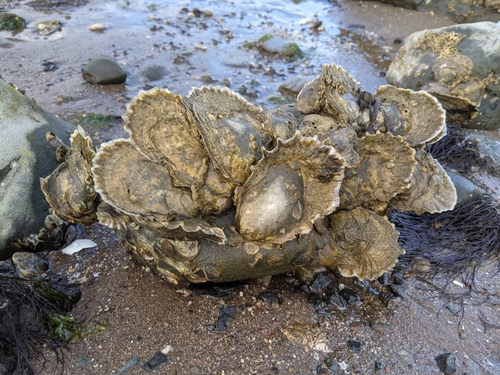
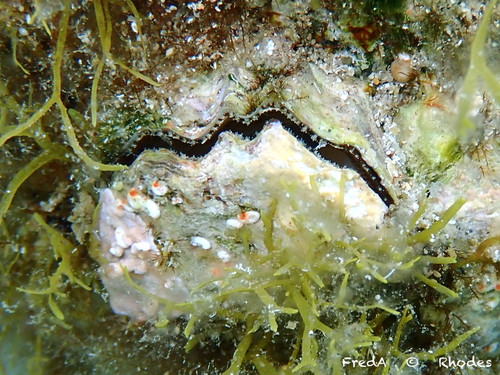
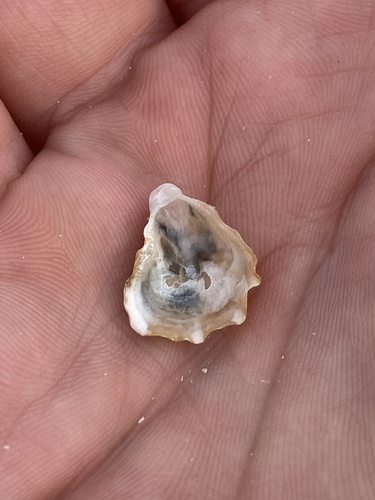
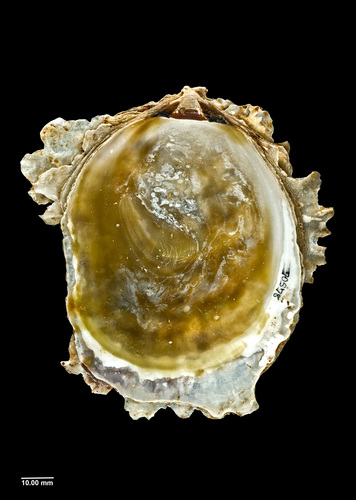
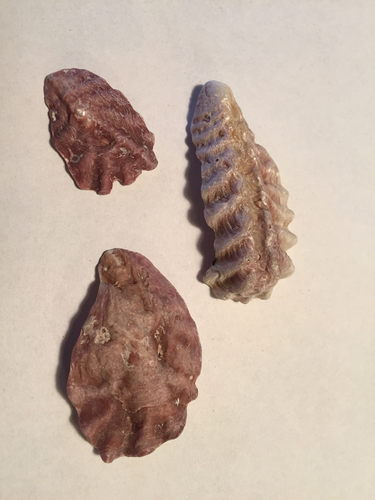
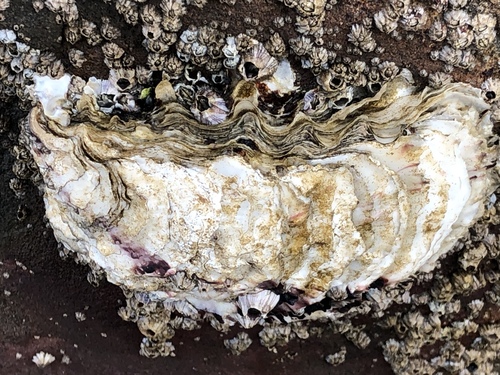
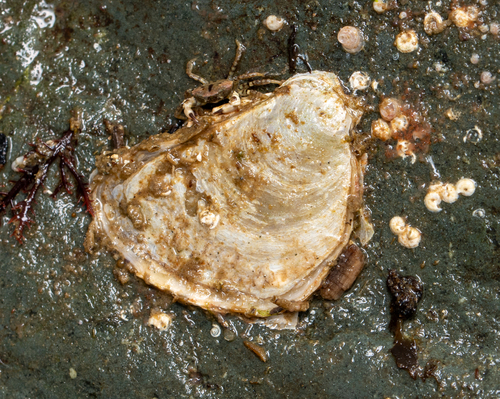
Ostrea lurida, commonly known as the Olympia oyster, is a bivalve mollusc that typically reaches 6 to 8 centimetres (2.4 to 3.1 inches) in length. Its shell can be rounded or elongated, and ranges in color from white to purplish black, and may be striped with yellow or brown. Unlike most bivalves, the Olympia oyster’s shell has no periostracum, the outermost shell layer that prevents erosion of the underlying shell material. Its flesh is colored from white to light olive green.
Ostrea lurida individuals attach firmly to substrate with their left valve. Like other oysters, adult Ostrea lurida lack a foot, do not have an anterior adductor muscle, and do not secrete byssal threads the way mussels do. Olympia oysters are suspension feeders: they filter surrounding water to strain out phytoplankton for food. They filter between 9 and 12 quarts of water per day, though this rate varies heavily based on environmental conditions. This filtering activity helps keep marine waters clean, and oyster beds formed by this species provide shelter for anemones, crabs, and other small marine organisms.
Ostrea lurida lives in bays and estuaries. It occupies areas bordering mudflats at slightly higher elevations, and eelgrass beds at lower elevations. It attaches to the underside of rocks or to the shells of existing old oyster beds. Its suitable habitat has a water depth between 0 and 71 meters, water temperatures between 6 and 20 degrees Celsius, and a salinity above 25 parts per thousand. The species can also survive salinity fluctuations caused by incoming stream flow; these fluctuations actually protect the oysters from parasitic flukes, which cannot tolerate changing salinity. This species is native to Puget Sound, and its range extends north as far as Southern Alaska. Ostrea lurida populations have declined rapidly in recent history, and oyster reef restoration projects have been established to support the continued survival of the species.
Olympia oysters spawn between May and August, when water temperatures rise above 14 degrees Celsius. During their first spawning cycle, individuals function as males, and then switch sexes in subsequent spawning cycles. Males release spermatozoa from their mantle cavity as sperm balls, which dissolve in water to release free-floating sperm. Females brood their eggs: sperm are filtered into the female’s gill slits from surrounding water, and eggs are fertilized inside the female’s mantle cavity, which acts as a brooding chamber. Fertilized eggs then move to the branchial chamber within the mantle cavity, where they develop into veliger larvae. Larvae remain in the female’s mantle cavity for 10 to 12 days to complete development.
During brooded development, larvae form blastulae (cell masses with a central cavity) on the first day, become gastrulae (hollow two-layered sacs) on the second day, develop into free-swimming trochophore larvae on the third day, and gain defined valves on the dorsal surface on the fourth day. Over the remaining brooding period, valves fully form and larvae develop into straight-hinged veligers. Once larvae (called spat) leave the brooding chamber, they develop an eye spot and a foot, then migrate to hard surfaces, most commonly old oyster shells, where they attach by secreting a glue-like substance from their byssus gland. Ostrea lurida spat swim with their foot positioned above the rest of their body, so they typically end up attaching to the underside of horizontal surfaces. A female produces between 250,000 and 300,000 larvae per brood. Mature eggs are 100 to 105 micrometres in diameter, and newly developed larvae measure around 187 micrometres long. The number of larvae a female produces depends on her size and the amount of stored nutrients she has when eggs are fertilized.
Native American peoples harvested and ate this oyster across its entire range. Consumption was so intense in San Francisco Bay that large middens of oyster shells accumulated over thousands of years. One of the largest of these middens, the Emeryville Shellmound located near the mouth of Temescal Creek and the eastern end of the San Francisco–Oakland Bay Bridge, is now buried under the Bay Street shopping center. Native peoples have harvested these oysters along the estuarine shores of the Santa Barbara Channel region for at least 8200 years, and likely even longer.