About Ostrea edulis Linnaeus, 1758
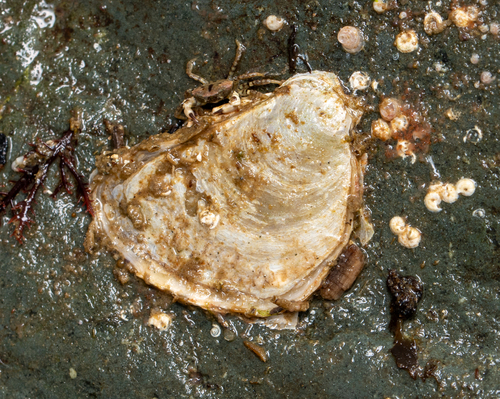
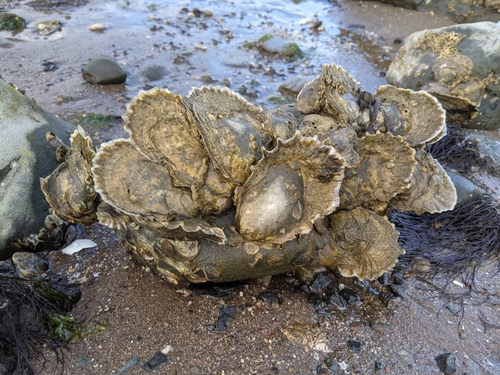
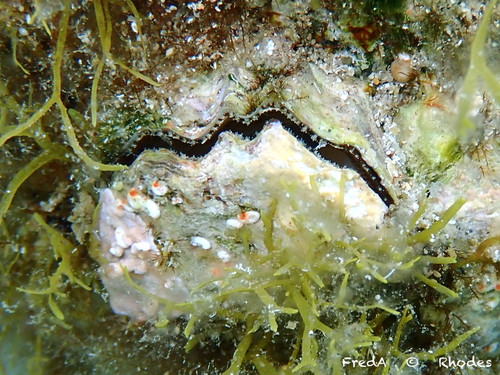
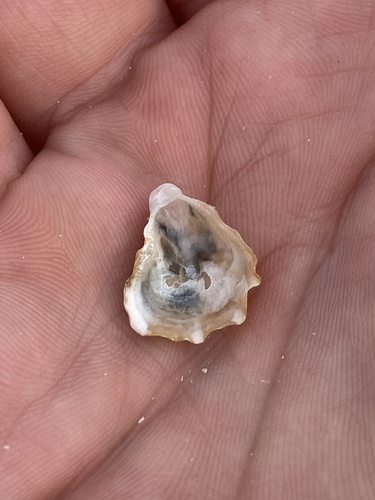
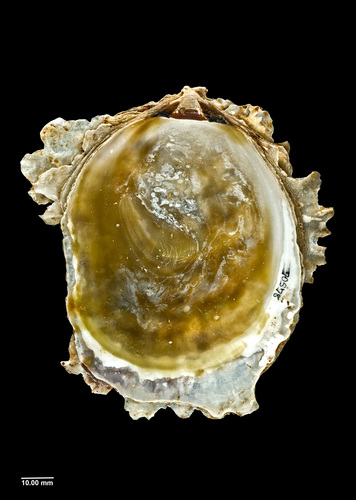
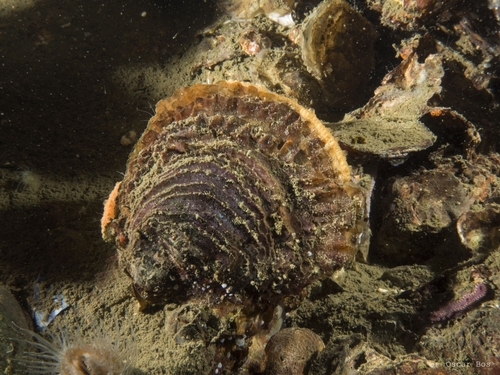
When mature, adult Ostrea edulis measure 3.8 to 11 centimetres (1.5 to 4.3 inches) across. Their shells are oval or pear-shaped, with a base colour of white, yellowish, or cream. The outer shell surface is rough, and the right valve bears pale brown or bluish concentric bands. The two valves differ noticeably in shape and size: the left valve is concave and anchors to the substrate, while the right valve is almost flat and fits inside the left valve. The inner shell surface is smooth, and coloured whitish or bluish-grey. This species naturally occurs along the western and southern coasts of Europe, ranging from Norway to Morocco, and covering most of the British Isles and the Mediterranean coast. After artificial introduction in the 1940s and 1950s, naturally self-sustaining populations became established in eastern North America, from Maine to Rhode Island. Ostrea edulis inhabits estuarine and shallow coastal waters, where it lives on hard substrates made up of mud and rocks. Humans have harvested this species as an important food source across Europe since prehistory. Large quantities of O. edulis were exported from Britain back to Italy during the Roman occupation of Britain. Today, Pacific oysters (Crassostrea gigas) make up over 75 percent of Europe's oyster production, due to their more robust build and greater ease of cultivation. European flat oysters are famously cultivated in Brittany, France. The true Belon oyster, a cultivated form of O. edulis grown in France's Belon River, holds an AOC protected name. In the 1950s, Dutch scientists artificially introduced Belon oyster seed into waters off Maine to establish a viable stock. The initial project was abandoned, but natural colonies of flat oysters were found in the wild ten years later. Many North American suppliers apply the name 'Belon' to wild oyster species found across the United States. Ostrea edulis is also currently maricultured in the U.S. states of California, Maine, and Washington. This species once dominated European oyster production, but disease, pollution, and overfishing caused a sharp reduction in harvests. At present, projects across Germany, the UK, France, Scotland, and Wales work to restore oyster reefs and preserve this species' habitat. U.S. oyster growers farm O. edulis in small quantities on both the Atlantic and Pacific coasts. It is prized for its unique tannic seawater flavour, which is sometimes described as dry and metallic, and it sells for a higher price than other American oysters. Its flavour is considered excellent for eating raw on the half shell. Compared to other oyster species, the European flat oyster has a somewhat weaker shell seal, caused by the shape of its shell combined with the size of its adductor muscle. It is common practice to secure oysters with rubber bands before consumption to stop them from spilling their internal liquor and dehydrating during storage.