About Ostracion cubicus Linnaeus, 1758
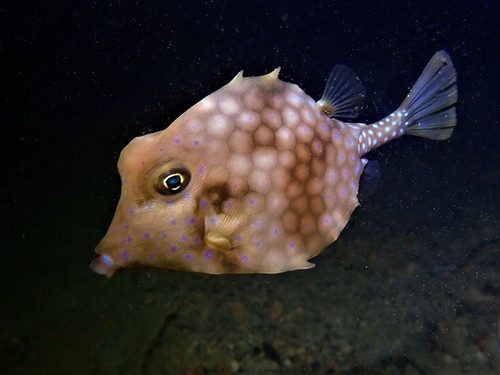
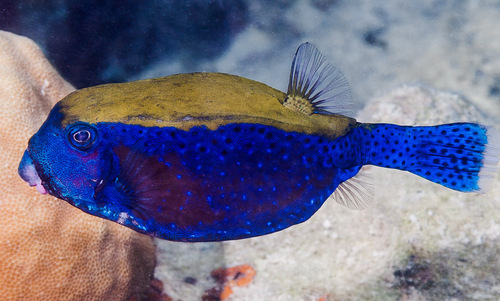
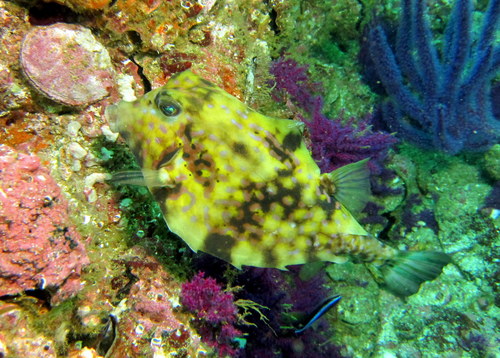
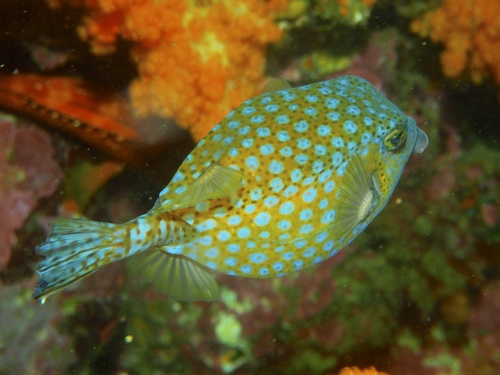
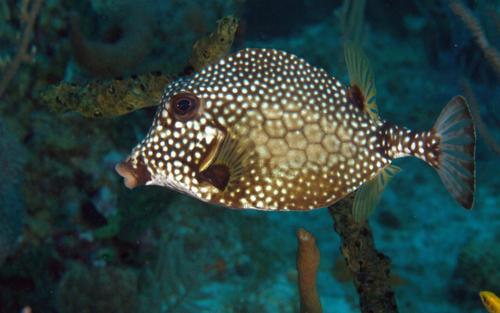
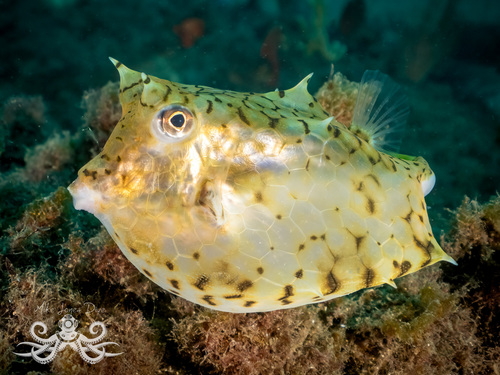
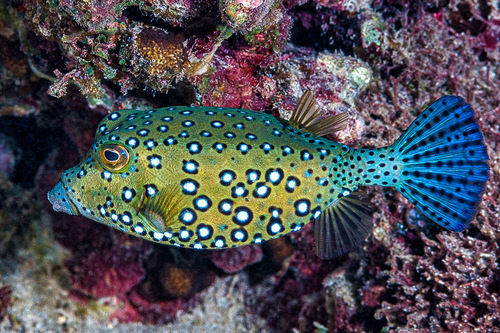
The yellow boxfish (Ostracion cubicus Linnaeus, 1758) reaches a maximum length of 45 centimetres (18 in). As its common name suggests, it has a box-shaped body. Like other boxfish, it has an armored, rigid body covering called a carapace that covers its head and entire body. The carapace has openings for the mouth, nostrils, gill opening, anus, caudal peduncle, and fins. Researchers originally believed the rigid body shape from the surrounding carapace helped stabilize the fish while swimming as water flowed over its body, keeping it on course in high-flow, turbulent conditions. However, studies later found the carapace actually has little to no effect on swimming stability; instead, it is destabilizing because it increases drag. The caudal fin acts as a stabilizing force and functions like a rudder instead. Despite having a stiff, rigid body covering, yellow boxfish are strong and swift swimmers. They can swim steadily for long periods and can maneuver through complex reef environments. Scientists previously thought boxfish only swam in burst movements by sculling their fins like boat oars, but this species actually uses a combination of movements from its dorsal, anal, and pectoral fins. The dorsal and anal fins move stiffly, either at the same time or separately, and the fish reaches its maximum speed using these fins. The pectoral fins generate thrust while moving in a figure-eight motion. At low speeds, the fish relies primarily on its pectoral and anal fins. As speed increases to moderate and faster levels, locomotion shifts to become dominated by the dorsal and caudal fins. Additionally, yellow boxfish have a keel that aids their swimming. The keel is a ridge located near the caudal peduncle, and it provides support and improves swimming stability; for this species, the keel specifically helps stabilize against roll. Juvenile yellow boxfish are bright yellow in color. As the fish ages, the brightness of this yellow color fades, and very old specimens develop blue-grey to black coloration with only faded yellow tones. Yellow boxfish are solitary animals. Breeding takes place during the spring, in small groups made up of one male and 2 to 4 females. The yellow boxfish can be confused with the spotted boxfish (Ostracion meleagris), as both share the same box-like body shape and have spots covering their entire bodies. The main difference between the two species is their coloration: the yellow boxfish is primarily bright yellow with dark spots, while the spotted boxfish is darker overall with white spots. The yellow boxfish has a wide distribution across the Indo-Pacific, ranging from the Red Sea and the eastern coast of Africa south to South Africa, east to Hawaii, north to Japan, and south to northern New Zealand. It has also been recorded in the eastern Mediterranean Sea, and it most likely reached this area by traveling through the Suez Canal. This species lives at depths between 1 and 75 m (3 ft 3 in and 246 ft 1 in), and can be found on sheltered coastal and offshore coral reefs, as well as in areas with flat seabed. It is adapted to maneuver through the channels and crevices of coral reefs, and to feed on the benthic invertebrates that also live in these reef habitats.