About Ostorhinchus doederleini (Jordan & Snyder, 1901)
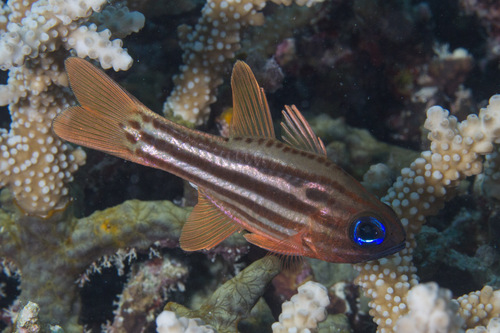
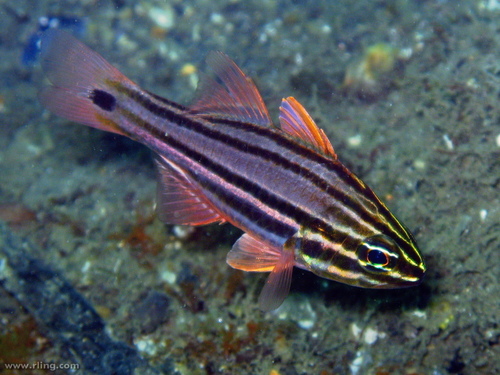
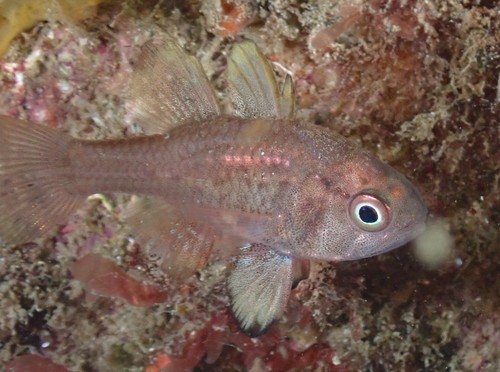
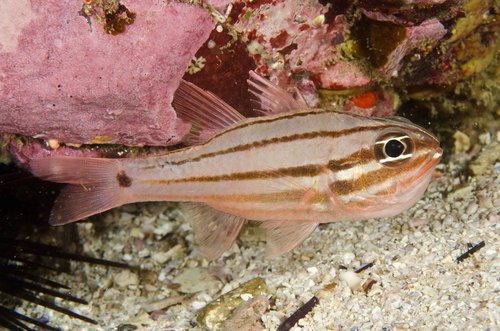
Ostorhinchus doederleini is a fish species from the cardinalfish family. Its common names include Doederlein's cardinalfish and fourline cardinalfish; it is called osuji-ishimochi in Japanese. This species is native to subtropical areas of the western Pacific Ocean, where its distribution ranges from Japan to Taiwan, Australia, New Caledonia, and the Kermadec Islands. Adults of this species grow to around 14 centimeters in total length. Males and females of this species look identical. Their bodies are pinkish or brownish, marked with four brown stripes that stretch almost from the head to the tail, and a distinct black spot at the base of the tail. Individuals stop growing once they reach 3 years of age, and the maximum recorded lifespan of this species is approximately 7 years. Ostorhinchus doederleini lives in nearshore rocky habitats, including rocky ledges. It is a nocturnal species; during daylight hours it hides in caves and rock crevices. It feeds primarily on invertebrates, with gammarid amphipods being its main prey. Individuals are solitary outside of the breeding season, when they form temporary breeding pairs. Pairings only last for a short time, with males and females courting for a few hours each afternoon over consecutive days. During courtship, the pair engages in a behavior called "parallel-circling", where the female positions herself pointing toward the male's side, circles him, and occasionally pokes him with her snout. Both fish lighten in color during courtship, with their dark markings becoming paler. The female will often chase away other fish that approach the pair. After several rounds of circling behavior, the female releases an egg mass approximately 2 to 3 centimeters wide. Like other cardinalfish species, O. doederleini is a paternal mouthbrooder, meaning the male cares for the eggs by holding them inside his mouth. Within seconds after the female spawns, the male scoops the entire egg mass into his mouth. After spawning, the female leaves, and the male broods the eggs alone. A single male can incubate multiple broods over one breeding season, which lasts a few months, varying in length by location. One egg mass holds approximately 10,000 eggs. Incubation for a single brood takes between 5 and 17 days, with incubation length determined by water temperature. Larger males typically incubate more eggs per brood. During the breeding season, male mouths expand significantly to hold broods, and their lower jaw becomes more flattened in shape. Male O. doederleini very often eat the eggs they are brooding. In one study of 361 egg masses guarded by males, 47 masses were eaten by the male within one day of brooding starting. Other studies report an overall egg cannibalism rate between 12% and 18%. Males do not feed on their normal prey while they are mouthbrooding. Towards the end of the breeding season, after a male has brooded multiple broods, he becomes physically weakened, and is more likely to cannibalize his eggs at this stage. Younger males also frequently eat their first egg clutch of the season; this may be because they are still growing and gain more nutritional benefit from eating the eggs than they would from successfully producing offspring. Sometimes males only eat a small number of eggs from a clutch, which may reduce crowding in their mouth or improve oxygen flow to the remaining eggs. Males are also more likely to eat eggs laid by smaller females than eggs laid by larger females. After cannibalizing a clutch, males will quickly mate with a different female, which suggests they actively choose which mates to invest reproductive effort in. This species is a host for Pseudacanthocanthopsis apogonis, a parasitic chondracanthid copepod. The species' specific name honors German zoologist Ludwig Döderlein (1855-1936), who worked at the Imperial University in Tokyo, in recognition of his research on Japanese fishes.