About Ostorhinchus cyanosoma (Bleeker, 1853)
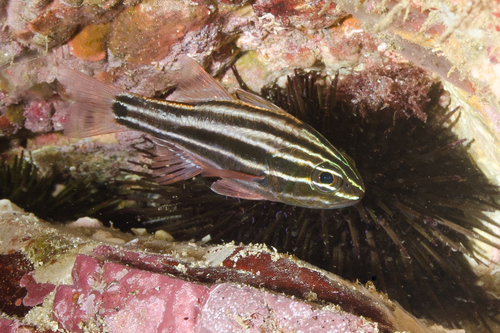
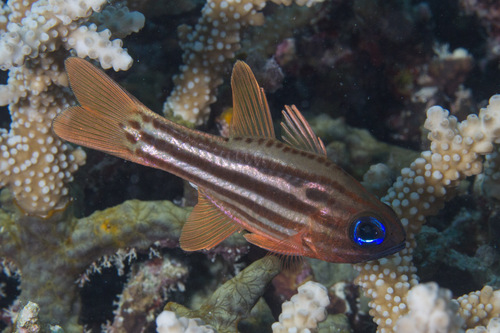
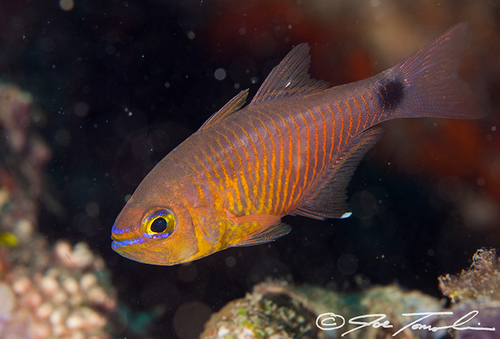
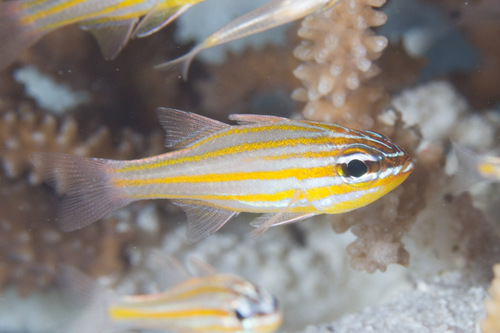
Large individuals of Ostorhinchus cyanosoma reach a maximum total length of 8 cm, while the species’ average length is 6 cm. Their base body color is silver with a bluish tinge, and they have six orange-yellow stripes, one of which is a short stripe located behind the eye. In 1998, the new species Ostorhinchus rubrimacula was split from the Ostorhinchus cyanosoma species complex. O. rubrimacula has nearly identical morphology to O. cyanosoma, but it bears a pinkish-red spot on its tail base; this separation was genetically confirmed in 2014. Notably, when Bleeker described the original sample of O. cyanosoma, he recorded red fins (noted as 'pinnis rubris') but never recorded a red spot on the tail. The most comprehensive recent authority records the range of O. cyanosoma across the Indo-Pacific. Its distribution extends from the Red Sea, south to eastern Africa, and east through Western Australia and Queensland to New Caledonia, reaching north to the Ryukyu and Ogasawara Islands. Ostorhinchus cyanosoma is a paternal mouthbrooder. Males of this species exhibit a wider gape and a more protruding lower jaw, which is a form of sexual dimorphism. Mouthbrooding behavior is a more likely driver of this dimorphism than prey specificity: a larger mouth allows males to protect more eggs from predators, and also supports better water circulation to oxygenate both the brooded eggs and the male parent. Pair bonding in this species does not appear to deliver the genetic benefits associated with strict monogamy. Like many pair-bonding fish in its family, pair bonding in O. cyanosoma appears to be driven by selection related to predation, rather than selection for exclusive reproductive pairing.