About Ostorhinchus aureus (Lacepède, 1802)
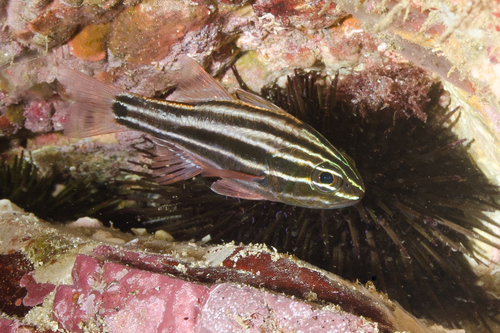
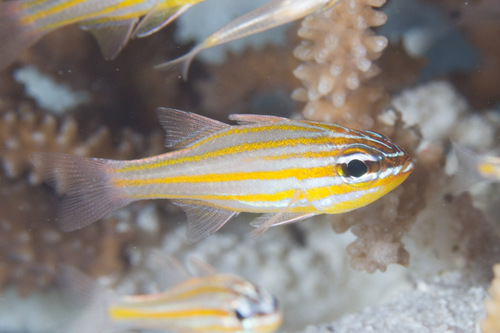
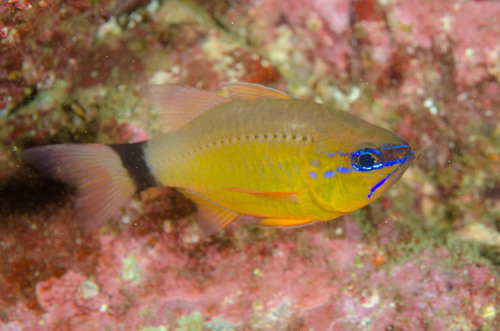
Ostorhinchus aureus (Lacepède, 1802) is a fish with coppery coloration, reaching a maximum length of 14.5 cm. It has a broad blackish bar at the base of its tail, a narrow blue streak on the upper jaw, and a broad blackish stripe that runs from the front of the snout to the eye. This species is easily confused with Ostorhinchus fleurieu, which has a black tail bar that does not narrow in its center. Unlike O. fleurieu, the characteristic blackish stripe from snout to eye is present even in juvenile O. aureus. Internally, O. aureus belongs to a large group of nocturnal feeding fishes that have a black pigmented gut lining. This lining is thought to hide the glow of bioluminescent prey from the piscivores that hunt O. aureus itself. The eyes of O. aureus can transmit ultraviolet light; if the species is confirmed to be able to see ultraviolet light, this ability could improve its nocturnal foraging. Ostorhinchus aureus lives in rock holes or under ledges in shallow water. During summer and autumn, it forms mixed mixed-species aggregates with Ostorhinchus apogonoides. In winter and spring, the two species form separate, species-specific aggregates instead. O. aureus is an external brooder, specifically a mouthbrooder. During the daytime, adult individuals typically form pairs, while juvenile individuals aggregate in groups.