About Osteopilus septentrionalis (Duméril & Bibron, 1841)
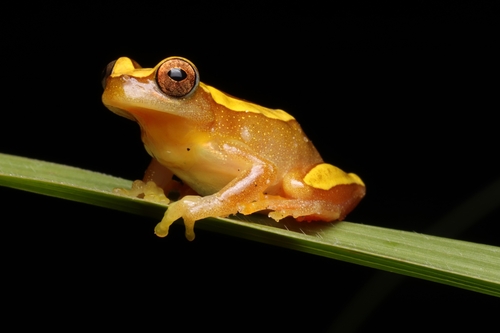
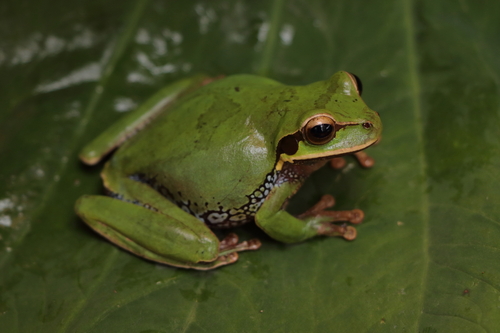
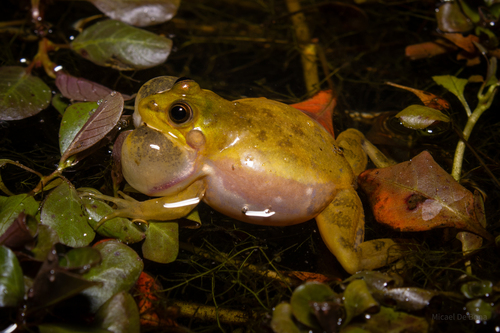
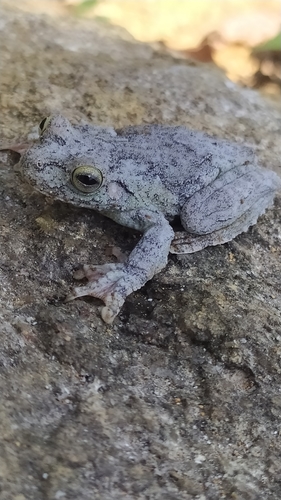
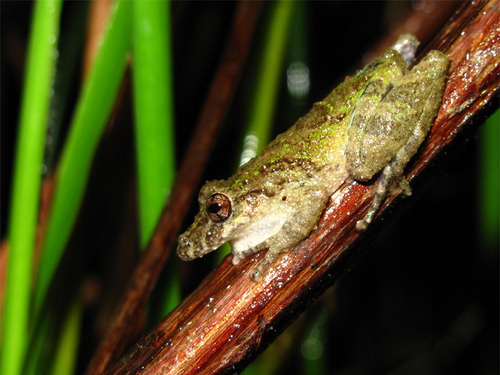
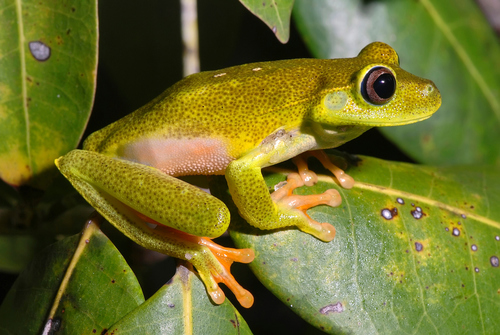
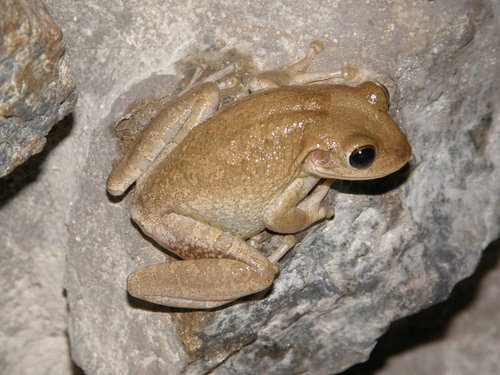
Cuban tree frogs, scientifically named Osteopilus septentrionalis, are the largest tree frogs in North America. Their adult length ranges from 2 to 5.5 inches (5 to 12.7 cm). Their base body color is most often gray, brown, or green; young individuals have more green coloration than adults. They have rough, warty skin marked with blotchy or mottled patterning, and can change their color and pattern to camouflage themselves. The inner thighs of Cuban tree frogs are bright yellow, which confuses predators when the frog jumps and reveals this color. Their toes have sticky pads suited to their arboreal (tree-dwelling) lifestyle. A unique physical trait of this species is that the skin on the head is fused to the skull: rubbing the skin between the eyes of an adult frog will not move the skin. This fused (co-ossified) area has fewer blood vessels, which is an adaptation that reduces water loss. Cuban tree frogs secrete a toxic mucus through their skin, which causes a fiery, burning sensation if it comes into contact with human eyes. The species is native to Cuba, the Bahamas, and the Cayman Islands, and has been introduced to Puerto Rico, the U.S. Virgin Islands, and the British Virgin Islands. It is debated whether Cuban tree frogs are native to Florida's Key West region, or were introduced there. The species first arrived in the area via cargo ships in the 1800s, and was first discovered in the region in the 1930s. Cuban tree frogs can survive in brackish water, a trait that may have helped them spread to multiple islands. Their spread into mainland Florida is thought to have been aided by the construction of State Road A1A in the 1940s. Today, the species is established in southern Florida, parts of the Florida panhandle, and can be found as far north as South Carolina. Cuban tree frogs commonly hitchhike on shipments of potted plants, vegetation, packaging, boats, and other motorized vehicles, which allows them to reach new locations where they become an invasive species. In Puerto Rico, they are a known predator of the common coquí (Eleutherodactylus coqui). They have multiple traits that make them successful colonizers: high fecundity, short generation time, a general diverse diet, strong competitive ability, and the ability to live alongside humans. Their toxic skin mucus also reduces the number of natural predators that target them. Cuban tree frogs inhabit a wide range of habitats, including estuaries, low-density suburban developments, small towns, agricultural areas (especially those with exotic plants), lowland forests, and swamps. Within these habitats, they occupy damp, shady spots, most often around shrubs and trees, as well as near cisterns, rain barrels, and buildings. They prefer areas near medium and large trees, and require temperatures that stay above 10 degrees Celsius. Like most frog species, female Cuban tree frogs are larger than males. During the breeding season, males develop a black nuptial pad on their hand or wrist that helps them grip the female during amplexus (mating). Cuban tree frogs can breed year-round when conditions are suitable, and prefer to breed during wetter months. Optimal breeding conditions are 81.5 °F (27.5 °C), 97.8% humidity, and rain. A single female can lay a clutch of several hundred to over one thousand eggs. Eggs can hatch in less than 30 hours, and tadpoles complete their full development in one month. Tadpoles have wide caudal fins, two rows of labial teeth on the upper mouth, and four rows on the lower mouth. They feed primarily on algae, will occasionally eat other tadpoles, and very rarely consume recently metamorphosed juvenile frogs. After metamorphosis, newly developed froglets measure between 0.55 and 0.67 inches (14 and 17 mm) long. Known predators of Cuban tree frogs include rat snakes, eastern garter snakes, ribbon snakes, black racers, American crows, Cuban knight anoles, and humans. American crows specifically hunt juvenile Cuban tree frogs and tadpoles at breeding sites.