About Osteocephalus castaneicola Moravec, Aparicio, Guerrero-Reinhard, Calderón, Jungfer & Gvozdík, 2009
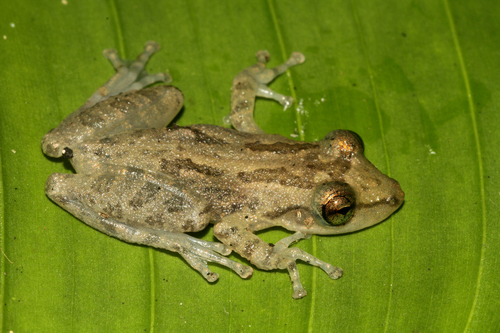
Description: Adult males of Osteocephalus castaneicola measure 48–51 mm (1.9–2.0 in) in snout–vent length, while adult females measure 48–63 mm (1.9–2.5 in) in the same measurement. In dorsal view, the snout is rounded; in lateral profile, it is rounded and slightly inclined posteroventrally. The canthus rostralis is distinct. The tympanum is large, and ranges from oval to round in shape. The supratympanic fold is conspicuous and covers the upper edge of the tympanum. The fingers have basal webbing, while the toes are three quarters webbed. The dorsum ranges in color from tan to pale brown to purple brown, and has narrow, irregular dark brown markings. The upper lip has a narrow pale supralabial line that expands into a subocular spot. The flanks are uniformly pale. The throat and belly are creamy white. The ventral surface of the thighs is fleshy pink. The iris is bicoloured: golden in the upper portion, bronze in the lower portion, with a dark horizontal stripe and reticulate or radiating lines. Males have an indistinct vocal sac. The largest tadpoles reach 33–35 mm (1.3–1.4 in) in total length. Habitat and conservation: Osteocephalus castaneicola occurs in both unflooded terra firme and floodplain rainforests, at elevations of 81–400 m (266–1,312 ft) above sea level. Observed individuals have typically been found sitting on vegetation 0.5–2 m (2–7 ft) above the ground. This species is locally threatened by habitat loss driven by agricultural activities (including habitat conversion for cattle ranching) and illegal gold mining. It is present in Manu National Park and Los Amigos Conservation Concession in Peru, as well as in Cuniã Ecological Station and Jamari National Forest in Brazil. Reproduction: This species reproduces inside water-filled Brazil nut fruit capsules, or more rarely, in water-filled palm bracts that lie on the forest floor. A single capsule can hold tens of tadpoles. These capsules are opened and left on the forest floor by agoutis or local people. Osteocephalus castaneicola is the first hylid frog recorded to use this reproductive strategy, though similar behavior has been documented for two dendrobatids (Adelphobates castaneoticus and Adelphobates quinquevittatus) and one bufonid (Rhinella castaneotica). The tadpoles are oophagous, meaning they may consume conspecific eggs.