About Osphronemus goramy Lacepède, 1801
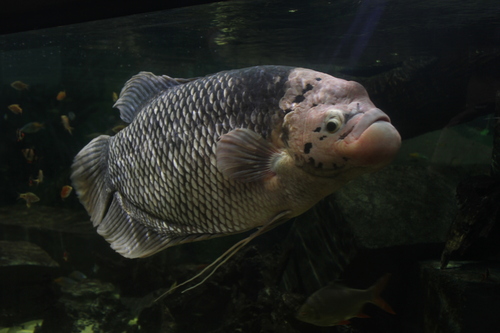
The giant gourami, Osphronemus goramy, is a large gourami species native to freshwater habitats in Southeast Asia, and has been introduced to locations outside its native range. This species is commercially important: it is farmed and fished as food, sold in the aquarium trade, and used for weed control on highly invasive aquatic plants such as Salvinia molesta, because giant gouramis are voracious herbivores. Giant gouramis can breathe moist air, allowing them to survive out of water for long periods. They are far larger than most other gourami species; only other members of the Osphronemus genus reach a similar size. They grow to a maximum standard length of 80 cm (31 in), though most individuals reach only around 45 cm (18 in). Giant gouramis are native to rivers, streams, marshes, swamps, and lakes across Southeast Asia. Their native range covers the lower Mekong basin in Cambodia and Vietnam, the Chao Phraya and Mae Klong basins in Thailand, river basins across the Malay Peninsula, Sarawak in Malaysia, Java, and the regions of Sumatra and Western Kalimantan in Indonesia. The exact boundaries of its natural range are uncertain, for two main reasons. First, other Osphronemus species were only formally scientifically described in 1992 and 1994, leading to past confusion between species. Second, giant gouramis have been widely released outside their native range. For example, both giant gourami and elephant ear gourami have been recorded from the middle Mekong, and both giant gourami and O. septemfasciatus have been recorded from Borneo's Kapuas River and Sarawak river basins. However, middle Mekong records of giant gourami are likely misidentifications of elephant ear gourami; the only area of the Mekong basin where giant gourami is thought to naturally occur is the southernmost section, such as tributaries that originate in the northern Cardamom Mountains. The presence of giant gourami in Borneo is likely the result of introduction. The final species in the Osphronemus genus, the giant red tail gourami, is only found in Sabah, where no other Osphronemus species occur. This pattern suggests that different Osphronemus species originally had allopatric or parapatric distributions. Giant gouramis have been widely introduced outside their native range, both deliberately and accidentally, to be used as a food fish. Across Asia, introductions have expanded their range to cover an area from southern China to India and Sri Lanka. On other continents, they are now found in Australia, Mauritius, Réunion, Madagascar, and other locations. Translocations of the species within Southeast Asia likely began in ancient times. Europeans recognized giant gourami's value as a food fish hundreds of years ago; for example, Georges Cuvier (1769–1832) suggested that it should be introduced to French colonies. Partly due to its large size, the giant gourami is a significant food fish, and it has been harvested as a traditional food source in its native regions. In Southeast Asian cuisine, giant gourami is highly valued as food for its thick flesh, pleasant texture, and tasty flavor. Unlike carp and milkfish, giant gouramis do not have fine bones in their flesh, which makes them easy to eat and increases their economic value. Giant gourami is one of the most highly-valued freshwater food fish in Southeast Asian markets. Its flesh is rich in protein and minerals, and it is a popular food fish in Indonesian, Malaysian, and Thai cuisines. It is particularly popular in the Sundanese cuisine of Indonesia, where it is commonly prepared as fried ikan goreng, grilled ikan bakar, or spiced and cooked wrapped in a banana leaf as pepes. In some parts of Southeast Asia, giant gourami is salted to preserve it and extend its shelf life.