About Osmundastrum cinnamomeum (L.) C.Presl
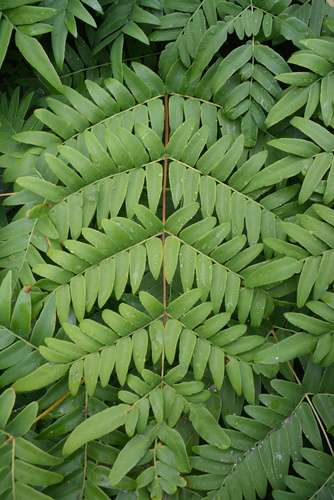
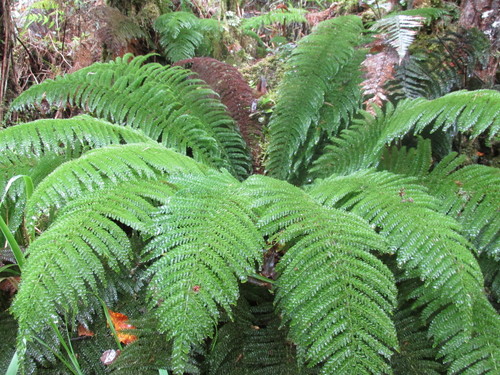
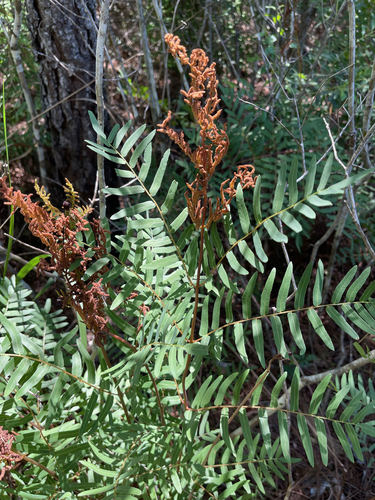
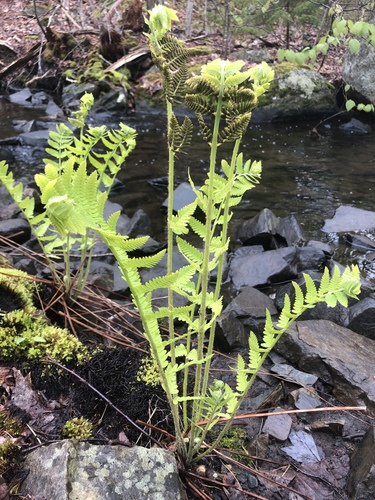
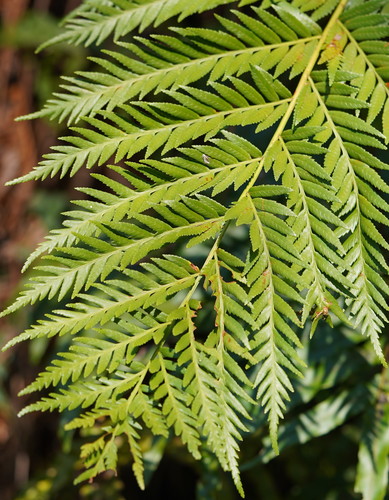
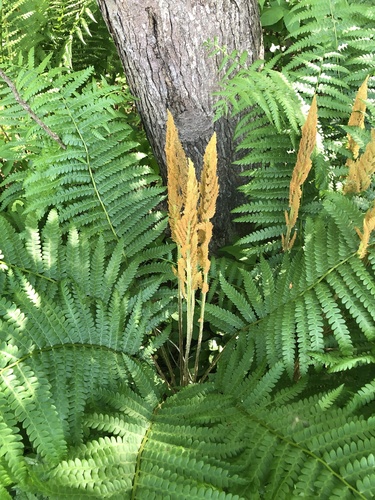
Osmundastrum cinnamomeum, commonly called cinnamon fern, is a fern species that is typically deciduous, though it can be semi-evergreen. It produces two distinct types of fronds: separate fertile spore-bearing fronds and sterile fronds. Sterile fronds grow in a spreading pattern, reaching 30–150 cm tall and 15–20 cm broad. They are pinnate, with pinnae 5–10 cm long and 2–2.5 cm broad that are deeply lobed, making the fronds almost, but not fully, bipinnate. Fertile spore-bearing fronds are shorter, growing 20–45 cm tall in an erect form. They turn cinnamon-colored as they mature, which is the source of the species' common and scientific names; the species does not produce actual cinnamon. Fertile fronds emerge first, starting green before slowly turning brown as the season progresses and spores are released. After sterile fronds are killed by frost, the fertile spore-bearing stems remain standing until the next growing season. Spores must develop within a few weeks after release or they will not survive. This fern has shallow, black fibrous roots, and its rhizome can grow into an erect, trunk-like structure similar to its close relatives. Osmundastrum cinnamomeum forms large clonal colonies in swampy areas, developing massive rootstocks made of densely matted, wiry roots. This dense root mass makes an excellent growing substrate for many epiphytic plants, and it is often harvested as osmunda fiber for horticultural use, particularly for propagating and growing orchids. Chlorophyll synthesis in cinnamon fern leaf primordia is regulated by two pigment systems: phytochrome, which responds to red and far-red light, and a blue-light-absorbing pigment system. Studies have found blue light suppresses leaf elongation, while far-red light promotes it, confirming that multiple pigment systems regulate the fern's development. The range of Osmundastrum cinnamomeum covers both the Old World and New World, but it is notably absent from western North America despite the modern species evolving in that region. This distribution makes it a classic example of the eastern Asian–eastern North American disjunction, a biogeographic pattern where plant lineages that were once widespread across large areas in past geological periods became restricted only to eastern North America and eastern Asia over time. Fossil evidence shows the species persisted in western North America until the Neogene. In North America, cinnamon fern occurs across most of the eastern United States, specifically in Alabama, Arkansas, Connecticut, Delaware, Washington D.C., Florida, Georgia, Illinois, Indiana, Iowa, Kentucky, Louisiana, Maine, Maryland, Massachusetts, Michigan, Minnesota, Mississippi, Missouri, New Hampshire, New Jersey, New York, North Carolina, Ohio, eastern Oklahoma, Pennsylvania, Rhode Island, South Carolina, Tennessee, eastern Texas, Vermont, Virginia, West Virginia, and Wisconsin. In Canada, it is found in New Brunswick, Newfoundland, Nova Scotia, Ontario, Prince Edward Island, and Québec. Its range extends into Mexico, where it occurs primarily in the Yucatán dry forests and Petén–Veracruz moist forests, as well as into Central America (Guatemala, El Salvador, Costa Rica, Honduras, and Nicaragua) and the Caribbean (Haiti, Cuba, Bermuda, Puerto Rico, and Jamaica). In South America, the species is mainly found in Bolivia, Peru, Ecuador, Venezuela, Colombia, Paraguay, Uruguay, and northern Argentina. In Brazil, it is widespread, particularly in the states of Alagoas, Bahia, Ceará, Maranhão, Paraíba, Pernambuco, Piauí, Rio Grande do Norte, Sergipe, Paraná, Rio Grande do Sul, Santa Catarina, Espírito Santo, Minas Gerais, Rio de Janeiro, and São Paulo. In Asia, its northern range reaches the Russian Far East, including Amur, Kamchatka, Khabarovsk, the Kuril Islands, Primorye, and Sakhalin. It is widespread across East Asia, occurring across the entire Korean Peninsula, Japan, and much of the People's Republic of China—specifically Hunan, Henan, Hubei, Jiangxi, Anhui, Guangdong, Fujian, Zhejiang, Hong Kong, Macau, Jiangsu, Heilongjiang, Jilin, and Liaoning. The species is also present on Taiwan. In Southeast Asia, it occurs mainly in Vietnam, Thailand, and Myanmar. In South Asia, cinnamon fern is found in Bhutan and northeastern India, specifically in Arunachal Pradesh, Assam, Manipur, Meghalaya, Mizoram, Nagaland, Tripura, and Sikkim. Because of its broad range, cinnamon fern grows in a wide variety of ecoregions. In the United States alone, its habitats range from the wet Atlantic Coastal Pine Barrens and boggy coastal swamps to the Texas Blackland Prairies. It can grow in both organic soil and sand, prefers shaded conditions but will also grow in areas with more direct sunlight. Cinnamon fern typically grows in moist, acidic soils and has a strong preference for wetland environments, though it also grows well in dry-mesic forests with seasonal sub-irrigation. It also thrives in large meadowlands, where it often becomes one of the most dominant plant species present. A study of forest understory vegetation found cinnamon fern occurred in the wettest study plots and showed high sensitivity to changes in soil moisture, indicating strong adaptation to saturated or hydric soils. The fern is cold hardy. Cinnamon fern plays multiple ecological roles in its native habitats, influencing carbon and water dynamics, participating in complex reproductive signaling, and hosting symbiotic fungi. In constructed wetlands built to treat aquaculture wastewater, cinnamon fern helped reduce pollutants including total phosphorus, ammonia nitrogen, and turbidity, indicating potential for use in phytoremediation and nutrient cycling in wetland systems. Understories dominated by cinnamon fern in high-elevation Appalachian forests are strongly linked to higher soil respiration during summer months, meaning the species influences carbon cycling more actively during the growing season. Cinnamon fern is a known host for Mixia osmundae, a rare intracellular parasitic fungus. Like most ferns, adult cinnamon fern is toxic to most herbivores and is generally avoided by grazing animals. Ferns in the Osmundaceae family tend to accumulate high levels of lanthanum, which is toxic to most mammals. While ferns are not a major part of the diet of most modern herbivores, evidence suggests they played a more prominent role in the diets of prehistoric animals. The oldest fossils of modern Osmundastrum cinnamomeum have been found in the Horseshoe Canyon Formation in Alberta and the Prince Creek Formation of Alaska. Both formations are of similar age and host similar fossil fauna, including the ceratopsian Pachyrhinosaurus and the hadrosaur Edmontosaurus. Evidence indicates these dinosaurs likely consumed ferns including cinnamon fern as part of their diet and could extract nutrients from them. Cinnamon fern was a major component of the fern community in these Cretaceous formations, growing alongside other ferns in a warm environment. It lived alongside ferns such as Blechnum and Microlepia, as well as other plant types including ginkgos, redwoods, Parataxodium and Trochodendroides in these Cretaceous habitats. It briefly coexisted with another species, O. precinnamomea, during the Paleogene. Today, cinnamon fern is often found growing alongside bracken, lipferns, Christmas fern, Blechnum, horsetails, and its close relative the American royal fern. In eastern North America, it grows in diverse forests that contain a wide variety of tree species, including oaks, birches, hickories, maples, ashes, hazels, sweetgums, tulip trees, elms, dogwoods, junipers, beeches, magnolias, plane trees (sycamores), pines, arborvitaes, spruces, bald cypresses, larches, firs, yews, podocarps, cycads and laurels, among others. In South America, it grows alongside tree ferns, cycads, podocarps, Nothofagus trees, magnolias, Araucaria trees, Ocotea trees, and other species. In Asia, it occurs in forests dominated by larches, magnolias, podocarps, sycamores, figs, spruces, pines, firs, yews, birches, ginkgos, arborvitaes, cycads and oaks. Historically, cinnamon fern was used as a food source by the Abenaki and Menominee peoples. The Iroquois and Cherokee tribes used the fern for a range of medicinal purposes, including as a remedy for colds, a gynecological aid, a venereal disease treatment, and a remedy for snake bites. Today, cinnamon fern is often used in constructed wetlands for wastewater treatment, due to its ability to tolerate waterlogged conditions and contribute to nutrient removal. It is mainly hardy in USDA hardiness zones 4–9, though it can also be grown as far south as USDA zone 11.