About Osmunda regalis L.
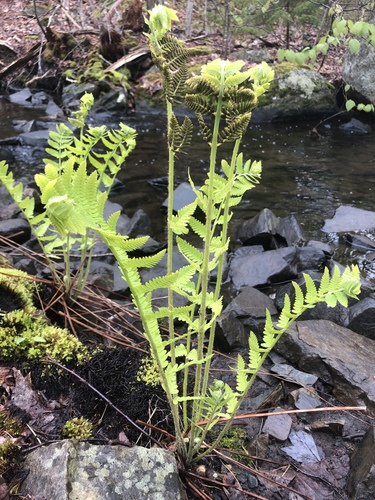
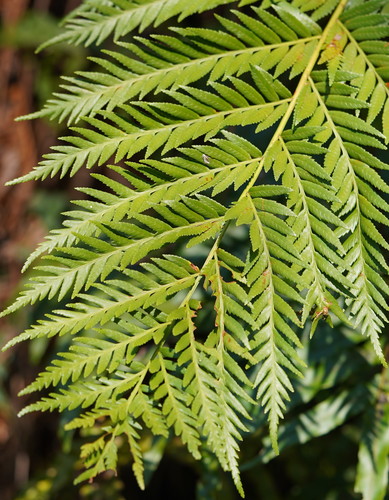
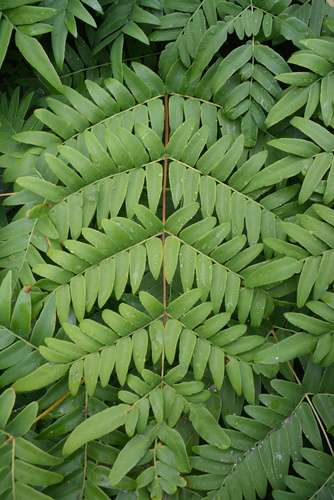
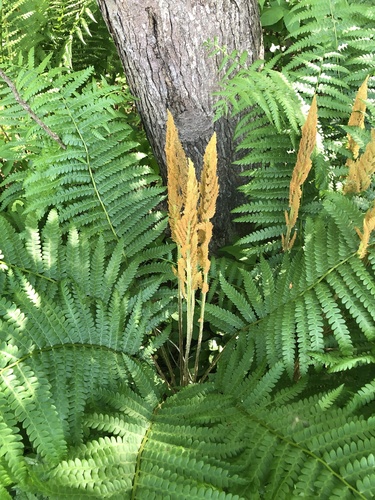
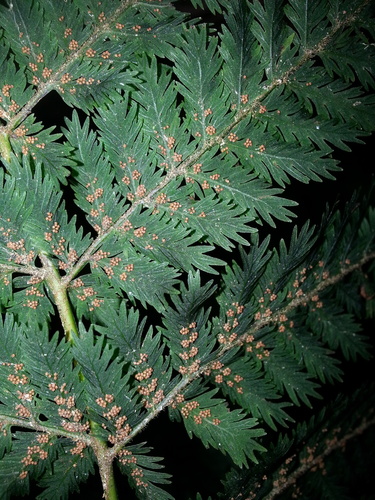
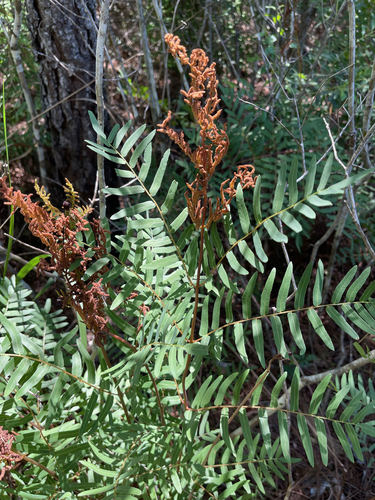
Osmunda regalis L., commonly called royal fern, is a large perennial fern. It has stout ascending rhizomes that develop into a woody, trunk-like base over many years, covered by interwoven roots, and reaches 1 m or more in height. Its large fronds, or leaves, grow directly from the rhizome; they typically reach up to 120 cm long, and can grow exceptionally as long as 400 cm, with a width of 30-40 cm. Each frond is bipinnate, with 5–9 pairs of pinnae that grow up to 30 cm long. Each pinna bears 7–13 pairs of pinnules, which measure 2.5–6.5 cm long and 1–2 cm broad. Many fronds have a terminal fertile section, where the leaf blade is reduced almost entirely to the midrib, and is densely covered with brown sporangia. New fronds are initially covered in golden-brown hairs that fall off quickly, leaving a smooth, pale green leaf surface. Veins are prominent on both sides of the frond. In its gametophyte stage, the prothallus is a small, green, fleshy structure only a few millimetres across. Royal fern is native across Europe, North Africa, and the Middle East as far east as Iran, ranging from Norway in the north to Algeria in the south. It is classified as an introduced species in New Zealand. Its presence across North America is complicated by taxonomic uncertainty over whether Osmunda spectabilis should be recognized as a separate species from O. regalis. In many regions, O. regalis has become rare due to agricultural drainage of its wetland habitat. Osmunda regalis is widely cultivated in temperate regions. Both the species and its cultivar 'Cristata' have earned the Royal Horticultural Society's Award of Garden Merit. It grows best in acidic, moist soil, and pairs well with other large moisture-loving plants like Rodgersia and Gunnera. It can also tolerate a range of other soil and climatic conditions. The roots of O. regalis, along with roots from other Osmunda species, are used to produce osmunda fibre, a growing medium for cultivated orchids and other epiphytic plants. In Slavic mythology, the fern's sporangia are called "Perun's flowers" and are said to hold various magical powers: they can allow their holder to defeat demons, grant wishes, unlock secrets, and let the holder understand the language of trees. Collecting these sporangia is said to be a difficult and frightening process. In older traditions, they had to be collected on Kupala Night; after the spread of Christianity, the collection date was changed to Easter eve. Regardless of the date, anyone collecting Perun's flowers must stand inside a drawn circle around the plant and endure taunts and threats from demons. The young shoots of royal fern, like those of many other fern species, are called fiddleheads in some regions and are eaten as food, described as having an asparagus-like taste.