About Osmorhiza berteroi DC.
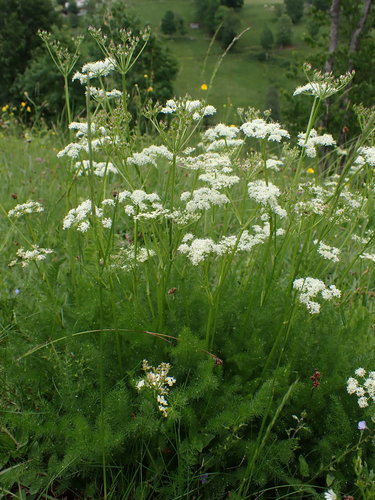
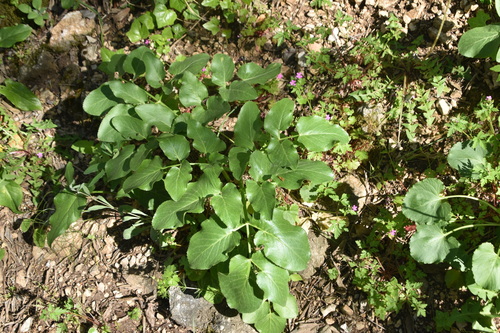
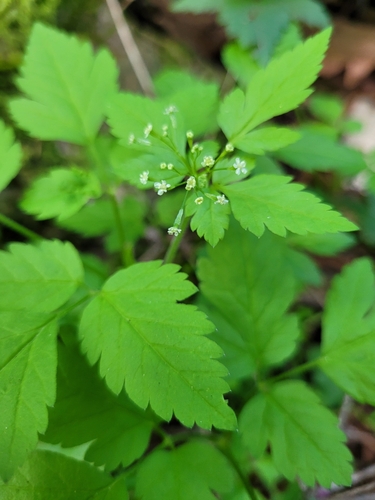
Osmorhiza berteroi DC. is an aromatic perennial herb that grows a branching stem which can reach over 1 meter in height. It produces abundant green leaves with blades up to 20 centimeters long; each leaf blade is divided into three toothed or lobed leaflets (trifoliate), and is borne on a long petiole. The inflorescence is a compound umbel made of many tiny white flowers, located at the tip of a stem-like peduncle. Each umbellule holds 4 to 10 florets, and only the central florets produce anthers. The fruit is narrow, elongated, ribbed, and bristly, reaching up to 2.5 centimeters long. This species has an amphitropical distribution, native to temperate regions of both North America and South America. In the Northern Hemisphere, it occurs in boreal zones ranging from Alaska to Newfoundland, extending south to South Dakota; it also grows in Pacific coastal adjacent mountain ranges from the Alaska panhandle to California and Arizona. In South America, it is found in Magellanic forests of Argentina and Chile. Its amphitropical distribution is thought to have developed recently, within the last 1 million years, most likely from seeds carried on the feathers of migratory birds. Its east-west disjunct distribution is most likely the result of relict populations of a once continuous geographic range. It grows in wooded and forested areas; in the Great Lakes region, it occurs in hardwood forests dominated by Sugar Maple. Several groups of Native Americans across this species' entire native range used it as a food source. These groups include the Selkʼnam people of what is now Chile, and Great Plains tribes such as the Cheyenne and Blackfoot. Its root was eaten, and also used medicinally to treat coughs and colds.