About Osmerus mordax (Mitchill, 1814)
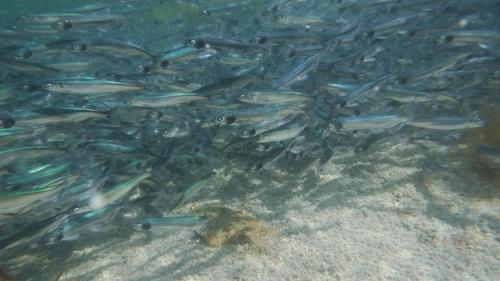
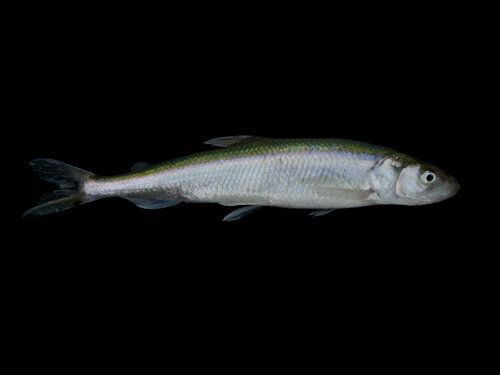
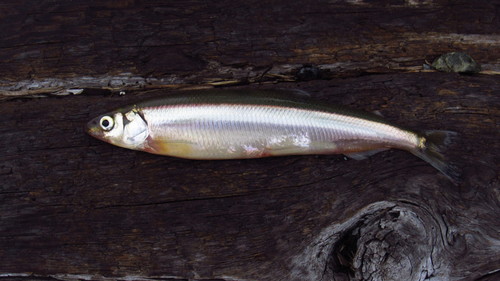
Osmerus mordax, commonly known as rainbow smelt, has a slender, cylindrical body. It has a silvery, pale green back, iridescent purple, blue, and pink sides, and a light-colored underside. Full-grown adults typically measure 7 to 9 inches (18 to 23 cm) long and weigh around 3 ounces (85 g), though individuals longer than 12 inches (30 cm) have been recorded. The species is widespread across North American watersheds. Its native North American range covers Atlantic drainages between New Jersey and Labrador, extends to Arctic drainages, and reaches as far south as Vancouver Island in Pacific drainages. It has been intentionally introduced to water bodies in the U.S. states of Colorado, Connecticut, Georgia, Idaho, Illinois, Indiana, Iowa, Kansas, Kentucky, Louisiana, Maine, Maryland, Massachusetts, Michigan, Minnesota, Missouri, Montana, Nebraska, New Hampshire, New York, North Carolina, North Dakota, Ohio, Pennsylvania, South Dakota, Tennessee, Vermont, Virginia, and Wisconsin. Rainbow smelt invaded the Great Lakes watershed after the 1912 intentional introduction of eggs from Maine's landlocked populations to Crystal Lake, Michigan; this lake drains into Lake Michigan, and smelt escaped from it to spread rapidly throughout the Great Lakes and their tributaries. Early records of their range expansion in the Great Lakes include Lake Michigan, Lake Erie, Lake Huron, Lake Ontario, and Lake Superior. Rainbow smelt were first reported in Lake Ontario in 1929, and likely reached the lake via natural waterway dispersal from New York's Finger Lakes, where they were intentionally introduced in 1917. The dispersal ability of rainbow smelt depends on lake connectivity, the ability of smelt to move through connecting streams, and the habitat suitability of connected lakes. Because rainbow smelt are weak swimmers, they cannot pass over fish ladders, which has prevented wider range expansion for the species. Rainbow smelt live in rivers, coastal areas, and ponds. In their anadromous ranges, they spend summers along the coast, usually in water no more than 20 feet (6.1 m) deep and within 1 mile (1.6 km) of shore. They overwinter under ice in estuaries, producing an antifreeze protein and glycerol. In spring, they spawn at night in small streams, many of which dry up during summer. In 1883, Stedman and Argyle found that rainbow smelt consume bloaters (Coregonus hoyi) and alewives (Alosa pseudoharengus). They also noted that while this predator had not affected bloater populations at that time, future population impact was a possibility. A 2003 study by Horppila et al. found that smelt densities can exceed 40,000 individuals per hectare, which may create high predation pressure in lakes. The study also recorded that a single smelt consumes between 0.12 and 0.14 grams of wet weight food per day. Another study found that the primary food sources for rainbow smelt in Lake Ontario are slimy sculpins (Cottus cognatus) and opossum shrimp (Mysis relicta), but the study did not address whether this predation has a significant impact on the prey populations. In 1973, Havey reported increased growth in landlocked Atlantic salmon populations after the introduction of rainbow smelt. In 1986, Brandt and Madon showed that adult lake trout (Salvelinus namaycush) can act as a keystone predator species for rainbow smelt. Hrabik et al. (1998) found evidence of food competition between introduced rainbow smelt and native yellow perch (Perca flavescens) in Wisconsin lake habitats, and noted that smelt may be partially responsible for the decline of Great Lakes whitefish (Coregonus spp.). In 2008, the U.S. EPA stated that it believes rainbow smelt contributed to the extinction of the blue pike (Stizostedion vitreum glaucum) by outcompeting it for food. Acidity can alter rainbow smelt distributions, as multiple surveys have not found the species in small lakes with a pH below 6.0. Rainbow smelt eggs may be exposed to lethal pH decreases in poorly buffered lakes due to snowmelt.