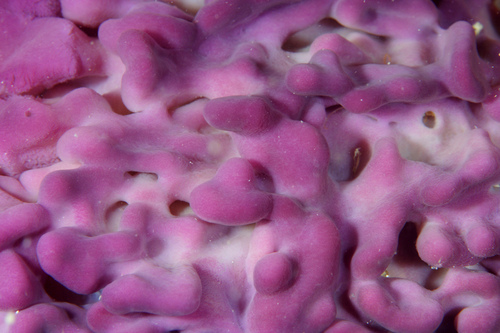
About Oscarella lobularis (Schmidt, 1862)
Oscarella lobularis is an encrusting sponge that grows as a thick soft, gelatinous layer with a velvety surface, found attached to rocks, stones and large seaweeds. Its colonies can reach up to 30 cm wide and 3 cm thick, and have an irregularly lobed surface. The sides of its nodular lobes are scattered with ostia, openings that let water pass into the sponge. At the top of each lobe sits a single round osculum, the opening through which water exits, that can be up to 1 cm in diameter. The tissues of this sponge contain neither spicules nor spongin fibres. Its colour is usually some shade of yellow or brown, but it can occasionally be red, violet, green or blue, and it often has a cream-coloured base layer. Like all other sponges, Oscarella lobularis is a filter feeder. Water is drawn into the sponge's interior through the ostia, where bacteria and organic particles that the sponge feeds on are filtered out, and excess water is expelled through the osculi. This species is hermaphrodite. It releases ciliated parenchymella larvae into the water; these larvae soon settle onto a substrate and undergo metamorphosis to develop into adult sponges. It can regrow damaged body structures, and can reform a fully functional whole body from completely separated individual cells. This morphogenetic process involves epithelial cells fusing together to form a single continuous layer of epithelium. Oscarella lobularis can also reproduce asexually. Colonies growing under overhangs can develop elongations that take on a teardrop shape. These elongations dangle while attached by thin threads of tissue, eventually detach, land on the seabed below, and grow into new colonies. The species has also been observed forming bubble-like buds on its outer surface. These buds detach from the parent colony, are buoyant, get dispersed by water currents, and rapidly grow into new colonies.

