About Oryx leucoryx (Pallas, 1777)
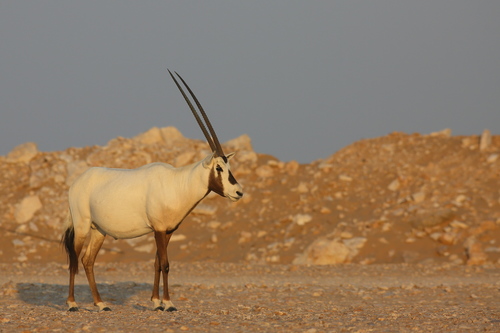
This species, the Arabian oryx (Oryx leucoryx (Pallas, 1777)), has an almost luminous white coat, with brown undersides and legs. Black stripes appear where the head meets the neck, on the forehead, on the nose, and extend from the horn down across the eye to the mouth. Both sexes have long, straight or slightly curved, ringed horns that measure 0.61–1.49 m (2–4.9 ft) long. The Arabian oryx stands 0.79 to 1.25 m (2.6 to 4.1 ft) tall at the shoulder, and typically weighs 100 to 209 kg (220 to 460 lb).
Historically, the Arabian oryx probably ranged across most of the Middle East. In the early 1800s, it still occurred in the Sinai, Palestine, Transjordan, much of Iraq, and most of the Arabian Peninsula. During the 19th and early 20th centuries, its range contracted toward Saudi Arabia, and by 1914 only a few individuals survived outside the country. A small number were recorded in Jordan into the 1930s, but by the mid-1930s the only remaining wild populations were in the Nafud Desert of northwestern Saudi Arabia and the Rub' al Khali in the south. In the 1930s, Arabian princes and oil company clerks began hunting Arabian oryx with automobiles and rifles. Hunts increased in scale, and some reports note that as many as 300 vehicles were used for a single hunt. By the mid-20th century, the northern wild population was effectively extinct. The last wild Arabian oryx prior to reintroduction was recorded in 1972.
Arabian oryx prefer to live in gravel deserts or hard sand, where their speed and endurance protect them from most predators and hunters on foot. In the sand deserts of Saudi Arabia, they were historically found in the hard sand flats between softer dunes and ridges. The species has been reintroduced to Oman, Saudi Arabia, Israel, the United Arab Emirates, Syria, and Jordan. A small population was introduced on Hawar Island, Bahrain, and large semi-managed populations exist at several sites in Qatar and the UAE. The total reintroduced population is currently estimated at around 1,000 individuals. This number places the Arabian oryx well above the threshold of 250 mature individuals required to qualify for endangered status, though the majority of the total population is concentrated in Saudi Arabia.
In terms of behaviour and ecology, the Arabian oryx rests during the hottest part of the day. A herd in Oman can range over 3,000 km2 (1,200 sq mi). Herds are mixed-sex, and usually contain between 2 and 15 individuals, though herds of up to 100 individuals have been recorded. Arabian oryx are generally not aggressive toward one another, which allows herds to coexist peacefully for extended periods.