About Oryx gazella (Linnaeus, 1758)
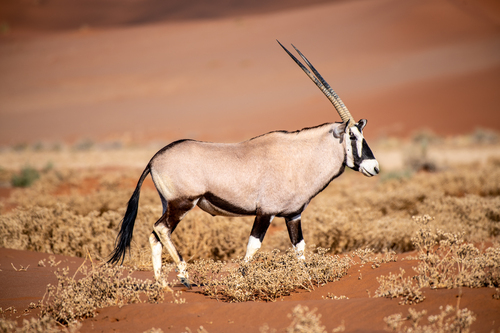
Gemsbok, scientifically named Oryx gazella (Linnaeus, 1758), have a base coat color ranging from light taupe to tan, with lighter patches on the lower rear of the rump. Their tails are long and solid black. A blackish stripe runs from the chin along the lower edge of the neck, through the shoulder-leg junction, along the lower flank on each side, and connects to the blackish section of the rear leg. They have muscular necks and shoulders; their legs have white 'sock' markings, with an additional black patch on the front of each front leg. Both male and female gemsbok have long, straight horns. In comparison, the closely related East African oryx does not have a dark patch at the base of the tail, has far less black marking on the legs (with no black markings at all on the hind legs), and less black marking on the lower flanks. One very rare color variant of gemsbok is the 'golden oryx', where the species' characteristic black markings are muted and take on a golden appearance. Gemsbok are the largest species in the Oryx genus. They stand approximately 1.2 m (4 ft) tall at the shoulder. Their total body length ranges from 190 to 240 cm (75 to 94 in), and their tails measure between 45 and 90 cm (18 to 35 in). Adult male gemsbok weigh 180 to 240 kg (400 to 530 lb), while adult females weigh between 100 and 210 kg (220 to 460 lb). Gemsbok inhabit arid and semi-arid bushlands in southwestern Africa, particularly around the Namib and Kalahari deserts. Their current native range includes Botswana, Zimbabwe, Namibia, and South Africa; they were formerly native to Angola, where they are now considered extirpated. There is also a sizeable introduced population of several thousand gemsbok living in the Chihuahuan Desert of Southern New Mexico at White Sands Missile Range, where the species is disruptive to the local ecosystem. Gemsbok form herds of 10 to 40 individuals, which typically include one dominant male, a small number of non-dominant males, and females. As primarily desert-dwelling animals, they do not need to drink water to meet their physiological requirements. They can run at speeds of up to 60 km/h (37 mph). Gemsbok are mostly crepuscular, active during dawn and dusk, when temperatures are tolerable and their ability to detect predators is highest. Gemsbok have a polygynous mating system, where one resident resident male mates with all receptive females in his herd. A male will attempt to keep mixed or nursery herds within his territory to secure exclusive mating access to the females. Gemsbok do not have a fixed breeding season, but calves in a given herd are usually around the same age because females have synchronized reproductive cycles. Pregnant females leave the herd before they give birth. Gestation lasts 270 days, and mothers give birth to 1 to 2 offspring per pregnancy. After birth, the calf stays hidden for 6 weeks, after which the mother and calf rejoin the main herd. Calves are weaned at 3 and a half months old, become independent at 4 and a half months old, and reach sexual maturity between one and a half to two years old for both sexes.