About Oryx dammah (Cretzschmar, 1827)
The scimitar oryx, scientifically named Oryx dammah (Cretzschmar, 1827), is a straight-horned antelope that measures just over 1 meter (3.3 feet) tall at the shoulder. Males weigh 140–210 kg (310–460 lb), while females weigh 91–140 kg (201–309 lb). The body measures 140–240 cm (55–94 in) from the head to the base of the tail. The tail is 45–60 cm (18–24 in) long and ends in a tuft. This species is sexually dimorphic, with males larger than females.
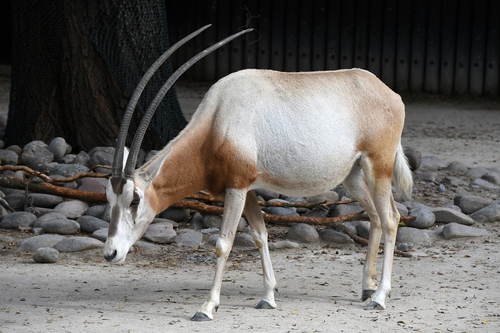
Their coat is white with a red-brown chest and black markings on the forehead that run the full length of the nose. The white coat reflects the sun’s rays and desert heat, while the black portions of the coat and the tip of the tongue protect against sunburn. Newborn calves are born with yellow coats and lack the species’ characteristic markings, which develop as they mature. Calves gain their adult pelage coloration between 3 and 12 months old.
Both male and female scimitar oryxes have horns, with females’ horns being more slender. The horns are long, thin, symmetrical, and curve backward, which is a distinctive trait of this species. In both sexes, horns can reach 1.0 to 1.2 meters (3 ft 3 in to 3 ft 11 in) in length. The hollow walls of the horns are thin enough that they break easily. Females have an udder with four teats. Their large, spreading hooves are well adapted for walking on the sand of their dry habitats.
Scimitar oryxes can live up to 20 years. One female at the Smithsonian National Zoo died at 21 years old, an exceptional age, as females typically live around 15 years.
Historically, the scimitar oryx inhabited grassy steppes, semideserts, and deserts across a narrow strip of central North Africa, particularly in Niger and Chad. It was widespread across the fringes of the Sahara, mostly in the subdesert steppe: the grassy zone between the full desert and the Sahel, which receives 75–150 mm (3.0–5.9 in) of annual rainfall. In 1936, a single herd of 10,000 scimitar oryxes was observed in Chad’s steppe region. By the mid-1970s, over 95% of the world’s wild scimitar oryx population lived in Chad.
The scimitar oryx was a highly social animal that typically traveled in herds of 2 to 40 individuals led by a dominant bull. Historically, this species gathered in groups of several thousand for migration. During the wet season, they migrated north into the Sahara. Scimitar oryxes are diurnal. During the cool early mornings and evenings, they rest under trees and shrubs; if no such cover is available, they dig depressions in the soil with their hooves to rest in. Males fight often, but their fights are short and not violent. Predators including lions, leopards, hyenas, cheetahs, golden jackals, vultures, and Cape hunting dogs mostly kill weak and young oryx.
Both male and female scimitar oryxes reach sexual maturity between 18 and 24 months of age. Births peak between March and October, and mating is more frequent when environmental conditions are favorable. In zoos, males are most sexually active in autumn. The estrous cycle lasts roughly 24 days, and females experience an anovulatory period in spring. The average interval between births is less than 332 days, confirming that the scimitar oryx is polyestrous.
Courting occurs via a mating circle: the male and female stand parallel to one another, facing opposite directions, then circle each other until the female allows the male to mount from behind. If the female is not ready to mate, she runs away and circles in the reverse direction. Copulation is completed in around 10 seconds. Females mate again during their postpartum estrus, so they can produce one calf per year. Gestation lasts approximately nine months, after which a single 10–15 kg (22–33 lb) calf is born. Twin births are very rare, with only 0.7% of births recorded in one study being twins. After giving birth, the mother returns to the herd while the calf hides at a distance from the herd. The female separates from the herd for a few hours to nurse her calf and clean the calf when it defecates. Weaning starts at 3.5 months, and young oryx become fully independent around 14 weeks old.