About Oryctolagus cuniculus (Linnaeus, 1758)
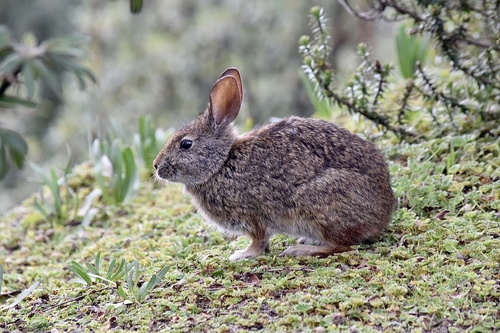
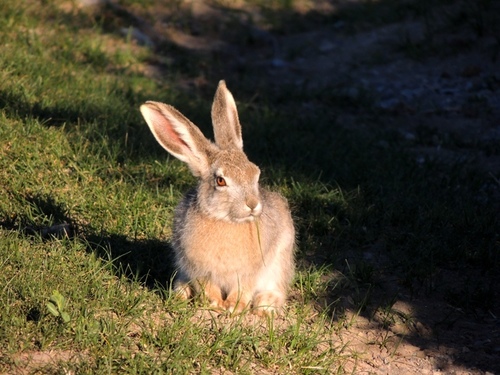
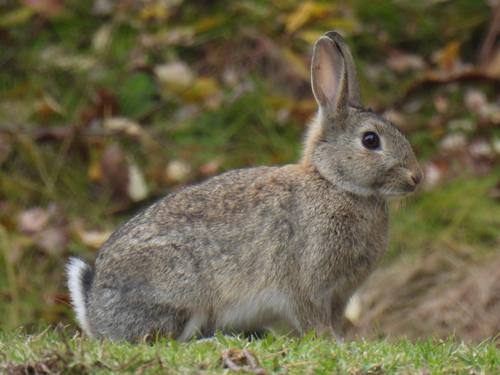
An adult European rabbit (Oryctolagus cuniculus (Linnaeus, 1758)) measures around 40 cm (16 in) in length, and weighs 1.2–2.0 kg (2.6–4.4 lb). The hind foot ranges from 8.5–10 cm (3.3–3.9 in) in length, while the ears measure 6.5–7.5 cm (2.6–3.0 in) long from the occiput. The European rabbit is smaller than the European hare and mountain hare, has proportionately shorter legs, and lacks the black ear tips seen in these two hare species. Size and weight vary based on food availability and habitat quality; rabbits living on light soil with only grass to eat are noticeably smaller than specimens found on highly cultivated farmlands with abundant roots and clover. Pure European rabbits that weigh 2.3 kg (5 lb) or more are uncommon, but are occasionally reported. One particularly large specimen, caught in February 1890 in Lichfield, weighed 2.8 kg (6 lb 2 oz). Unlike the brown hare, the male European rabbit is more heavily built than the female. The penis is short, lacks a baculum and true glans; the testicles, which sit in scrotal sacs on each side of the penis, can be retracted into the abdomen when food is scarce or during periods of sexual inactivity. Rudimentary nipples are also present in male rabbits. The fur of the European rabbit is made of soft down hair covered by stiff guard hairs, and is generally greyish-brown, though fur color varies widely. The guard hairs have brown and black, or grey bands, while the nape of the neck and scrotum are reddish. The chest patch is brown, and the rest of the underparts are white or grey. A white star-shaped marking is often present on kits' foreheads, but this rarely occurs in adults. The whiskers are long and black, the feet are fully furred and buff-coloured. The tail has a white underside that becomes prominent when the rabbit escapes danger, which may act as a signal for other rabbits to run. Moulting happens once a year, starting in March on the face and spreading across the back. The entire underfur is replaced by October–November. The European rabbit shows great variation in fur color, ranging from light sandy to dark grey and completely black. This variation depends largely on the proportion of guard hairs relative to regular pelage. Melanistic individuals are not uncommon on mainland Europe, while albinos are rare. Like other leporids, the European rabbit's skeleton and musculature are adapted for survival through rapid escape from predators. The hind limbs are a prominent exaggerated feature: they are much longer than the forelimbs and can produce more force, and their growth and use are correlated with the growth of the rest of the rabbit's body, as muscle action pressure creates force that distributes through the skeletal structures. Underuse of a rabbit's muscles leads to osteoporosis through bone rarefaction. At rest, the European rabbit's skull has a noticeable facial tilt of roughly 45° forward relative to the basicranium, which supports its primarily jumping or hopping (saltatorial) locomotion rather than running (cursorial locomotion). The European rabbit's ideal habitat is short grasslands with secure refuge such as burrows, boulders, hedgerows, scrub, and woodland located near feeding areas. It can live up to the treeline, as long as the land is well-drained and shelter is available. The size and distribution of its burrow systems depend on the type of soil present. In areas with loose soil, the species selects sites with supporting structures like tree roots or shrubs to prevent burrow collapse. Warrens tend to be larger and have more interconnected tunnels in chalk areas than those in sand. In large coniferous plantations, the species only occurs in peripheral areas and along fire breaks and rides. The European rabbit's grazing habits tend to promote its ideal open grassland habitat by dispersing seeds and trimming vegetation. In the European rabbit's mating system, dominant bucks are polygynous, whereas lower-status individuals (both bucks and does) often form monogamous breeding relationships; monogamous relationships are also common in rabbit groups with low female density. Rabbits signal their readiness to copulate by marking other animals and inanimate objects with an odoriferous substance secreted through a chin gland, a process called "chinning". While male European rabbits may sometimes be amicable with one another, fierce fights can break out among bucks during the breeding season, which typically starts in autumn and continues through to spring. Occasionally, the mating season extends into summer. Introduced populations in the Southern Hemisphere have breeding seasons during the opposite half of the calendar year. European rabbits produce 4 to 5 litters per year, each usually containing three to seven kittens (an average of five), but in overpopulated areas, pregnant does may lose all their embryos through intrauterine resorption. Shortly before giving birth, the doe builds a separate burrow called a "stop" or "stab", generally in an open field away from the main warren. These breeding burrows are typically a few feet long, lined with grass and moss, along with fur plucked from the doe's belly. The breeding burrow protects kits from adult bucks and predators. The gestation period of the European rabbit is 30 days, and the sex ratio of male to female kits is usually 1:1. Greater maternal investment in male offspring may result in higher birth weights for bucks. Kits born to dominant bucks and does, which have access to better nesting and feeding grounds, tend to grow larger and stronger and become more dominant than kits born to subordinate rabbits. It is not uncommon for European rabbits to mate again immediately after giving birth, and some specimens have been observed nursing previous young while pregnant. Female European rabbits can become pregnant at three months of age, but do not reach full reproductive capacity until they are two years old, after which they remain able to reproduce for an additional 4 years. Bucks reach sexual maturity at four months of age. Female European rabbits nurse their kits once a night, for only a few minutes. After suckling is finished, the doe seals the entrance to the stop with soil and vegetation. In the species' native range of Iberia and southern France, young European rabbits have a growth rate of 5 g (0.18 oz) per day, while kittens in non-native ranges may grow 10 g (0.35 oz) per day. Birth weight is 30–35 g (1.1–1.2 oz), and increases to 150–200 g (5.3–7.1 oz) by 21–25 days of age, during the weaning period. European rabbit kits are born blind, deaf, and nearly naked. The ears do not gain the ability to move until 10 days of age, and can be erected after 13 days. The eyes open 11 days after birth. At 18 days old, the kittens begin to leave the burrow. The European rabbit has been hunted in its native range since at least the Last Glacial Maximum and remains a game animal today, but most of the world's rabbit meat supply comes from domestic rabbits. A 1994 estimate puts global annual rabbit meat production at 1,500,000 tonnes (3.3×10⁹ lb). In the United Kingdom, rabbit was a popular food source for poorer social classes. Among wild rabbits, those native to Spain were reputed to have the highest meat quality, followed by those in the Ardennes. Because rabbits have very little fat, they were rarely roasted, and were instead prepared by boiling, frying, or stewing. The rabbit's pelt is heavier and more durable than a hare's. Historically, Marshall calculated that the value of the skin relative to the carcass was greater than that of sheep and oxen. Rabbit fur is primarily used for felting or making hats. It is also dyed or clipped, and sold as an imitation for more valuable furs such as fur seal. While cheap and easily acquired, fur from meat rabbits has low durability. However, some rabbit breeds are bred for fur rather than meat; large Angora rabbit breeds are raised for their long, soft fur, which is often spun into yarn. Other breeds are raised for the commercial fur industry, particularly the Rex, which has a smooth, velvet-like coat.