About Orycteropus afer (Pallas, 1766)
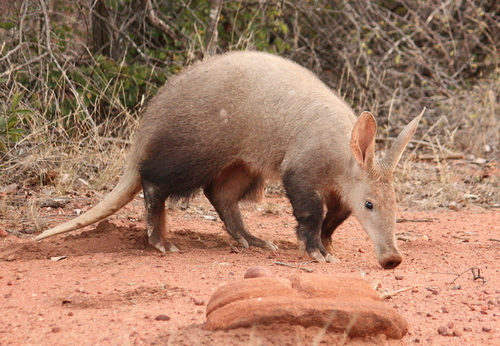
The aardvark, scientific name Orycteropus afer (Pallas, 1766), has a vaguely pig-like appearance. It has a stout body with a prominently arched back, and is sparsely covered in coarse hairs. Its limbs are of moderate length, with rear legs longer than the forelegs. The front feet have lost the pollex, or 'thumb', resulting in four toes, while all five toes are present on the rear feet. Each toe carries a large, robust nail that is somewhat flattened and shovel-shaped, appearing intermediate between a claw and a hoof. Though the aardvark is classified as digitigrade, it sometimes appears to be plantigrade. This confusion occurs because it stands on its soles when squatting. A specialized endosteal tissue called compacted coarse cancellous bone (CCCB) contributes to the aardvark's burrow-digging ability. The stress and strain resistance provided by CCCB allows aardvarks to create their burrows, which ultimately create a favorable environment for plants and a variety of other animals. Digging is also made easier by the unusually stout ulna and radius in the aardvark's forearm. Aardvarks typically weigh between 60 and 80 kilograms (130–180 lb). Their body length usually ranges between 105 and 130 centimetres (3.44–4.27 ft), and can reach a total length of 2.2 metres (7 ft 3 in) when including their tail, which can grow up to 70 centimetres (28 in) long. They are 60 centimetres (24 in) tall at the shoulder, and have a girth of approximately 100 centimetres (3.3 ft). Aardvarks do not exhibit sexual dimorphism. They are the largest members of the proposed clade Afroinsectiphilia. Their base color is pale yellowish-grey, and they are often stained reddish-brown from contact with soil. Their coat is thin, and their primary form of protection is their tough skin. Hair is short on the head and tail, while hair on the legs tends to be longer. Across most of the body, hair grows in clusters of three to four hairs. Dense hair surrounds the nostrils to help filter out particulate matter while digging. The aardvark's tail is very thick at the base and gradually tapers toward the tip. Aardvarks inhabit sub-Saharan Africa, wherever there is suitable habitat (savannas, grasslands, woodlands and bushland) and access to their food source of ants and termites. They spend daylight hours resting in dark burrows to avoid the heat of the day. The only major habitat they do not occupy is swamp forest, because the high water table prevents digging to a sufficient depth. They also avoid terrain that is rocky enough to interfere with digging. They have been recorded at elevations as high as 3,200 metres (10,500 ft) in Ethiopia. They range across most of sub-Saharan Africa from Ethiopia south to the Cape of Good Hope in South Africa, with a few exceptions including the coastal areas of Namibia, Ivory Coast, and Ghana. They are not found in Madagascar. Aardvarks can live up to 23 years in captivity. Their keen hearing alerts them to predators including lions, leopards, cheetahs, African wild dogs, hyenas, and pythons. Some humans also hunt aardvarks for meat. Aardvarks can dig quickly or run in a zigzag pattern to escape enemies, but if these tactics fail they will strike with their claws, tail and shoulders, sometimes flipping onto their backs to remain motionless except to lash out with all four feet. They are capable of causing substantial damage to unprotected areas of an attacker. They will also dig to escape when necessary, and can dig extremely quickly when pressed. Aardvarks are thought to have polygamous breeding behavior. During mating, the male secures himself to the female's back using his claws, which can occasionally leave noticeable scratches. Males do not participate in parental care. Aardvarks only pair during the breeding season. After a seven-month gestation period, one cub weighing around 1.7–1.9 kilograms (3.7–4.2 lb) is born between May and July. At birth, the young aardvark has flaccid ears and many wrinkles. While nursing, it feeds from each teat in succession. After two weeks, its skin folds disappear, and after three weeks its ears can be held upright. Body hair begins to grow after 5 to 6 weeks. The cub is able to leave the burrow to accompany its mother after only two weeks, starts eating termites at nine weeks old, and is weaned between three months and 16 weeks of age. At six months old, it can dig its own burrows, but it will often stay with its mother until the next mating season, and reaches sexual maturity at approximately two years of age.

