About Ortmanniana ligamentina (Lamarck, 1819)
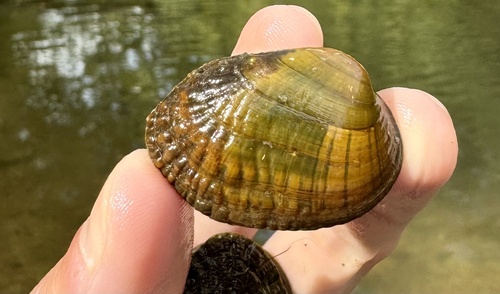
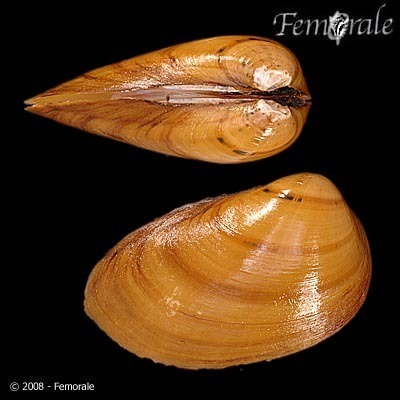
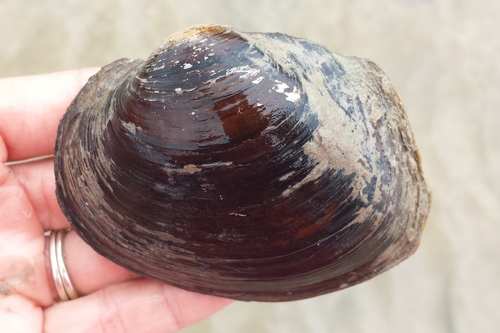
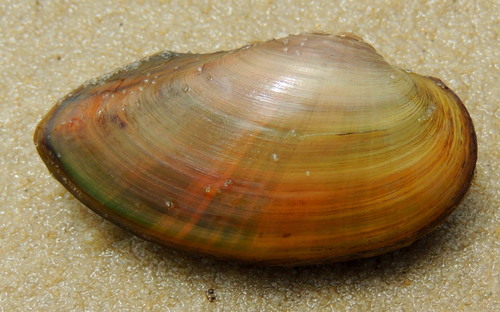
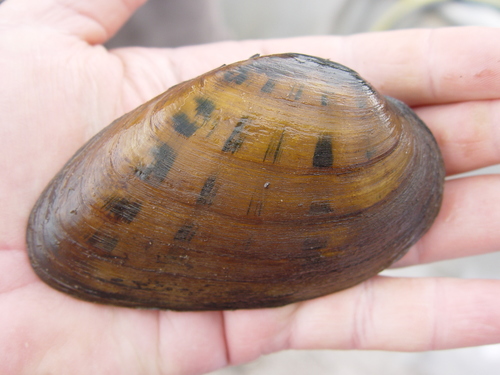
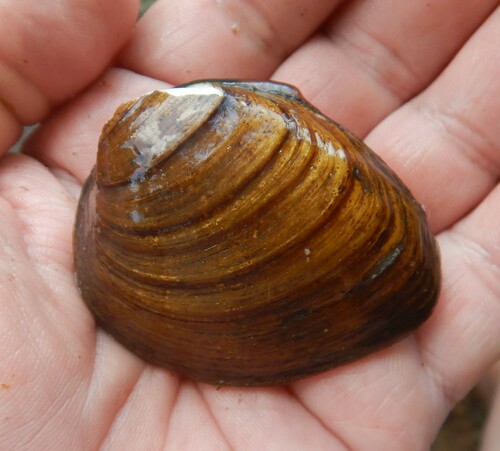
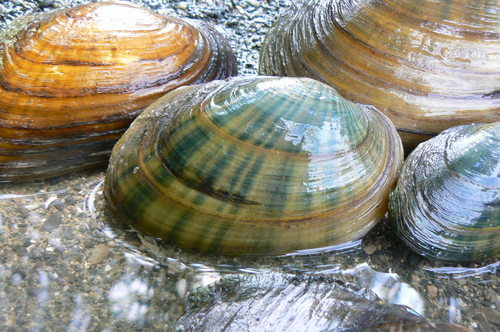
Ortmanniana ligamentina (Lamarck, 1819) is a large species of mussel. Adult individuals of this species can grow up to 140 mm (5.5 in) in length. Its shell is stout, and can be oval, oblong, or elliptical in shape. The anterior end of the shell is broadly rounded, while the posterior end may be either broadly rounded or somewhat pointed. The periostracum (outer shell layer) ranges in color from light yellowish brown to greenish, and darkens to dark brown or dull olive yellow as the mussel ages. The periostracum may also have broad, dark green rays that can be either interrupted or uninterrupted, though these markings are not present on every specimen. The external surface of the shell is relatively smooth, but is often marked with irregular, raised concentric ridges. The nacre (inner shell layer) is white, and becomes iridescent near the posterior end of the shell. Sexual dimorphism is not commonly visible in this species, although some female specimens may have a more inflated posterior region. Young mussels may appear somewhat compressed, and their shell thickens as they age. Ortmanniana ligamentina is a widespread freshwater mussel native to eastern North America. Its range covers the Mississippi River basin, including the Tennessee River and Cumberland River drainages, the St. Lawrence River basin, and tributaries of Lake Erie, Lake Michigan, and Lake Ontario. This distribution includes waterways in the Canadian provinces of Ontario and Québec, and the U.S. states of Alabama, Arkansas, Illinois, Indiana, Iowa, Kansas, Kentucky, Louisiana, Michigan, Minnesota, Mississippi, Missouri, Nebraska, New York, Ohio, Oklahoma, Pennsylvania, Tennessee, Virginia, West Virginia, and Wisconsin. This species is most commonly found in rivers or creeks at depths of 1 m (3 ft 3 in) or less, on substrates of cobble, gravel, sand, or mud. It often occurs in strong-current riffles, but can also be found in slower streams, lakes, and ponds. Adult Ortmanniana ligamentina are filter feeders that eat bacteria, plankton, and detritus suspended in the water column. The larval glochidial stage of this mussel are parasites that live on freshwater fish. Known host fish species for its glochidia include the American eel (Anguilla rostrata), banded killifish (Fundulus diaphanus), bluegill (Lepomis macrochirus), black crappie (Pomoxis nigromaculatus), white crappie (Pomoxis annularis), common carp (Cyprinus carpio), green sunfish (Lepomis cyanellus), orangespotted sunfish (Lepomis humilis), largemouth bass (Micropterus salmoides), smallmouth bass (Micropterus dolomieu), roach (Rutilus rutilus), rock bass (Ambloplites rupestris), sauger (Stizostedion canadense), silverjaw minnow (Ericymba buccata), tadpole madtom (Noturus gyrinus), Tippecanoe darter (Etheostoma tippecanoe), white bass (Morone chrysops), and yellow perch (Perca flavescens). Breeding for this species occurs from August to May. Females are bradytictic (long-term brooders), starting to develop eggs in mid-summer, and carry glochidia from September through May to August of the next year. Individual Ortmanniana ligamentina can live up to 25 years, and reach sexual maturity at approximately 4 to 6 years of age.