About Orthorhyncus cristatus (Linnaeus, 1758)
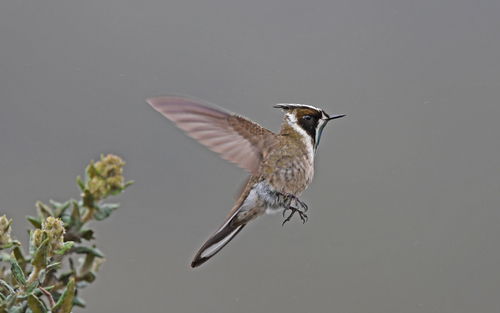
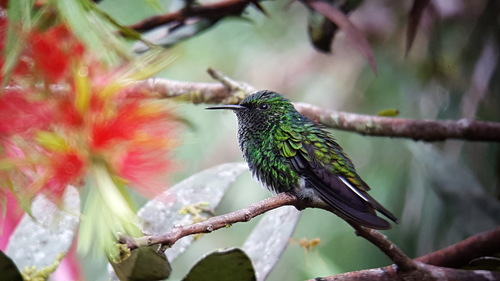
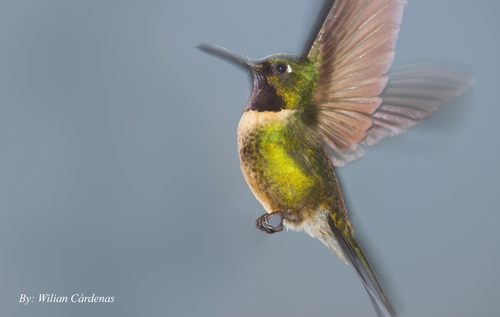
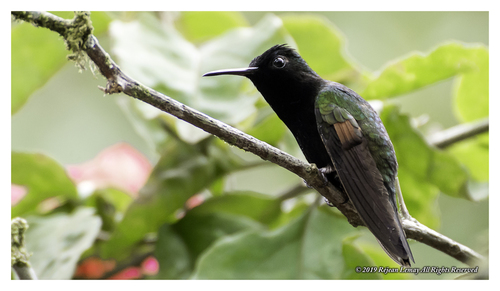
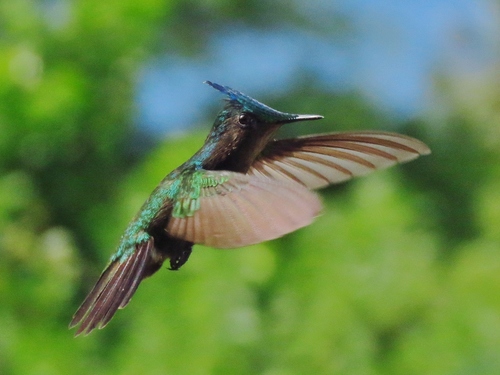
Orthorrhyncus cristatus, commonly known as the Antillean crested hummingbird, is one of the few hummingbird species that has a crest, matching its common name. This species shows the typical sexual dimorphism seen in hummingbirds: males are bright and colorful, while females are more tannish and dull in appearance. Males have a short, straight black bill, a green crest on the head with tips ranging from metallic green to bright blue-green, dull metallic bronze-green upperparts, sooty black underparts, and a rounded black tail. Females have a bill similar to males, but lack a crest on the head; their forehead, crown, and upperparts are metallic bronzy-green, their underparts are light grey, and their rounded blackish tail has four outer rectrices broadly tipped with whitish grey. Subspecies of this species can be distinguished by the color of their crests: subspecies exilis has an entirely green crest, or a crest with only a slight blue tinge on the tip; subspecies ornatus has a crest with an abruptly blue terminal portion; the nominate subspecies cristatus has a golden to emerald crest with a violet terminal; subspecies emigrans is similar to the nominate subspecies but has more bluish violet coloration and a paler grey throat; the degree of paleness in the female underparts also varies between different races. The calls of this species include short "tsip" or "tzip" notes, as well as a longer series of "tslee-tslee-tslee-tslee". The natural habitats of Orthorrhyncus cristatus are subtropical or tropical moist lowland forest, semiarid forest, and heavily degraded former forest, which includes open vegetation, parks, plantations, and forest borders, ranging from sea level to high mountains. It is most common below 500 m. It has a sedentary lifestyle, with possible dispersal to higher altitudes in July and August. Subspecies exilis is a rare straggler to the United States. The diet of Orthorrhyncus cristatus is made up of arthropods and nectar from flowering shrubs including Lantana and Euphorbia, vines, the lower parts of hedges, and large flowering trees such as the capparis tree; other nectar sources include Hibiscus, Bauhinia, Tabebuia, and Delonix. Antillean crested hummingbirds feed from near the ground up to the canopy of tall trees, but appear to prefer flowering plants of the understory. They collect small arthropods either from plant surfaces or by hawking them in the air.