About Orthopsittaca manilata (Boddaert, 1783)
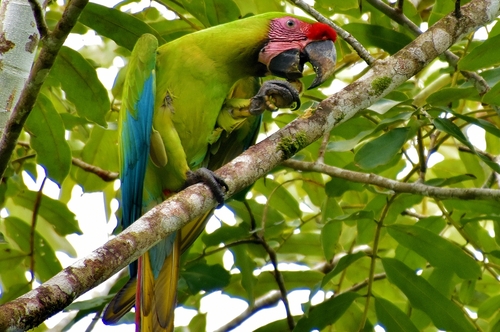
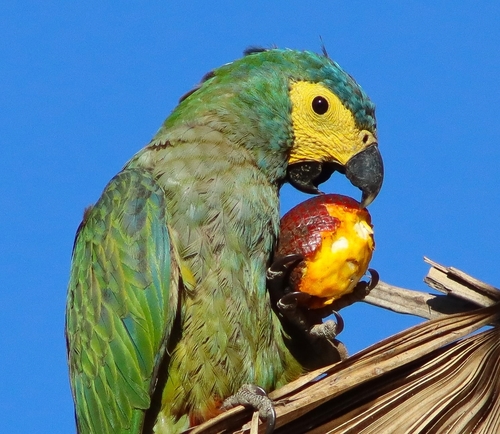
Description: The red-bellied macaw is a medium-sized parrot, weighing approximately 300 g (11 oz) and measuring about 46 cm (18 in) in total length when including its long pointed tail. Most of its plumage is green. Bare mustard-yellow skin covers the cere and most of its face, and its irises are dark brown. Its forehead has a bluish colour, while its chin, throat, and upper chest are greyish with faint green scalloping, and a large maroon patch is present on its lower abdomen (the belly). Its tail is long and tapered, and its underwings and undertail are dull olive yellow. Adult red-bellied macaws have dark-grey beaks, and their legs and feet are also dark grey. Like other parrots, they have zygodactyl feet: two toes point forward, and two point backward. Males and females have identical plumage, but males are generally larger overall and have larger heads. Juveniles have duller colouration than adults, and they have a grey beak with a noticeable white mid-line stripe running the full length of the culmen, which is the top of the upper beak. Spix's macaw is the only other macaw species whose juveniles have a similar white stripe on the culmen. Distribution and habitat: The red-bellied macaw has an extremely large range across most of the Amazon Basin in Brazil's North Region. It is absent from the basin's northwest quadrant, which is centered on the large region of the Rio Negro that flows from Colombia and Venezuela. Its range extends through the Guianas, including the Guiana Highlands, into eastern Venezuela and the lower Orinoco River Basin, and reaches as far as the island of Trinidad. In southern Brazil, its range is limited by the south-central and northwestern cerrado that borders the Amazon Basin. Food and feeding: The diet of the red-bellied macaw consists almost entirely of fruit and seeds from the moriche palm, and from the Caribbean royal palm on Trinidad. These food sources are 100% carbohydrate, 0% fat, and very high in beta-carotene.