About Orthonyx temminckii Ranzani, 1822
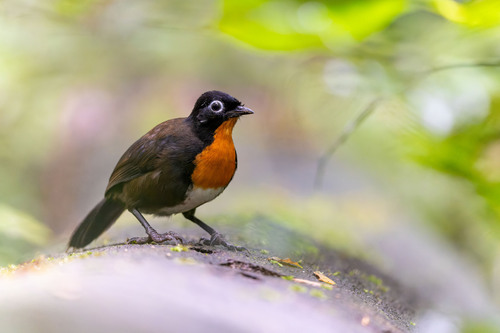
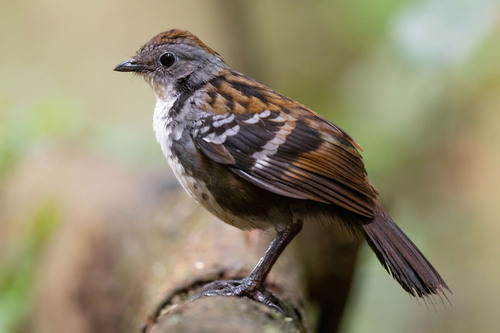
As a group, logrunners are distinguished by their unique tail feathers: the central shafts (rachis) of the tail feathers protrude and are stiffened. The bird’s broad tail is less than 10 cm (four inches) long. The strong protruding rachises at the tips of the tail feathers have almost none of the usual barbs, which gives the feathers a spine-like appearance. This trait inspired common names for the bird including spine-tail and spine-tailed logrunner. There is ongoing debate over the number of tail feathers the Australian logrunner has: some sources state it only has 10 tail feathers, while others describe it as having 12. Most bird species are recorded to have 12 tail feathers, but there are well-known exceptions. The Australian logrunner is not the only bird with an unusual tail feather structure. Other birds, such as the greater melampitta (Melampitta gigantea), also have spiny, stiffened tail feathers, though not to the same degree as the logrunner. Creepers, woodpeckers, swifts and penguins also use their modified tail feathers as braces and supports. The logrunner’s head and back are reddish-brown; its wings are primarily black; and its tail is dark brown. The wing-coverts have grey tips, and the eyebrow and ear-coverts are also grey. The feathers of the throat, breast and abdomen are white. Female logrunners have an orange-rufous throat. Males are also larger than females. The Australian logrunner is found in southeastern Australia, ranging from the Illawarra district in New South Wales to the Bunya Mountains in Queensland. It prefers the leaf-covered floor of rainforests, which are rich with scattered logs, forest debris, ferns, vines and saplings. Logrunners live in pairs or small groups, and aggressively defend their territory from neighboring birds. They are thought to form permanent, monogamous bonds. The female lays two oval, white eggs that measure approximately 29 mm × 24 mm (1.1 in × 0.9 in). The incubation period for the eggs is between 20 and 25 days. Sources also conflict on when the Australian logrunner breeds: some note breeding occurs between April and October, others state it usually happens between May and August, and others claim breeding can happen at any time of year, but most often between July and December. Eggs are laid in a large, domed nest with a ramp. The nest is built from sticks, ferns, leaves and natural fibers, and is typically covered in green moss. It is lined with smaller materials and leaves. Nests are most often built against a stone or log, or in a tree buttress, but they may occasionally be built in dense forest vines or ferns close to the ground. Logrunner nests vary somewhat in their construction materials and appearance. Logrunners conceal their nests by adding surrounding leaves and sticks to the top of the structure, and building a moss hood over the nest entrance, using moss gathered from the local area. Detailed observations of the nest building process follow these steps: First, the bird lays a foundation platform of up to 50 mm of short, strong dry sticks. Next, it uses short, strong sticks to build up the sides and back of the platform, curving sticks in over the top to form a roof. The roof and walls are then covered with dry leaves and moss to a thickness of around 25 mm. Additional dry leaves and twigs are placed on the moss roof to improve concealment. The moss roof is extended so it slopes toward the front of the nest, forming a hood or awning over the entrance that almost completely hides the opening. Finally, the inside of the nest is lined with dry vegetation such as bark, dry moss and fern fiber. Only the female constructs the nest, and she is solely responsible for incubating the eggs, which takes between 20 and 25 days. She also handles rearing the young until they leave the nest 16 to 19 days after hatching. After the young leave the nest, both the male and female share responsibility for feeding them.