About Orthonevra nitida (Wiedemann, 1830)
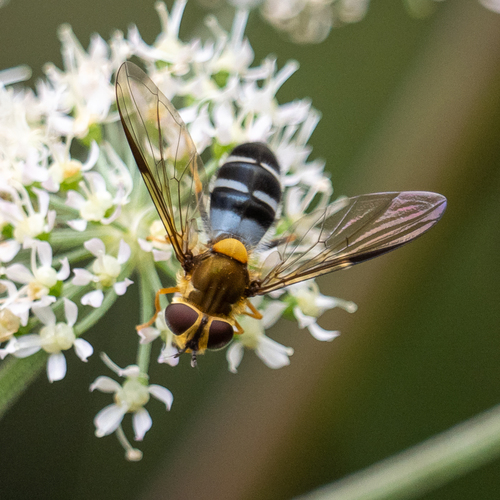
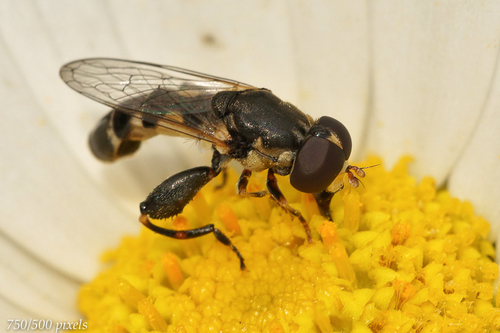
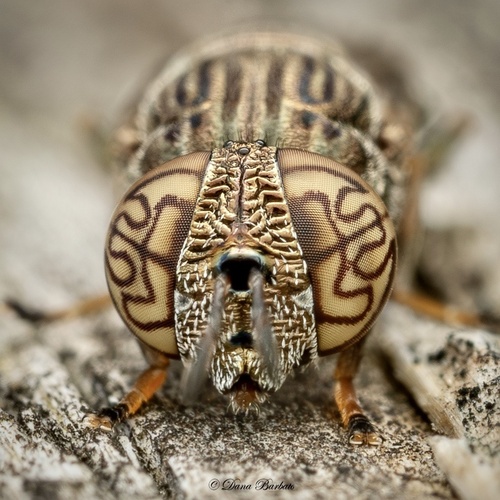
For terminology used in this description, refer to Speight's key to genera and accompanying glossary. Orthonevra nitida measures 4–5 mm (0.16–0.20 in) in total size. The head is brassy metallic black and covered in scale-like pile. In females, the front is narrow above, strongly transversely rugose, and marked with a median furrowed longitudinal line. In males, the frontal triangle is rugose. The face is rugose, and concave on its lower portion; the epistoma is only slightly produced. A small silvery spot sits on each side of the face, near the upper edge of the eye. The antennae are longer than the face: the scape and pedicel are yellowish red or brownish, while the flagellum is black and only slightly longer than the pedicel. The eyes bear a straight horizontal median line, plus two prominent recurving vertical brown lines; males have holoptic eyes. The scutum is metallic green and finely roughened, marked with four longitudinal stripes of coppery or metallic purple color that appear brown in some light reflections. The outer stripes are more or less divided into two nearly contiguous sections. The scutellum is more distinctly roughened or lightly rugose, and bears a groove just before its apex. The wings are almost transparent, with thin blackish spots in the outer cells. The stigma is light brown, and a narrow brown cloud starts from the tip of the second vein (R2+3) and extends across the submarginal cell. Cross veins are narrowly clouded with brown. The veins at the outer portion of the discal and first posterior cells are rectangular, almost straight, and slightly angled in the middle. The fourth vein (M) terminates noticeably beyond the tip of the second vein. The M1 vein is perpendicular to the R4+5 vein, and the M2 vein divides the M1 vein into two equal parts. The dm-cu vein curves inward, and the CuA1 vein extends as a spur on the posterior corner of the discal cell. The crossvein r-m is located at the basal one-third of the discal cell. The legs are metallic black, with reddish yellow coloration on the joints, the base and tip of the tibiae, and the first two joints of the tarsi. The abdomen is deep metallic green. Its central area is roughened and non-shiny, while the edges and tip are noticeably shiny. The second and third abdominal segments have somewhat distinct bands of less translucent color on their front and back portions.