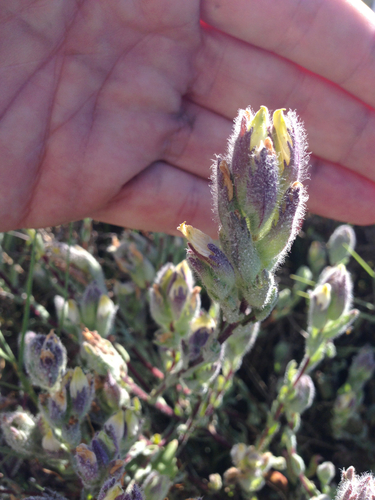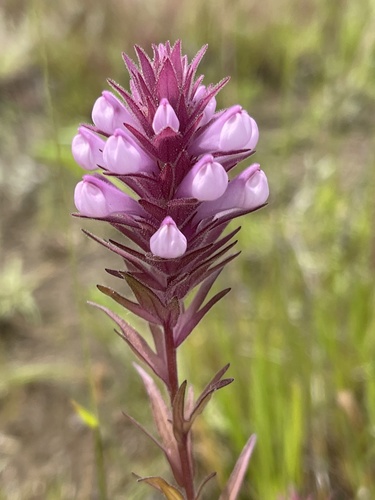
About Orthocarpus bracteosus Benth.
Orthocarpus bracteosus, commonly called rosy owl's-clover, is a flowering plant species belonging to the broomrape family Orobanchaceae. It is native to western North America, ranging from British Columbia to northern California, where it grows in moist habitats including meadows and vernal pools. Across the northern and southern ends of its native range, O. bracteosus is classified as endangered or threatened. More specifically, its native geographic range extends from northern California northward to the Trial Islands in British Columbia. There is a notable gap in its distribution between the Columbia River in southern Washington's Klickitat and Skamania Counties, and the populations found in northwestern Washington and Vancouver Island. In Oregon, this species occurs on both sides of the Cascade Range. It grows at elevations between 100 and 2,000 meters (330 to 6,560 feet). O. bracteosus is restricted to vernally wet meadows. It inhabits graminoid-dominated habitats that experience summer drought, and have high water tables during winter and spring; these habitats include vernal pools, wet meadows, depressions, and channels. Outside of its native range, O. bracteosus has been recorded just twice: once in Cayuga County, New York in 1918, and once in Maryland in 2001. The New York specimen was a non-reproducing waif.