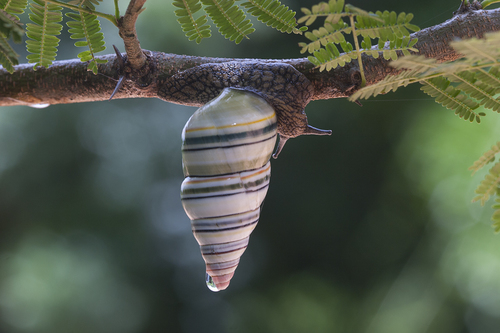
About Orthalicus reses (Say, 1830)
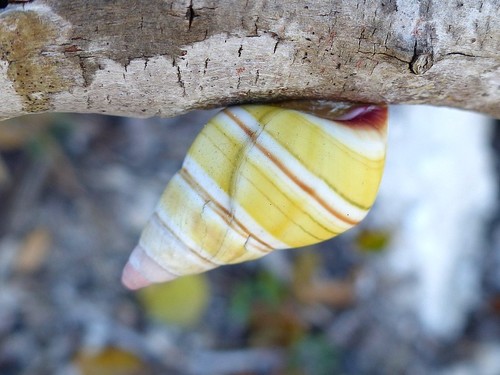
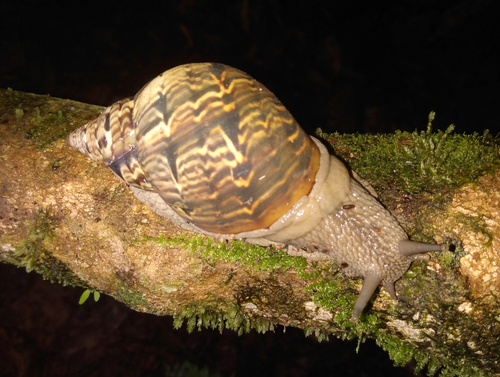
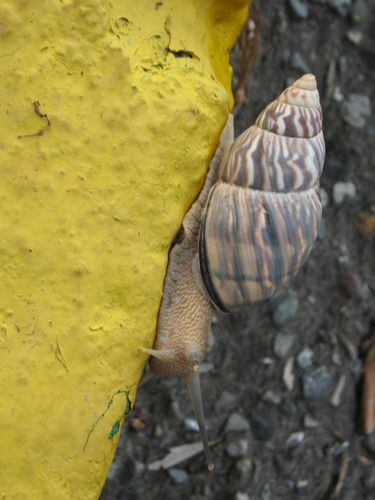
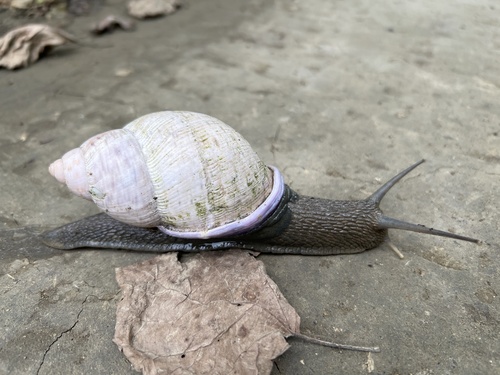
Orthalicus reses (Say, 1830) is a snail with a large conical shell that measures approximately 45 to 55 mm in length. While shell thickness varies between individuals, its shell is usually more lightweight and translucent than the shells of other species in the Orthalicus genus. The shell's outer ground color ranges from white to buff. It has three poorly developed spiral bands, alongside several flame-like purple-brown axial stripes that end at the lowest spiral band. These axial stripes are typically narrower than the whitish areas between them, and do not fork near the upper suture. There are two to three white apical whorls. The final whorl holds two to four darker brown growth-rest varices. Both the columella and parietal callus are white or faint chestnut brown.
The nominate subspecies Orthalicus reses reses is set apart from the proposed subspecies Orthalicus reses nesodryas by the lighter coloration of its apical whorl, columella, and parietal callus; these same features are chestnut-brown or darker in Orthalicus reses nesodryas.
In 1946, Henry Augustus Pilsbry proposed that Orthalicus reses reses arrived in Florida from Central America and the Caribbean, shortly after the Florida peninsula emerged during the late Pleistocene. He suggested snails sealed onto floating tropical trees could have washed ashore on the peninsula via high winds and hurricanes. This dispersal method has been proposed for both Orthalicus and Liguus, but the exact origin of these species remains uncertain. In 1972, Craig proposed that Orthalicus populations reached Florida directly across the Gulf of Mexico from Central America, though it was unknown what mode of transport they used, nor whether dispersal happened as a single event or multiple events. The timing of Orthalicus reses reses' arrival in the Lower Keys is also unknown.
Historically, the Stock Island tree snail (Orthalicus reses reses) was thought to have a very limited range, found only in tropical hardwood hammocks on Stock Island and Key West, though it may have also occurred in other Lower Keys hammock areas. Human activity from collectors has artificially extended its distribution, with introductions to Key Largo and the southernmost parts of mainland Florida. Orthalicus reses nesodryas has a broader range, found throughout the Florida Keys from Sugarloaf Key north. Only Orthalicus floridensis occurs naturally on mainland Florida, and it is also found in the Keys; this species is present in the National Key Deer Refuge.
Originally, Orthalicus reses occurred exclusively in the hardwood hammocks of the Florida Keys. This snail survives best in hammocks with smooth-barked native trees that support relatively large amounts of lichens and algae. In the Florida Keys, Orthalicus is restricted to the higher portions of the islands that support hammock forests, which have minimum elevations of 5 to 11 feet. Lower Keys hammocks are thick forests of tropical trees and shrubs that grow in limestone, marl, and calcareous sand soils. Canopy tree species include Krugiodendron ferreum (black ironwood), Bursera simaruba (gumbo limbo), Piscidia piscipula (Jamaican dogwood), Swietenia mahagoni (mahogany), Coccoloba diversifolia (pigeon plum), Metopium toxiferum (poisonwood), and Ficus aurea (strangler fig). Understory species include Amyris elemifera (torchwood), Drypetes diversifolia (milkbark), Psychotria nervosa (wild coffee), Ardisia escallonioides (marlberry), Eugenia sp. (stoppers), Colubrina elliptica (soldierwood), Gymnanthes lucida (crabwood), and Guettarda scabra (velvetseed).
Larger trees tend to support more Orthalicus reses reses snails than smaller trees, likely because they offer greater surface area for foraging. It is unknown whether Orthalicus reses reses prefers specific tree types or species. However, Voss (1976) proposed that tree snails generally prefer smooth-barked trees over rough-barked ones, as crawling over smooth bark requires less energy. Voss also suggested Orthalicus reses reses prefers smooth bark because it makes forming a secure mucous seal during aestivation easier, leading to lower mortality from dehydration or accidental dislodgement. Orthalicus reses reses snails are entirely arboreal except when they move to the forest floor to nest or travel. Hammocks with well-developed soils or leaf litter are important for nesting activity and dispersal. Light intensity and hammock moisture content are the key factors that affect food availability. There is no available data on the minimum hammock size required to support a viable population of these tree snails. Suitable habitat must be large enough to meet foraging and nesting requirements, and provide the specific microclimate (air temperature and humidity) that Orthalicus reses reses needs.
Differences in preference for edge versus interior hammock have been observed in Liguus populations on Lignumvitae Key, with older individuals found in central mature hammock and younger individuals found more often along hammock edges. Tuskes (1981) suggested this may be an adaptation where younger snails move to edges to escape competition from older snails. It is not known whether Orthalicus reses reses prefers interior or edge hammock. Recent surveys of introduced Key Largo populations found more snails along hammock edges than in the interior, though this result may be biased by differences in visibility during survey work.
Orthalicus reses reses snails are hermaphroditic, and cross-fertilization is common. Liguus snails can locate one another by following mucus trails, and Orthalicus reses reses likely does the same. They mate and nest in late summer and early fall, during the wettest part of the rainy season. They lay roughly 15 eggs per clutch, in a cavity dug into the soil humus layer, usually at the base of a tree. Egg deposition takes between 24 and 105 hours to complete. A humus layer is required for this species to lay eggs. Eggs hatch when rains begin the following spring. Immediately after hatching, juvenile snails climb nearby trees. Most nesting snails are around 2 to 3 years old. The species is estimated to live up to 6 years, with a mean age of 2.11 years for the Stock Island population recorded in Deisler's 1987 study. Tree snail age can be estimated by counting the number of dark "suture-like" lines, which form from pigment deposition during long annual dry seasons.