About Ortalis vetula (Wagler, 1830)
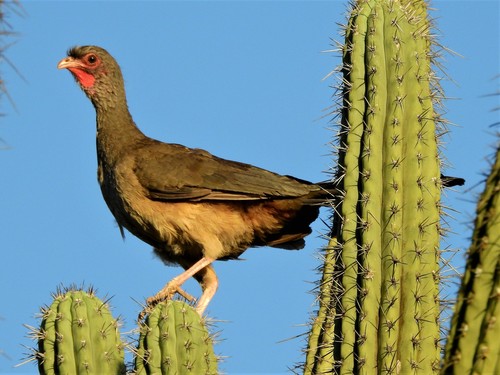
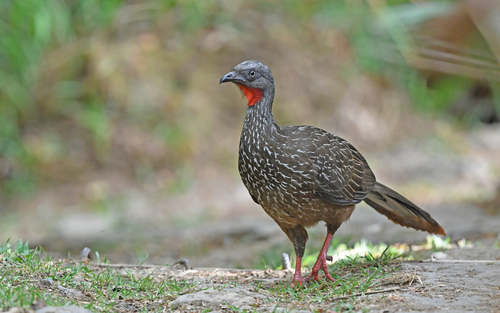
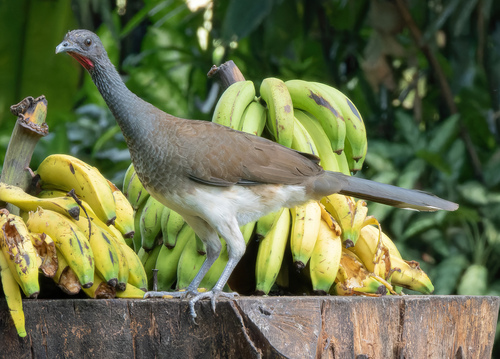
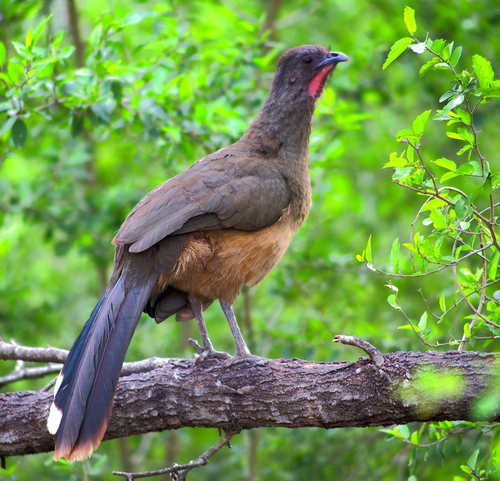
The plain chachalaca (Ortalis vetula) is a medium-sized galliform bird, roughly the same size as a common pheasant. Its total length ranges from 48 to 58 cm (19 to 23 inches). Male plain chachalacas weigh between 468 and 794 g (16.5 to 28.0 oz), while females weigh between 439 and 707 g (15.5 to 24.9 oz). On average, males are larger than females, but size overlap between sexes means size cannot be used to reliably tell them apart. Males and females have identical external appearance. This species has a long neck, small head, and a bare patch of skin on the throat that turns deep red in both sexes during the breeding season. Adult individuals have greyish heads and necks, with dull olive-brown bodies and wings. The underbelly ranges from pale to ochraceous in color. The tail is blackish with a green gloss and a buffy-white tip. The iris is brown, the bill is black, and orbital skin and feet are dull grey. Ortalis vetula acts as a host for the helminth parasite Dispharynx nasuta. A 1977 study by Christensen & Pence found that plain chachalacas carry D. nasuta, but do not carry the parasites Echinuria uncinata, Streptocara crassicauda, or Streptocara incognita. The native range of the plain chachalaca extends from the Lower Rio Grande region of Texas, along Mexico's eastern coast, through the Yucatán Peninsula, Belize, northern Guatemala, and northern Honduras, reaching just into north central Nicaragua. There is also a small native population on the Nicoya Peninsula of northern Costa Rica. The species has been introduced and established in San Patricio County, Texas, and on three Georgia coast islands: Sapelo Island, Blackbeard Island, and Little St. Simons Island. In parts of its introduced mainland North American range, it is considered an invasive species. The plain chachalaca lives in a wide variety of habitats, including primary forest, secondary forest, forest edge, riverine forest, thorny bush-scrub, and shrubland. It also occurs in human-modified habitats such as orchards, suburban parks and gardens, and croplands. Unlike other cracids, it can adapt to the scrubland that forms after tropical rainforest clearing. It occurs at elevations from sea level up to 1,850 m (6,070 ft).