About Orsotriaena medus Fabricius, 1775
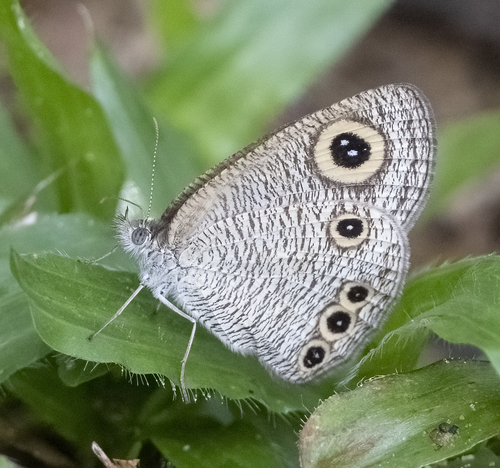
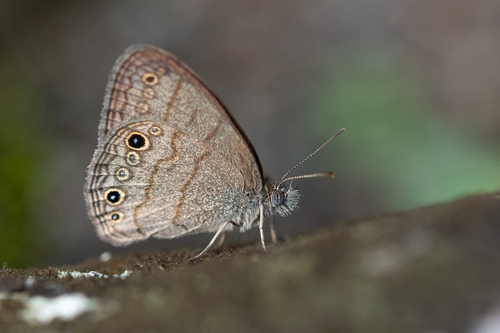
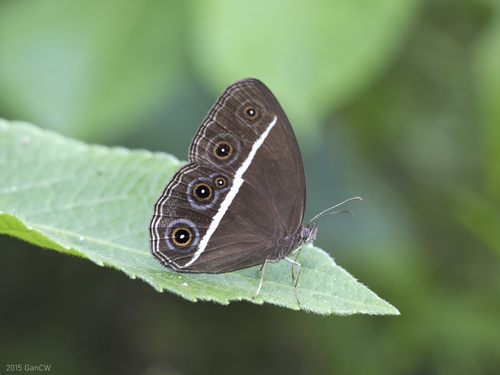
Orsotriaena medus is a medium-sized butterfly with a wingspan ranging from 45 to 55 mm (1.8 to 2.2 inches). The upper side of its wings is dark brown, marked by a thin pale border along the margin, and the upper hindwing has a thin submarginal line. There are no eyespots on the upperside of the wings. On the underside of the wings, a white discal band stretches across both wings, and there are a total of five eyespots. The forewing holds two eyespots, with the anterior one being slightly smaller. The hindwing has two eyespots in the apical region and a separate ocellus in the tornal, or hindmost, region; the uppermost of these hindwing eyespots is greatly smaller, while the remaining two are roughly equal in size. The eggs of this species are spherical and yellowish, and they are laid on the leaf blades and stems of grasses. Full-grown larvae are spindle-shaped, with transverse wrinkles, and are covered in small tubercles that create a rough texture. Two long brown spines on the head point forward, while a pair of pinkish prongs project out from the anal segment. The upper body of the larva is rosy red, with a blue dorsal line and a white lateral line; the underparts below these lines are green. Pupae are suspended perpendicularly, and are slender and regular in shape, except that the head-case extends into a long beak made of two thin processes similar to split straws. Pupal color ranges from whitish brown to yellow, with faint bands of darker shades, and the pupa resembles a large grain of barley or a tiny banana. Orsotriaena medus looks superficially similar to species in the genus Mycalesis (bushbrowns), but can be easily distinguished by the number of its spots. Orsotriaena medus is native to India, Sri Lanka, Myanmar, Cambodia, Thailand, southern Yunnan, Malaysia, the Indonesian archipelago, the Philippines, New Guinea, New Britain and Australia. Within India, it occurs in South India, Punjab, Uttar Pradesh, Bihar, West Bengal, Sikkim, Assam, Nagaland, and the Andaman and Nicobar Islands. This species is very common in grassy habitats at altitudes up to 1,600 m (5,200 ft). It is a shy, weak-flying insect that stays low among undergrowth. When disturbed, it only flies a short distance before settling back down. It basks in the sun, often holding its body aligned parallel to the sun's rays. The larvae of Orsotriaena medus feed on various grasses, including rice plants (Oryza sativa), sugarcanes (Saccharum officinarum), and para grass (Brachiaria mutica). Larvae are predominantly crepuscular, but may sometimes be active during the daytime.