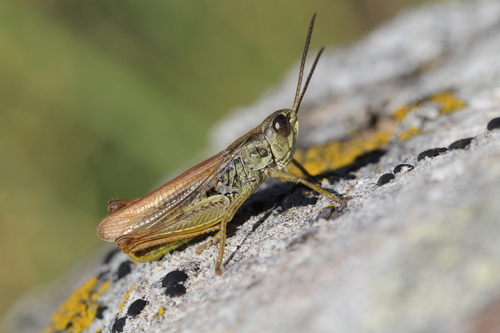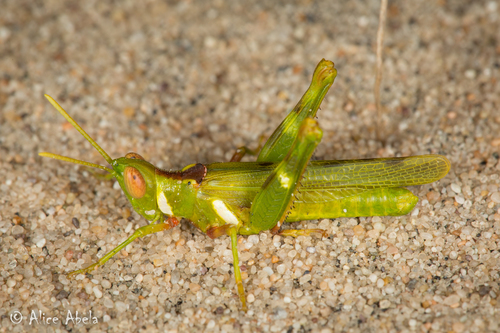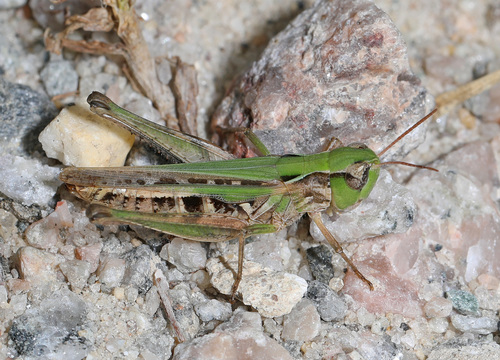
About Orphulella speciosa (Scudder, 1862)
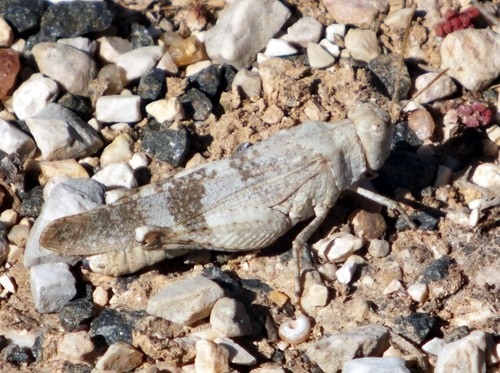
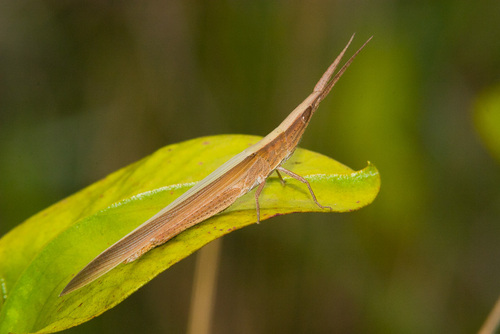
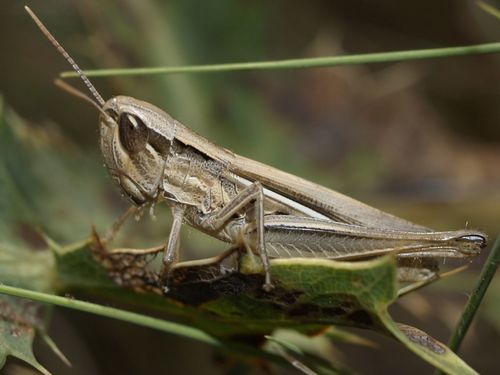
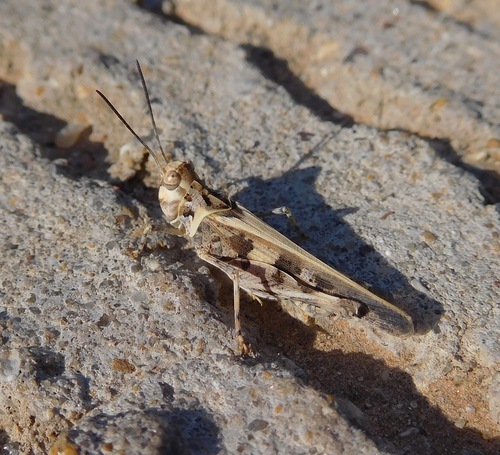
Identification: Orphulella speciosa has a distinctly slanted face. The margins of the head's vertex (the area between the eyes on the top of the head) are only weakly raised. Its foveola, a small depression in the outer integument, is not clearly defined. The pronotal disks located on the top of the first thoracic segment are nearly the same width at their front and back. The principal sulcus, the groove that crosses the middle of the pronotum's outer integument, cuts the pronotal disk slightly past its midpoint. The leathery, slender forewings (called tegmina) extend all the way to the end of the hind femora, and curve inward toward their apex. For males, the measurement from the end of the hind femora varies between 1.5 mm and 3 mm. This species is sexually dimorphic, with females being much larger than males. Females have a total body length of 16 to 21.5 mm, antennae 5 to 6 mm long, tegmina 9 to 16 mm long, and hind femora 9.5 to 12 mm long. Males have a total body length of 13 to 14 mm, antennae 4.5 to 6.5 mm long, tegmina 10 to 13 mm long, and hind femora 8.5 to 10 mm long. On the lower portion of the lateral lobes, the vertical sides of the male pronotum, there is a pale curved line. O. speciosa shows extensive variation in color, particularly in combinations of green and brown. Females are often light green with dark coloration on the head's vertex; females are occasionally brown, and feature a line along the sides of the pronotum. O. speciosa closely resembles O. pelidna, a related species in the same genus. The two species can be distinguished by the structure of the fastigium (the region of the head between the eyes) and by overall body size. O. speciosa has a small median ridge on the fastigium, and is much smaller than O. pelidna. O. pelidna has a semicircular indentation positioned farther back than that of O. speciosa, and has lateral carinae that are incised twice. Distribution and habitat: Orphulella speciosa is found from east of the Rocky Mountains all the way to the Atlantic Coast. It also occurs in southern Canada and northern Mexico. This species inhabits tallgrass and mixed grass prairies, and often prefers patches of shorter grass interspersed within the larger prairie plant community, including grazed grasslands. At the southern end of its range, such as in Texas, adult O. speciosa are most abundant from August to October, though fewer adults can be present from May to December. At the northern extent of its range, such as in New England, adult O. speciosa are most abundant during July and August.