About Orobanche reticulata Wallr.
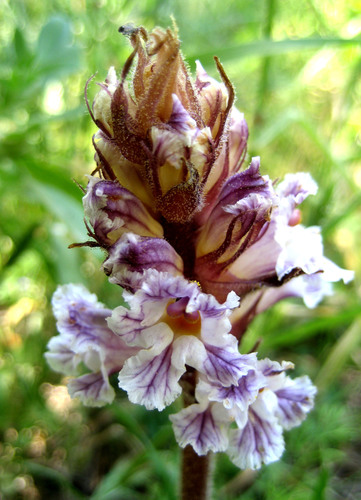
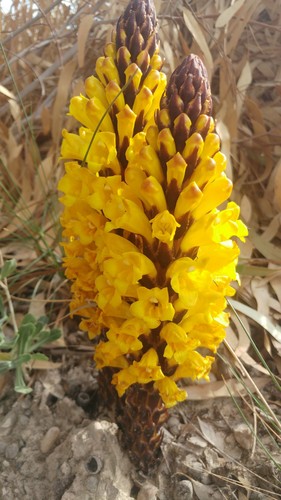
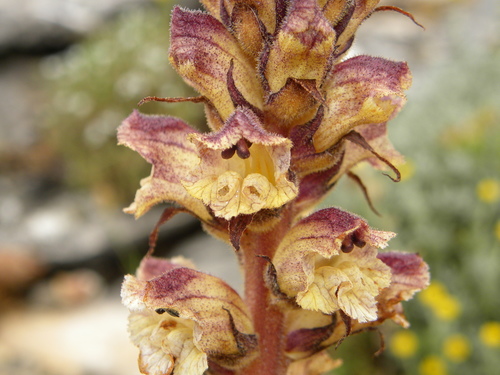
Orobanche reticulata was first formally described by taxonomist Karl Friedrich Wilhelm Wallroth (abbreviated Wallr.) in 1825. This species is a tuberous perennial herbaceous parasite, and its most common host plant is creeping thistle. It is self-supporting, with simple, broad, scale-like leaves, and typically grows to a maximum height of 70 centimetres (28 inches). Its flowering period occurs between May and July. It is a hermaphroditic species, and germination most likely takes place in the spring. It produces a yellow-purple stem, and two-lipped flowers that measure 15–25 mm (0.6–1 inch). These flowers have dark spots and purple stigmas. To fully confirm the identification of this species, it is necessary to record the identity of its host plant. Across its overall range, Orobanche reticulata is generally a lowland species that grows along river edges, road edges, and on floodplains, with a preference for grassland habitats. In the United Kingdom, it favors dry, calcareous, unshaded soil, and occurs at altitudes between 100 and 150 metres (328–492 feet). Seed dispersal by water has been documented as possible for this species in some locations. It grows in temperate climates, and is native to lowland areas of Western Europe and Central Asia. Its range occupies 10 to 30 percent of the area of Belgium and northern France, and 30 to 60 percent of the area of Germany, Denmark, and the Netherlands.