About Ornithorhynchus anatinus (Shaw, 1799)
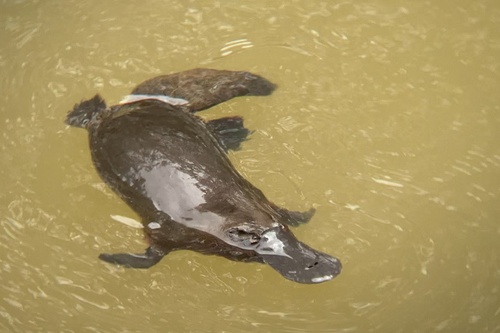
Most of the platypus' small streamlined body is covered with short, dense, brown fur that traps a layer of insulating air to keep the animal warm, both in and out of water. The fur coat is waterproof, and is made up of flattened guard hairs and curvy underfur hairs. The platypus is one of the most densely furred mammals, with only otters having denser fur. Its fur is biofluorescent, glowing cyan and green under ultraviolet light; this may help camouflage it in low light from UV-sensitive predators. The platypus' duck-like bill is a long snout and lower jaw covered in soft skin. Nostrils sit near the tip of the dorsal surface of the snout, while the eyes and ears lie just behind the snout in a groove that closes when the animal is underwater. It has cheek pouches to store food. The platypus' wide, flat tail is often compared to a beaver's tail, but it is furry rather than scaly; the tail stores fat reserves and acts as a rudder while swimming. The platypus has short legs with a sprawling stance. Webbing is much more developed on the front feet. When walking on land, the feet fold up for knuckle-walking to protect the webbing. The platypus has an interclavicle in its shoulder girdle, a trait it shares with reptiles. Like many other aquatic and semiaquatic vertebrates, platypus bones have osteosclerosis, which increases bone density to reduce buoyancy. Adult platypuses do not have teeth, and instead have heavily keratinized pads for grinding food. Young platypuses have one premolar tooth and two molars on each maxilla, and three molars on the dentaries. The first upper cheek tooth and third lower cheek tooth have only one major cusp, while all other cheek teeth have two. Young platypuses lose their teeth around the time they leave their natal burrow. Male platypuses have an average length of 50 cm (20 in) and an average weight of 1,700 g (3.7 lb); females are smaller, averaging 43 cm (17 in) in length and 900 g (2.0 lb) in weight. This species follows Bergmann's rule: individuals get larger the farther south they live, as a response to colder climates, though there are local exceptions. The platypus has an average body temperature of about 32 °C (90 °F), which is lower than the 37 °C (99 °F) typical of placental mammals. Research suggests this lower body temperature is a gradual adaptation to harsh environmental conditions in the few surviving marginal monotreme species, rather than a general characteristic of all past monotremes. The platypus has a single opening called a cloaca, used for both reproductive and waste systems. The male platypus has penile spines and an asymmetrical glans penis that is larger on the left side. The female has two ovaries, with the right ovary being non-functional, and has no teats. The platypus is native to freshwaters of eastern Australia, ranging from Queensland to Tasmania, including King Island but not the Furneaux Group. It was thought to be extinct on the South Australian mainland, with the last recorded sighting at Renmark in 1975. Platypuses were captively bred at Warrawong Sanctuary between 1990 and 1991. In October 2020, a nesting platypus was filmed in the wild after the previously abandoned Sanctuary reopened. A population of platypuses was introduced to Kangaroo Island in the 1920s; an estimated 150 individuals live in the Rocky River region of Flinders Chase National Park. Large portions of the island burned during the 2019–20 Australian bushfire season, which greatly reduced local wildlife. However, recovery teams from the SA Department for Environment and Water worked to restore platypus habitat, and multiple sightings were reported by April 2020. The platypus has almost disappeared from the Murray–Darling Basin, possibly due to poor water management. Platypuses live in a variety of freshwater habitats, including rivers, streams, lakes and lagoon-like pools. The surrounding terrestrial habitat includes tropical rainforests and colder alpine areas. The platypus is semiaquatic and requires permanent freshwater habitat. Its swimming style is unique among mammals: it propels itself with alternating strokes of each front foot, while the webbed hind feet and tail are used for steering. It can maintain its relatively low body temperature when feeding in cold depths below 5 °C (41 °F). In one study, dives lasted an average of thirty-five seconds, with average surfacing intervals of thirteen seconds. The species is mainly nocturnal, but is also active at dusk during summer and active during daytime in winter. A platypus may spend half its day in water, then retreat to a burrow it digs into the river bank. Burrows fall into two types: simple resting burrows and complex nesting/breeding burrows. A platypus may have a home range of up to 7 km (4.3 mi), with a male's home range overlapping the ranges of three or four females. Platypuses are not very vocal; they have been recorded growling when disturbed and squeaking when in pain. The platypus is a carnivore that forages by probing along river and stream bottoms. It feeds on insect larvae, annelid worms, shrimp, crayfish, bivalves, tadpoles and fish eggs. It stores collected food in its cheek pouches to eat later. In captivity, platypuses have survived up to thirty years, and wild specimens have been recaptured at twenty-four years old. Predators of the platypus include Murray cod, eels, carpet snakes, goannas, eagles, crocodiles, and foxes. Parasites and viruses also contribute to platypus mortality, though the species appears to have a high tolerance for these organisms. Externally, platypuses may carry fleas, mites, and ticks; ticks are more common on young individuals. The platypus is a common host for the tick species Ixodes ornithorhynchi. Internally, the platypus may host protozoans, trematodes, and nematodes. The fungus Mucor amphibiorum has been found in Tasmanian platypuses, where it causes the disease mucormycosis, with symptoms including skin lesions and ulcers across the body. Platypuses are seasonal breeders, with more southerly populations breeding later in the year than more northern populations; platypuses in New South Wales mate during fall and winter. Research has found both resident and transient platypuses, and suggests a polygynous mating system. Females are believed to reach sexual maturity at two years of age and continue breeding past nine years of age. During copulation, the male swims behind the female, grabs her tail with his bill, positions his own tail under her from the side, then grips her neck or shoulder. After mating, the female retreats to a nesting/breeding burrow made of grass, which can be 30 m (98 ft) long, to lay eggs and raise young. Early European naturalists did not believe that female platypuses lay eggs, but this was confirmed by William Hay Caldwell in 1884. Most mammal zygotes go through holoblastic cleavage, splitting into multiple divisible daughter cells. However, monotremes like the platypus, along with reptiles and birds, undergo meroblastic cleavage, in which the ovum does not split completely. The cells at the edge of the yolk remain continuous with the egg's cytoplasm, allowing the yolk and embryo to exchange waste and nutrients with the egg through the cytoplasm. A female platypus normally lays two small, leathery eggs around 17 mm (21⁄32 in) long. Eggs develop in utero for about twenty-eight days, followed by ten days of external incubation. The female curls around the incubating eggs as the embryo continues to develop. Newly hatched platypuses are vulnerable, blind, and hairless; they are fed by their mother's milk, which is thicker than the milk of placental mammals and provides all nutrients needed for growth and development. Since the female has no teats, milk is released through pores in her skin, and the young lap milk up from her fur. Offspring are milk-fed for around four months. A small minority of young are weaned after they exit the burrow, but this usually happens within five days of exiting. Newly hatched young also have a remnant yolk sac that disappears within four days. During incubation and weaning, the mother initially only leaves the burrow for short periods to forage. She leaves a series of thin soil plugs along the length of the burrow; pushing past these plugs when she returns squeezes water from her fur and keeps the burrow dry. After five weeks, the female spends less time with her offspring, and the young emerge from the burrow around four months old. By emergence, they are fully covered in fur, and are typically around 67% of an adult's weight and 80% of an adult's length. Juvenile males disperse farther than juvenile females, and both sexes are fully grown at around two years old.

