About Ornithoptera priamus (Linnaeus, 1758)
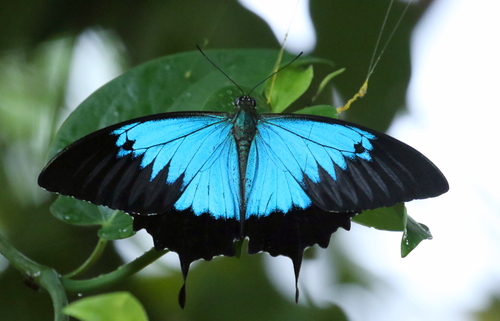
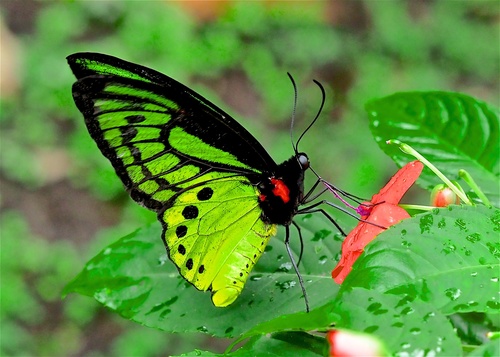
Ornithoptera priamus is a sexually dimorphic species. For males: The upperside of the forewings is velvety black. Most races have a green subcostal stripe, and most subspecies have a green marginal stripe that borders the termen, tormen, and dorsum of the wing. The sex brand is black and elongated. The underside of the forewing is black, with a chain of bluish or green postdiscal spots. The male hindwings are green, with basal yellow-gold spots along the wing's leading costa, plus a postdiscal chain of black spots. The edge of the hindwing is black. The underside of the hindwing is dark green or bluish; the yellow-golden spots are transparent. Part of the veins are black, and the marginal edge of the wing is black, with a postdiscal chain of black spots along the outer edge. The male abdomen (body) is yellow, while the head and thorax are black. The underside of the thorax has a coat of red hair. Females are larger than males, falling in the upper range of the species' wingspan. The female's basic body and wing color is dark brown. There is a chain of white postdiscal spots on the forewings, and a chain of larger white postdiscal spots with dark centers on the hindwing. The underside of the female's wings is very similar to the upperside. Newly hatched first instar larvae are wine red, and soon turn black or dark brown. All segments have soft tubercles with stiff ends that carry black spines. Tubercles on the 4th segment are red, while tubercles on all other segments are dark brown. In the second instar, tubercles no longer have spines. The 4th segment tubercles are light red, and tubercles on other segments match the body color. In the third instar, a white to pink saddlemark appears on the 4th segment. In the fourth and fifth instars, the larva's ground color is ashy grey to brown. The saddlemark on the 4th segment is white, and the 4th segment tubercles are also white. Saddlemarks may also be present on the 5th and 6th segments. The tips of the tubercles are black, and the osmeterium is dark red. The pupa is yellowish green or brown, marked with greyish veins that give it a leaf-like appearance. It may have a broad pale dorsal saddle mark. The abdomen has eight pairs of sharp dorsal processes, which are directed laterally.