About Ornativalva erubescens (Walsingham, 1904)
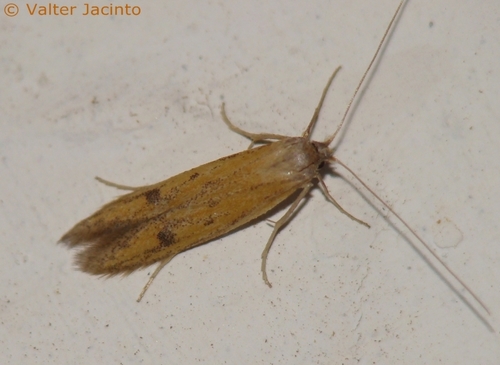
Ornativalva erubescens is a moth species belonging to the family Gelechiidae. It was first described by Thomas de Grey, 6th Baron Walsingham, in 1904. This species is found in Morocco, Algeria, Tunisia, Libya, Egypt, Sudan, Israel, Saudi Arabia, Iran, Pakistan, and the southwestern United States. It has a wingspan of 17–18 mm. Its forewings are whitish ochreous, with bright rosy red suffusion along the costa extending two-thirds of the way from the base. Between these two colours lies an olive-grey band that reaches the end of the cell; this band has two rectangular projections extending downwards into the paler space below it, and these projections are darker, leaning more toward fuscous, than the upper portion of the streak they blend into. At the end of this streak sits an oblique blackish spot, which comes before an area of the whitish ochreous ground colour; this area has a narrow brownish fuscous margin along its lower edge. There is a short narrow black streak on the flexus. On the pale costal third, there are two small clusters of brownish fuscous scales within the basal third of the wing; in the outer third, there are three larger clusters of these scales on the costa and costal cilia, and two similar scale groups appear in the cilia below the wing apex. The hindwings are somewhat iridescent grey, with a brownish tinge. Adult moths have been recorded in flight during January, May, August, and November.