About Oriolus oriolus (Linnaeus, 1758)
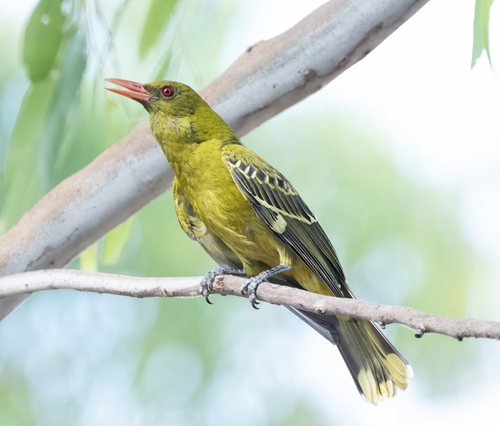
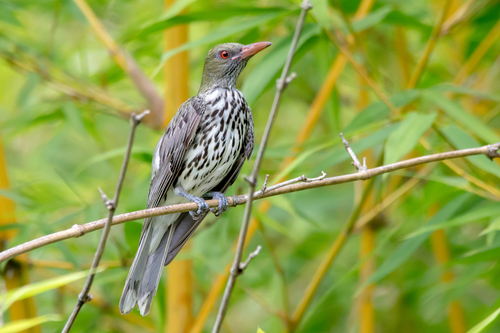
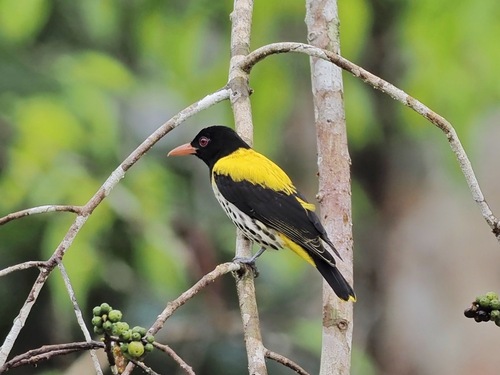
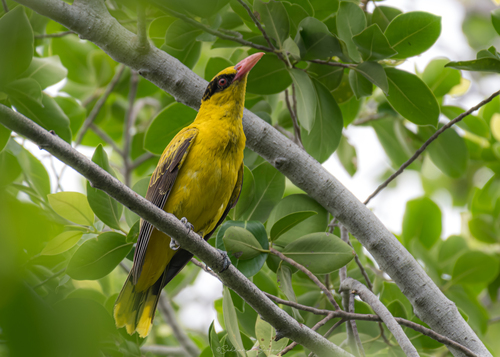
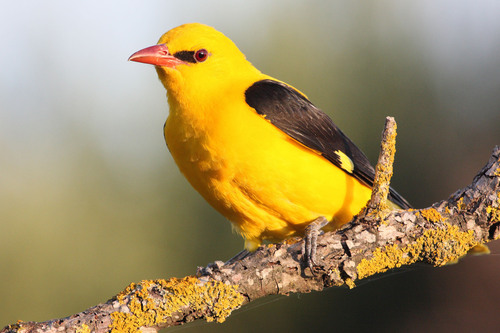
This species has the scientific name Oriolus oriolus (Linnaeus, 1758), commonly called the Eurasian golden oriole. Males have striking black and yellow plumage typical of orioles, while females are duller green-toned birds. All Eurasian golden orioles are shy, and even males are remarkably hard to spot among the dappled yellow and green leaves of the tree canopy. In flight, they look somewhat similar to thrushes, with strong, direct movement and shallow dips when traveling longer distances. Their call is a harsh "kweeaahk", while their song is a fluting weela-wee-ooo or or-iii-ole. The song is unmistakable once heard, and often has subtle variations between each sung phrase. The closely related Indian golden oriole (Oriolus kundoo) can be distinguished from the Eurasian golden oriole: male Indian golden orioles have a black eye-stripe that extends behind the eye, a longer and paler red bill, and more yellow in their plumage.
The Eurasian golden oriole's breeding range extends from western Europe and Scandinavia eastward to China. This species winters in central and southern Africa. Eurasian golden orioles generally migrate at night, though they may travel during the day on spring migration. During autumn migration, they pass through the Eastern Mediterranean, where they feed on fruit; this habit leads them to often be considered pests in this region. The species formerly bred in Great Britain, with the last confirmed breeding recorded in 2009 in East Anglia.
Eurasian golden orioles live in a variety of habitats. In Western Europe, they prefer open broadleaf forests, plantations, copses, riverine forests, orchards, and large gardens. In Eastern Europe, they can also inhabit more continuous forests, as well as mixed or coniferous forests. They generally avoid completely treeless habitats, but may forage in these areas. In their wintering range, they are found in semi-arid to humid woodland, tall forests, riverine forest, woodland-savanna mosaic, and savanna.