About Oriolus kundoo Sykes, 1832
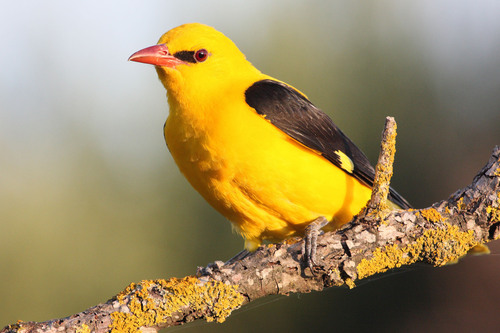
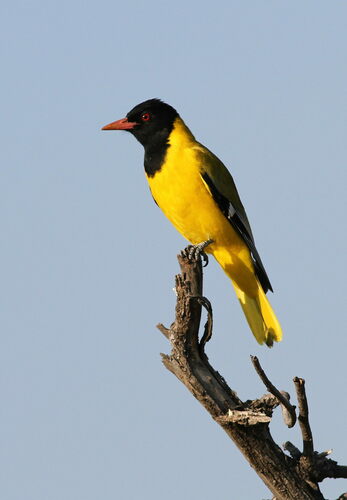
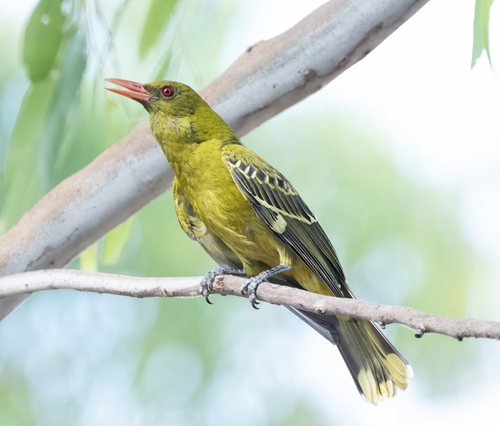
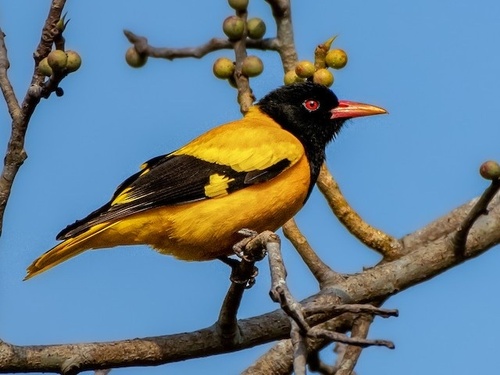
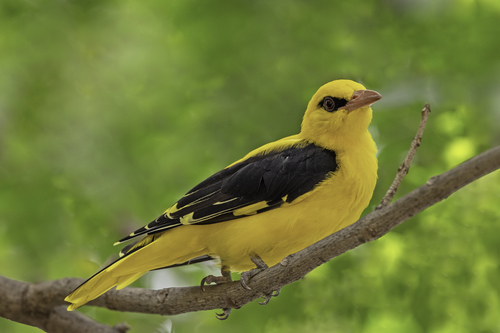
The Indian golden oriole (Oriolus kundoo) is very similar to the Eurasian golden oriole, but it has more yellow coloring in its tail, and a paler red shade in its iris and bill. Males of this species have a black eye stripe that extends behind the eye, a large carpal patch on the wing, and wide yellow tips on the secondaries and tertiaries. The underside streaks on female Indian golden orioles are sharper than those on female Eurasian golden orioles. The Eurasian golden oriole is larger: adult males have a wing length of 149–162 mm, compared to 136–144 mm for male O. kundoo. The two species also differ in wing formula: primary 2 is longer than primary 5 in O. oriolus, while primary 5 is longer than primary 2 in O. kundoo.
This oriole breeds from Baluchistan and Afghanistan along the Himalayas to Nepal. Some populations breed in the peninsular region, but these breeding populations are very localized. Northern populations winter in southern India, and some individuals winter in Sri Lanka. Populations found in the Maldives and the Andaman Islands have not been carefully examined. The Indian golden oriole lives in a wide range of habitats, including open deciduous forests, semi-evergreen forests, woodland, forest edges, mangroves, open country with scattered trees, parks, gardens, orchards, and plantations.
The flight of the Indian golden oriole is dipping but strong, and has been recorded reaching speeds of about 40 km/h (25 mph). It sometimes bathes by repeatedly flying into a small pool of water. An individual ringed in Gujarat was recovered in Tajikistan more than nine years after ringing.
Indian golden orioles feed on fruits, nectar, and insects. They are capable of dispersing the seeds of many berry-bearing plants, including the invasive Lantana camara. One individual has been recorded preying on southern flying lizards.