About Oriolus chinensis Linnaeus, 1766
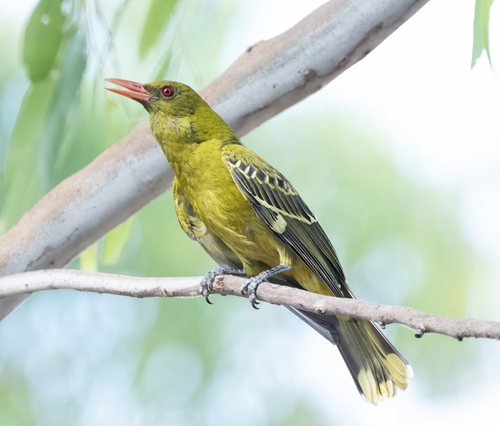
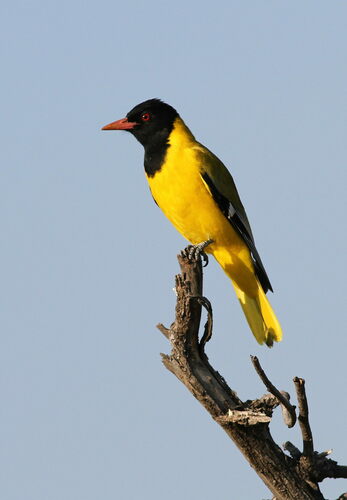
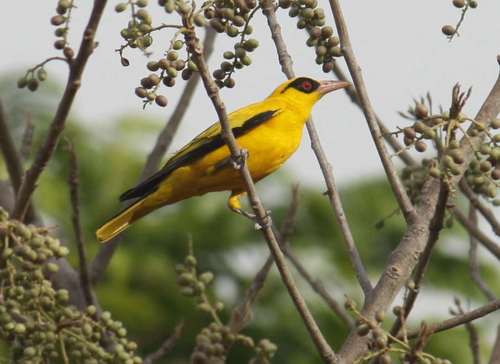
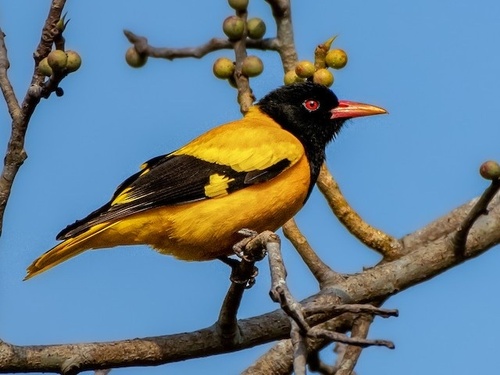
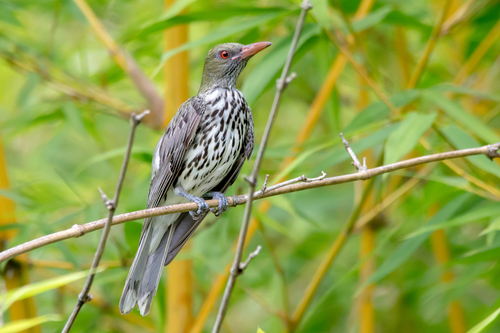
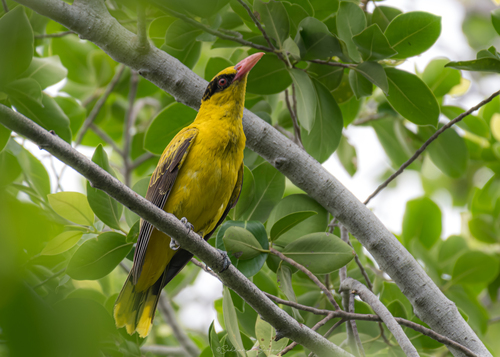
The black-naped oriole (Oriolus chinensis Linnaeus, 1766) is a medium-sized bird, with overall golden plumage, a strong pinkish bill, and a broad black mask and nape. Adult males have yellow-tipped central tail feathers, and their lateral tail feathers are yellow over a broader area. Females have more greenish or olive coloration on the mantle. Juveniles have a streaked underside. Nestlings have dull greenish plumage marked with brown streaks; their head and nape are more yellowish, and their undertail coverts are yellow. Multiple population variations exist, which have been classified as separate subspecies. The Andaman Islands subspecies O. c. andamanensis has entirely black wings. The Nicobar Islands subspecies O. c. macrourus has a very broad nape band that leaves only the top of the head yellow, with all black wings that have a yellow primary covert patch. The calls of these two Andaman and Nicobar subspecies are reported to be quite different, with O. c. macrourus producing more modulated call notes. Among Southeast Asian populations, geographic trends include decreasing yellow coloring on the forehead and decreasing brightness of yellow plumage moving from north to south. Females from southern populations have more greenish coloration on the back and tail, and lack the yellow spots on the tips of secondaries seen in northern populations. The species' usual call is a nasal niee or myaa, and its song (from the diffusus subspecies) is a fluty iwee wee wee-leeow. Black-naped orioles have a dipping flight pattern. This species occupies forests, gardens, and plantations. Subspecies diffusus breeds in eastern Siberia, Ussuriland, northeastern China, Korea, Japan, and northern Vietnam. It is widespread across India during winter, mainly in northeastern parts and the peninsular region, and also occurs in Bangladesh. Populations native to the Andaman and Nicobar Islands are resident. Eastern Asia breeding populations spend winter in tropical Southeast Asian regions such as Thailand and Myanmar. Subspecies diffusus is an uncommon migrant in most parts of South India, a very rare migrant to Sri Lanka, and is most regularly seen in the Western Ghats. In Singapore, black-naped orioles are thought to have only established breeding populations in the 1920s, and are now common even within the city's gardens. They were considered rare there in the 1880s, and remain fairly common in Singapore today. Black-naped orioles feed on berries and insects in the tree canopy. They have been recorded feeding on a range of berries including those from Trema orientalis, Ficus, and other plants, in addition to insects. It has been suggested that the species helped disperse Ficus species onto the island of Krakatoa, where black-naped orioles were also among the early pioneer species. In India, they have been observed taking nectar from large flowers such as those of Salmalia and Erythrina. They can sometimes act as nest predators, preying on smaller birds. The breeding season runs from April to June for most populations, and from January to March for populations in the Nicobars. The nest is a deep cup built in the fork of a tree. Clutches contain two to three salmon pink eggs with reddish spots and darker blotches. Nests are often built near the nest of a black drongo. A female may build two or three nests before finally choosing one to lay eggs in. Males will sometimes sit beside the unused nests. Only the female incubates the eggs, which hatch after 14 to 16 days, and the chicks fledge two weeks after hatching. Females stay closer to the nest, carrying out nest sanitation by removing fecal sacs, driving away predators, and feeding the young. Males take a more active role in feeding the young and guarding the nest. Eurasian tree sparrows and black bulbuls will sometimes use abandoned black-naped oriole nests. Nest predators of this species include crows, treepies, and hawks. In many parts of Southeast Asia, black-naped orioles are trapped and sold in the bird trade.