About Orgyia postica (Walker, 1855)
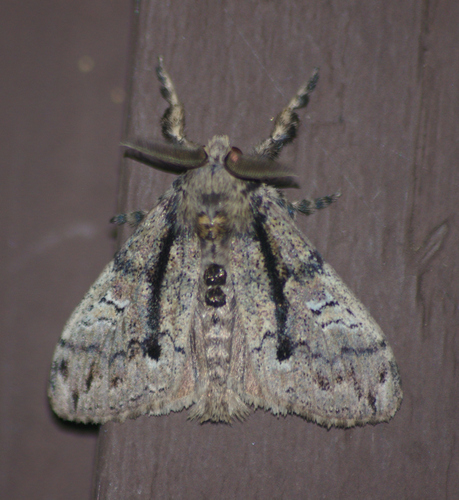
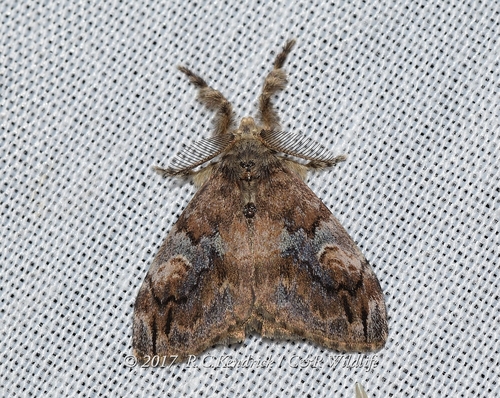
This species is Orgyia postica (Walker, 1855). Males have a wingspan of 20–30 mm. For male individuals, the head, thorax, and abdomen are brownish. Their forewings are brown, marked with an indistinct oblique sub-basal line. Waved antemedial and postmedial lines on the forewings approach one another at the lower angle of the cell. The area between these two lines has a faint bluish grey tinge, and holds a waved dark line edged with white on both sides of the discocellulars. Two indistinct, waved submarginal lines are also present on the forewings. The forewing apex has a slight grey tinge, and bears a few dark subapical streaks. Male hindwings are dark brown. Females of this species are wingless. Larvae are yellowish, and sparsely covered with brown hair. They have one dorsal and two lateral brown bands. Paired tufts of hair grow on the first and eleventh somites, projecting forward and backward respectively. Lateral tufts of grey hair project outward from the fourth and fifth somites. Dorsal tufts of yellow hair are located on the fourth through seventh somites. Larvae have a red head. Pupae are stout; male pupae are glossy black, and covered in many small, short tufts of hair. Eggs are pillbox-shaped and pale whitish brown, with a darker ring surrounding a depressed top area. Adult males can be found flying year-round. Larvae of this moth have been recorded feeding on a wide range of host plant species, including Buchanania, Mangifera, Durio, Ochroma, Casuarina, Terminalia, Shorea, Hevea, Ricinus, Pelargonium, Cinnamomum, Acacia, Albizia, Caesalpinia, Cajanus, Cassia, Dalbergia, Erythrina, Pithecellobium, Pterocarpus, Sesbania, Xylia, Lagerstroemia, Eucalyptus, Tristania, Zizyphus, Malus, Coffea, Citrus, Santalum, Dimocarpus, Litchi, Nephelium, Theobroma, Camellia, Grewia, and Tectona. Parasitoid wasps from the genus Telenomus are known to attack the eggs of Orgyia postica.