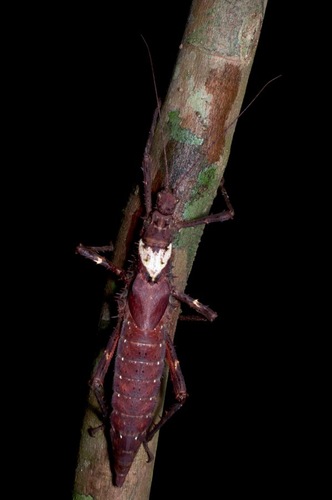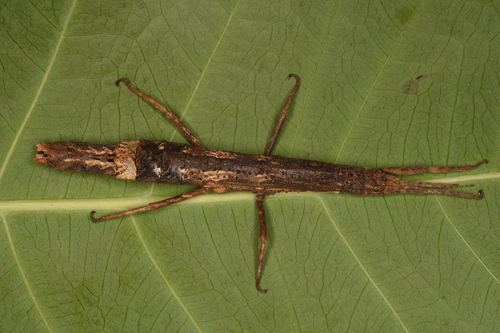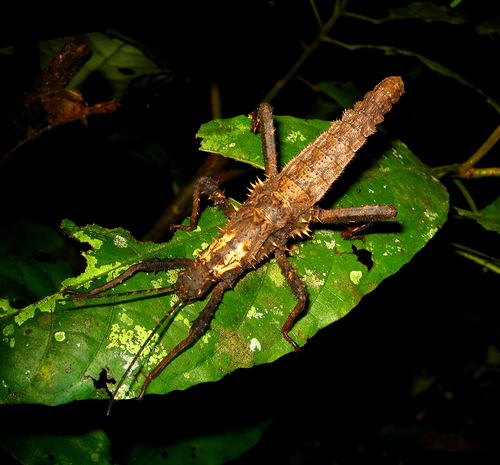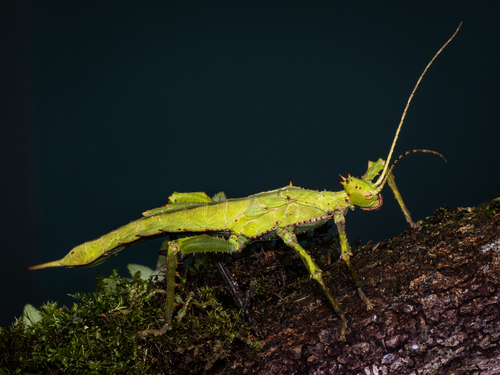
About Orestes shirakii (Ho & Brock, 2013)
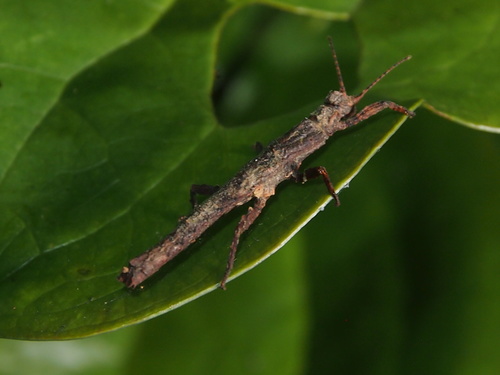
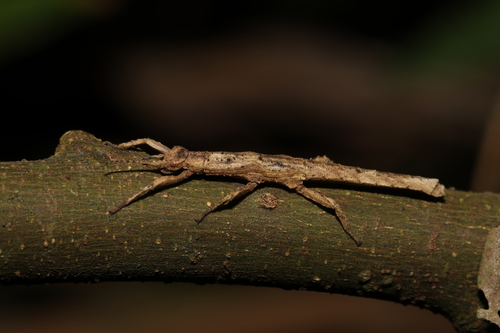
Only female individuals of Orestes shirakii have been discovered to date. These females are very slender and can grow up to 50 millimeters (2.0 inches) in length. They can be easily distinguished from the related species Orestes guangxiensis by their size. In Orestes shirakii, the elongated mesonotum is three times as long as the pronotum, while the mesonotum of Orestes guangxiensis is only 2.5 times as long as the pronotum. Orestes shirakii lacks posterior lateral tubercles on its third to fifth abdominal tergites, and also lacks the shortened posterior edge of the eighth abdominal sternite, also called the subgenital plate. The mesonotum of this species is slightly widened toward its rear end, and the metanotum is rectangular. This differs from the similar species Orestes japonicus, which has a parallel-sided mesonotum and a square metanotum. The species is distributed across large areas of Taiwan, where it occurs at altitudes below 1,000 meters (3,300 feet). After molting into their adult (imago) stage, females start laying one to three eggs per week, placing the eggs in or on moist soil. The eggs take four to six months to hatch. Newly hatched nymphs do not start feeding until approximately two weeks after hatching, and can take up to 15 months to reach full adulthood. When touched, both adult and nymph Orestes shirakii engage in thanatosis, or playing dead.