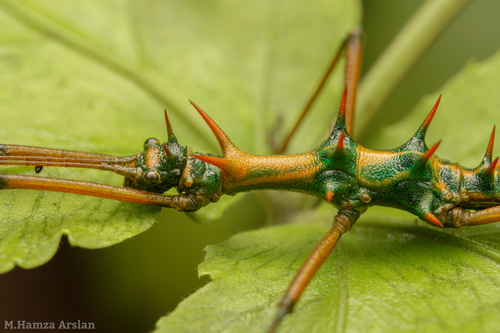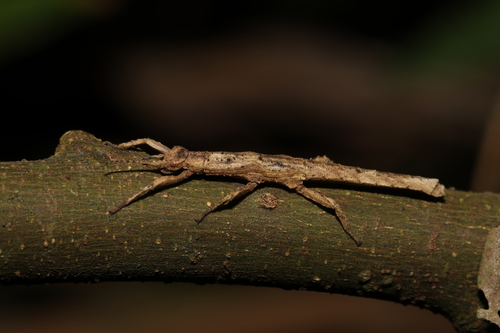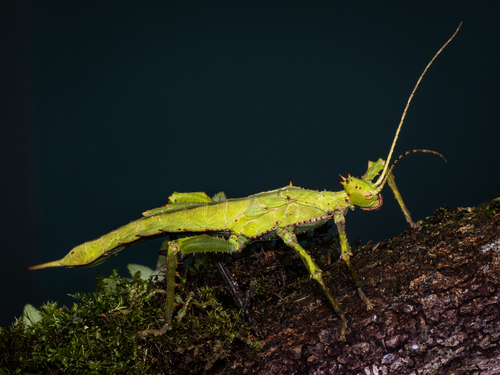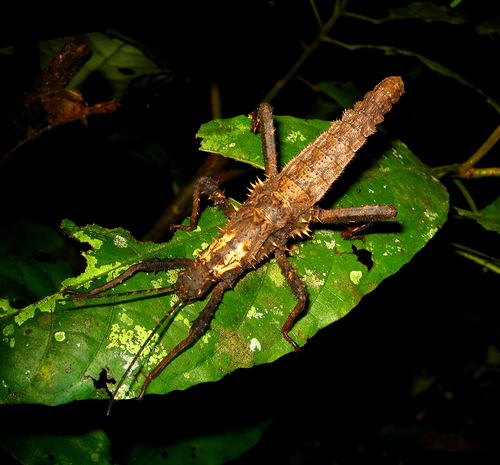
About Orestes mouhotii (Bates, 1865)
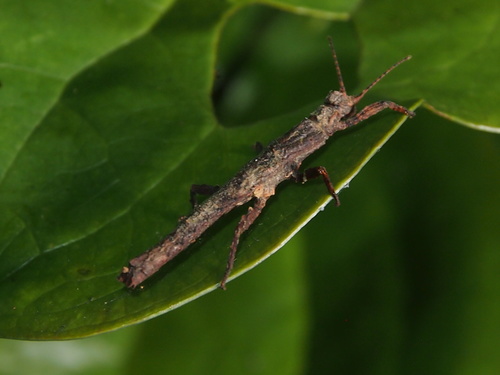
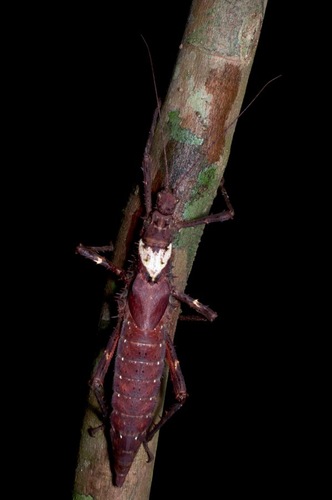
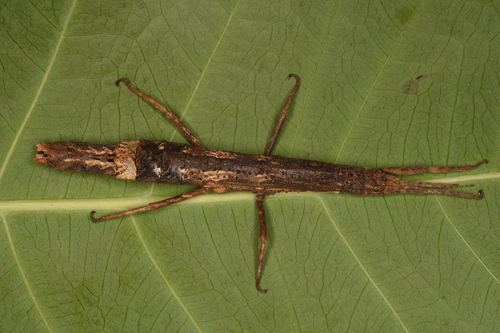
Adult female Orestes mouhotii measure 45 to 55 millimetres (1.8 to 2.2 inches) in length, making them longer than males, which grow to a maximum length of 40 millimetres (1.6 inches). Both sexes have noticeably short legs, with body coloration ranging from beige to brown. Males have semicircular horn-like auricles on the head, are generally more slender, and have a slightly thickened abdomen tip. Females have a more compact build, with a distinct thickening located just behind the middle of the abdomen that is particularly visible due to increased abdominal height. Freshly matured adult females have high-contrast patterning of light and dark brown, often with pale almost white areas especially on the sides and mid-section of the abdomen. A particularly distinct dark brown longitudinal band typically runs along the middle of the body across the anterior abdomen and metanotum; this band is somewhat lighter on the mesonotum and flanked by black tubercles. This high-contrast patterning fades as individuals age, and older insects become increasingly uniformly light brown. Confirmed occurrences of the species include the type localities of Orestes mouhotii and its synonym Orestes verruculatus, both located in southern Thailand. Depending on species interpretation, the full distribution extends from Cambodia through southern Vietnam, the Malay Peninsula, and Singapore, to Sumatra. The species has also been recorded in Yunnan province, China. Males have not been documented across the entire species range, and many populations are parthenogenetic. Only two populations are confirmed to be sexual: one found by Ingo Fritzsche in Thailand's Khao Yai National Park, and another found by Jérôme Constant in Cambodia's Kirirom National Park in 2015. A sexually reproducing sister species was collected by Christoph Röhrs in May 2018 on Havelock Island in the Andamans. In their daytime resting posture, Orestes mouhotii hold their hind legs backward and middle legs stretched forward, held close to the body, while fore legs and antennae are stretched forward. In this position, their plant mimicry is so effective that the insects are barely distinguishable from a short broken twig. They feed at night, with known food plants including species in the genus Curculigo, Dioscorea (such as Dioscorea glabra), Dracaena (such as Dracaena fragrans and Dracaena surculosa), and Epipremnum. Females begin laying eggs one at a time approximately two months after their final imaginal molt. Eggs are about 3 millimetres (0.12 in) long, 2 millimetres (0.079 in) wide, and average 14 milligrams in weight. Nymphs hatch from the eggs after just two months, and require around one year to complete development into mature adults. Adult females have a life expectancy of an additional one year after reaching maturity. The species reproduces cyclically via parthenogenesis, a form of asexual reproduction producing only female offspring, so natural populations are commonly made up entirely of females. Even in sexually reproducing populations, males are rare, occurring at a ratio of 1 male per 20 females.