About Orestes guangxiensis (Bi & Li, 1994)
Only female Orestes guangxiensis are known to science so far. In 2005, Paul D. Brock and Masaya Okada mistakenly described individuals from Japan's Miyako-jima as males of this species. In 2016, George Ho Wai-Chun reclassified these mistaken male specimens as Pylaemenes japonicus, a species he described at that time; this species is now called Orestes japonicus.
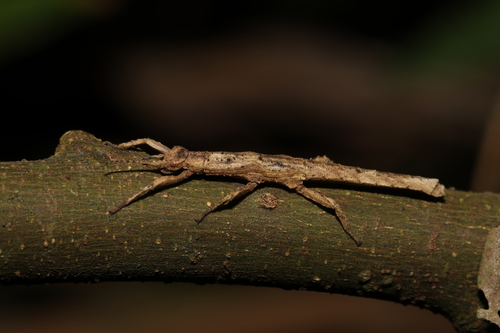
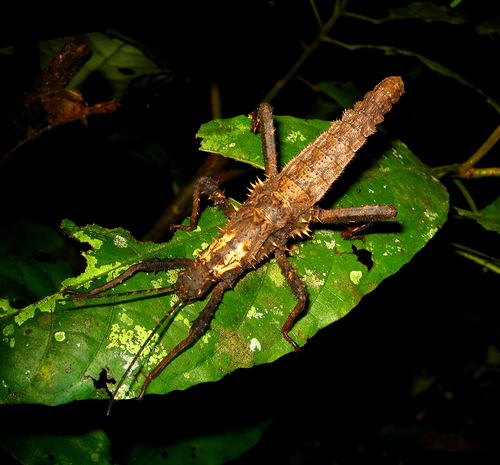
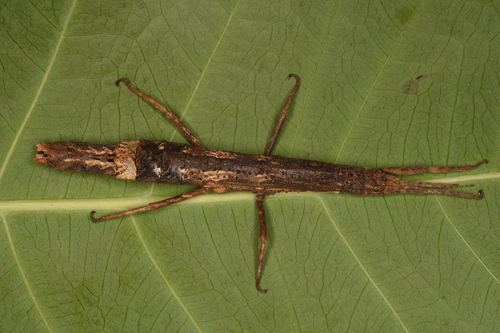
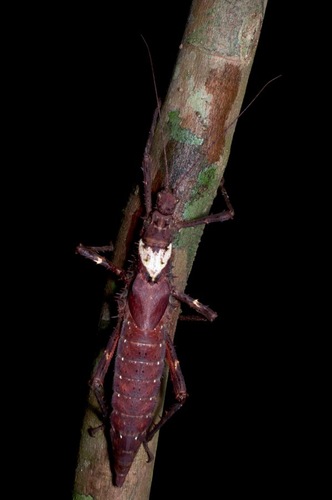
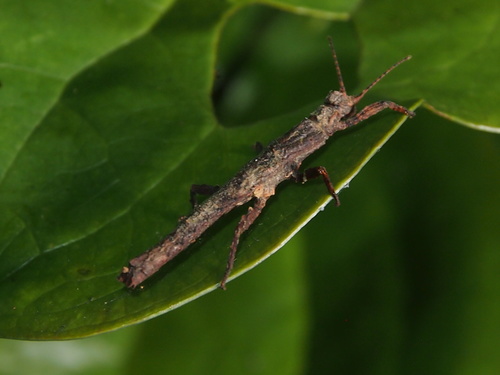
Known adult females of Orestes guangxiensis measure 40 to 50 millimetres (1.6 to 2.0 in) long and have a stocky body shape. Their basic body color is usually a light beige or brown, marked with additional almost white, brown, and black patterns. The body surface is covered in small, mostly black tubercles. A weak longitudinal ridge called a carina runs down the center of the otherwise flat upper surface of the thorax. The comparatively short mesonotum is 2.5 times as long as the pronotum, making it significantly shorter than the mesonotum of longer related species such as Orestes mouhotii or Orestes shirakii. On the forehead, which narrows toward the top, four small elevations form two edges that converge toward the tip of the forehead. When viewed from the front, these edges form a triangle shape. The abdomen widens noticeably up to its midpoint, and in egg-laying females it is also strongly raised laterally up to this midpoint. Unlike some other related species, female Orestes guangxiensis lack tubercles on the posterior lateral area of the third to fifth abdominal tergites.
The distribution of Orestes guangxiensis covers the Chinese provinces of Fujian, Guangdong, Hainan, the autonomous region of Guangxi, and the Special Administrative Region of Hong Kong. Animals originally classified as this species from Taiwan are now reclassified as Orestes shirakii. Populations where males are mostly known have been reclassified as Orestes japonicus.
Like all members of its genus, Orestes guangxiensis is nocturnal. These insects achieve near-perfect phytomimesis, or camouflage as plant material, by aligning their legs and antennae along their body. As a result, they are barely distinguishable from a short broken branch. This species is capable of parthenogenesis, which is why only females have been found at many of its known sites to date.
Approximately six weeks after molting into their adult (imago) stage, females begin laying one to three eggs per week. The eggs are around 3 millimetres (0.12 in) long and wide, and almost 2 millimetres (0.079 in) high. Their dorsal side is more curved, and they are covered in short, barb-tipped hairs. The micropylar plate of the egg has three arms: one points toward the egg lid, while the other two run circularly around the egg. Females lay eggs on or near the ground, often clamping the eggs into bark or pinning them to mosses.
Nymphs hatch after an average of four months. Hatchlings have distinct carinae along the center and edges of their body, and already have the high, pointed forehead that is characteristic of the species. Even adult Orestes guangxiensis do not have a flat head. Nymphs take around a full year to develop into adults. Older nymphs are often more contrasting and colorful than adult females, and typically show red-brown color tones.