About Oreoscoptes montanus (J.K.Townsend, 1837)
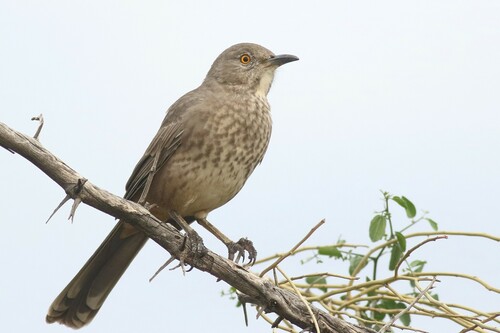
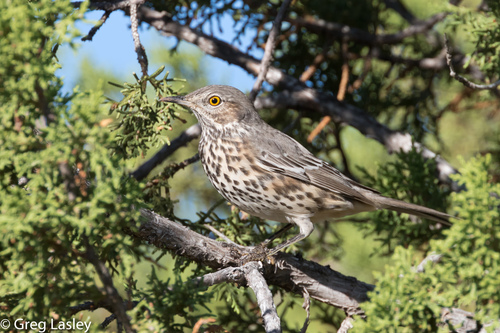
The sage thrasher, scientifically named Oreoscoptes montanus (J.K.Townsend, 1837), is a medium-sized passerine bird. It measures 20.0 to 23.0 cm in length and weighs between 39.6 and 50.3 grams. Its most distinctive feature is its eye color, which ranges from lemon-yellow to amber. Compared to adult sage thrashers, juveniles have paler upperparts and lightly streaked underparts. Adults have brownish-gray upperparts and white underparts marked with dark streaks. The species' plumage does not change significantly throughout the year. The sage thrasher can be told apart from other thrashers by its shorter, less curved bill, shorter tail, and smaller overall size. This bird breeds in shrubsteppe habitats dominated by big sagebrush (Artemisia tridentata) across the western United States and southern Canada. Sagebrush is essential for the species, as it provides nesting sites and protection from both heat and predators. The local abundance of sage thrashers is positively correlated with the amount of sagebrush cover, the amount of woody vegetation, and the amount of bare ground in an area; it is negatively correlated with grass cover. The northern edge of the species' breeding range reaches south-central British Columbia, Canada, specifically the Similkameen and Okanagan valleys. In the United States, breeding occurs from central Washington southward through eastern Oregon and northeastern California. The breeding range extends east across Nevada, Utah, western Colorado, southern Idaho, Wyoming, southern Montana, and into northern Arizona and New Mexico. During winter, the sage thrasher occurs from southern Nevada south through central and southern Arizona, and central and southern New Mexico, to west-central Texas. In Mexico, its wintering range covers northern Baja California, northwestern and central Sonora, northern Chihuahua, and Nuevo León, extending south as far as Durango. The sage thrasher is a short-distance migrant: it migrates to its breeding range in early spring and leaves for its wintering range in early fall.