About Oreortyx pictus (Douglas, 1829)
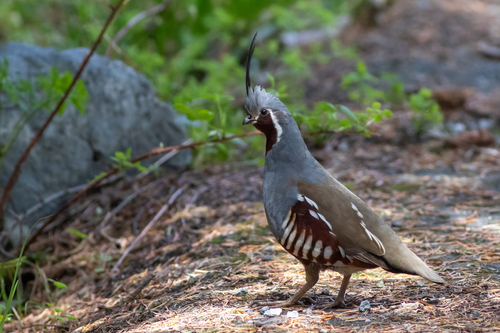
Oreortyx pictus (Douglas, 1829), commonly called mountain quail, has an average body length of 26–28 cm (10–11 in) and a wingspan of 35–40 cm (14–16 in). This species has relatively short, rounded wings and long, featherless legs. Mountain quails are easily identified by their head topknots: the topknot is shorter on females, and its color changes with the season and the geographic location of the population. This bird has a brown face, gray breast, brown back and brown primary flight feathers, and an underside marked with heavy white barring. Compared to males, females have more extensive brown coloring on their dorsal side, paler red undersides, and wider white barring along the flank. As mountain quails age, they lose the multi-colored primary coverts on their wings; by 15 months old, they only have solid-colored primary coverts. This non-migratory species lives in mountainous chaparral west of the Rocky Mountains. Its range stretches from British Columbia, Canada, and parts of Washington state, United States, south to the Baja Peninsula, Mexico. It occurs at elevations up to 3,000 m (9,800 ft) above sea level. While it is not migratory, some populations in certain mountain ranges are altitudinal migrants. In addition to chaparral and wooded areas of the Sierra Nevada Mountains and Coast Range, mountain quail also inhabit lava reefs on California's Modoc Plateau.