About Oreonympha nobilis Gould, 1869
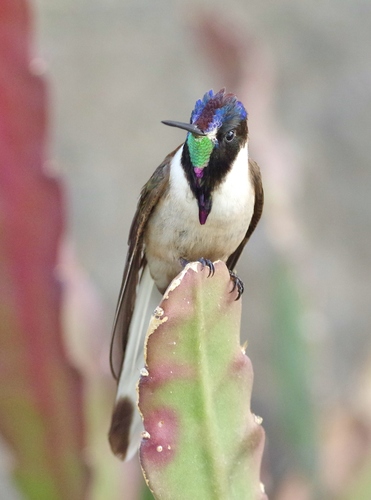
The bearded mountaineer (Oreonympha nobilis Gould, 1869) measures 14 to 16.5 cm (5.5 to 6.5 in) in total length, which includes its approximately 2.3 cm (0.91 in) long bill. It weighs around 7 to 9 g (0.25 to 0.32 oz). Adult males of the nominate subspecies have a deep purplish blue forecrown and crown marked with a narrow black stripe down the middle. Their face is bronzy black, with a narrow white band at the back of the face. The gorget is long and narrow: emerald green under the chin, with the remaining portion purplish and tipped blue. The nape, back, and rump are colored bronzy to bronzy brown. The tail is long and deeply forked; its feathers are bronzy, with an increasing amount of white from the innermost to outermost feathers. The center of the breast is white, the sides of the breast and flanks are brownish, and the undertail coverts are bronzy brown. Adult females are similar to males, but are duller overall and have a dingier underbelly. Their gorget is smaller and mostly white, and their tail is less deeply forked. Both sexes have black bills and black legs. Juveniles are duller than adults, with a scaly green crown, a dull brown throat, and a yellow mandible. Males of the subspecies O. n. albolimbata have white bands on either side of the crown and a much more coppery tail. Females of this subspecies have white that extends from the same crown white bands through the lores to the gorget. The nominate "eastern" subspecies of bearded mountaineer occurs in the Apurímac and Cuzco departments of south-central Peru, in the drainages of the Urubamba and upper Apurímac rivers. The "western" subspecies O. n. albolimbata is found in Peru's Huancavelica, Ayacucho, and Apurímac departments, in the drainages of the Mantaro, Pampas, and Chalhuanca rivers. This species lives in dry Andean valleys that have rocky, scrubby hillsides and open woodland. It occurs in a range of native plant communities, and is also regularly found in stands of tree tobacco (Nicotiana) and Eucalyptus, even alongside roads and within towns. Its elevational range is 2,500 to 3,900 m (8,200 to 12,800 ft).