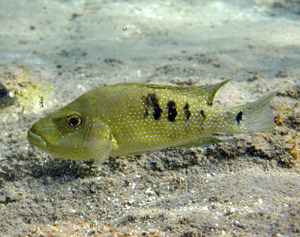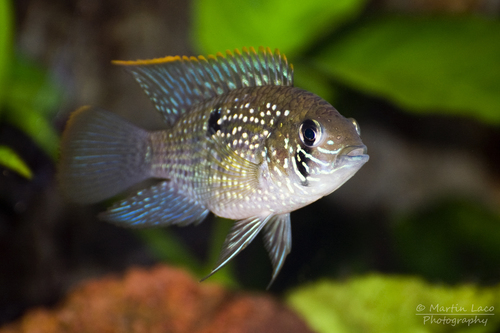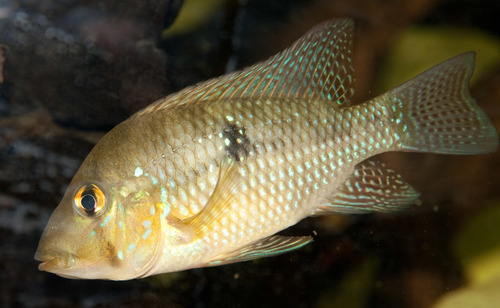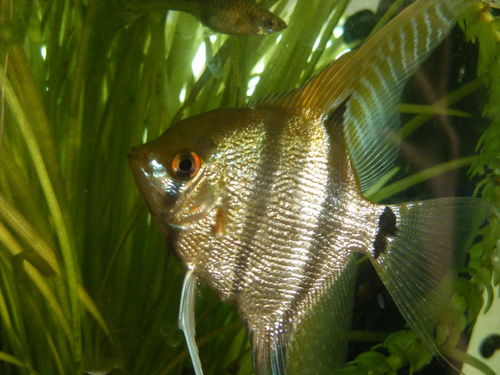
About Oreochromis niloticus (Linnaeus, 1758)
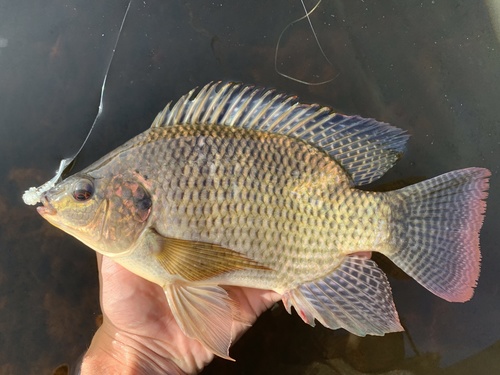
Nile tilapia (Oreochromis niloticus, first described by Linnaeus in 1758) can reach a maximum length of 60 cm (24 in) and weigh more than 5 kg (11 lb). As is typical for tilapia, males grow faster and reach larger adult sizes than females. Wild, natural-type Nile tilapia have an overall brownish or grayish coloration, often with faint, indistinct body banding, and vertical stripes along their tail fin. Breeding males develop a reddish color, particularly on their fins. Nile tilapia is commonly confused with blue tilapia (O. aureus); blue tilapia does not have the striped tail pattern of Nile tilapia, it has a red edge to the dorsal fin (Nile tilapia’s dorsal fin edge is gray or black), and breeding blue tilapia males are overall bluish. The two species can also be distinguished using meristic counts. Because many tilapia farmed in aquaculture and introduced globally are selectively bred variants, hybrids, or both, identifying them using the standard traits that work for wild natural-type individuals is often not possible. The poorly documented species O. ismailiaensis has a plain unstriped tail, but otherwise closely resembles Nile tilapia and may only be a variant of this species. O. ismailiaensis may be extinct, as its only known habitat in northeastern Egypt no longer exists, though similar-looking individuals have been recorded in the surrounding area. Nile tilapia can live for more than 10 years. Nile tilapia is native to much of Africa, excluding the Maghreb and almost all of Southern Africa. Its native range includes tropical West Africa, the Lake Chad basin, and most of the Nile system, including lakes Tana, Albert and Edward–George, as well as lakes Kivu, Tanganyika, and Turkana, and the Awash and Omo Rivers. In Israel, it is native to coastal river basins. It has been widely introduced to many other locations, both elsewhere in Africa and on other continents, including dozens of countries across Asia, Europe, North America, and South America. In these introduced regions, it often becomes highly invasive, threatening native ecosystems and native species. However, some introduced populations historically classified as Nile tilapia are actually hybrids or other species; Nile tilapia and blue tilapia have been especially frequently confused. In India, particularly in the southern state of Tamil Nadu, Nile tilapia was introduced by K. Kamaraj, who was the serving Chief Minister at the time, and has since become a threat to native fish species there. Nile tilapia inhabits most types of freshwater habitats, including rivers, streams, canals, lakes, and ponds, and occurs at elevations from sea level up to 1,830 m (6,000 ft). It can also live in brackish water, but cannot survive long-term in full salt water. It has been recorded in water temperatures ranging from 8 to 42 °C (46 to 108 °F), though it typically occurs in waters above 13.5 °C (56.5 °F), and its upper lethal temperature limit is usually 39–40 °C (102–104 °F). Temperature tolerance varies between different populations: populations from the northern part of its range can survive the lowest recorded temperatures, while isolated populations living in hot springs in the Awash Basin and along the Suguta River generally inhabit waters that are at least 32–33 °C (90–91 °F). Although Nile tilapia can survive in relatively cold water, breeding generally only occurs when water temperatures reach 24 °C (75 °F). Like most fish, Nile tilapia reproduce through mass spawning of a brood inside a nest constructed by the male. In this reproductive system, territorial behavior and sexual competition among males creates large variation in individual reproductive success within a group. The long-term genetic effect of this behavior is reduced genetic variability, because differential male reproductive success makes inbreeding between generations more likely. Likely driven by reproductive competition, Nile tilapia begin reproducing just a few months after birth. Their early sexual maturation leads to high birth rates and population turnover; the species’ rapid reproductive rate can actually negatively impact individual growth rate, resulting in stunted tilapia, as resources are shifted from somatic growth to sexual maturation. When female Nile tilapia detect other females, either visually or through chemical cues, they have shorter interspawning intervals. While female parental care lengthens the interspawning period, females that abandon their young to be cared for by a male gain the benefit of shorter interspawning intervals. This mechanism likely evolved to increase the reproductive advantage of females that do not provide care, giving them more opportunities to spawn. For males, the greater reproductive advantage goes to more dominant individuals. Dominant males have higher levels of the gonadotropic hormones that control spermatogenesis, so natural selection has favored increased sperm production in more reproductively successful males. Dominant males also hold the best territories in terms of available resources and have the greatest access to mates. Additionally, visual communication between mating pairs of Nile tilapia stimulates and modulates reproductive behaviors including courtship, spawning frequency, and nest building. Nile tilapia, which was likely the tilapia known in ancient times, was well-established as a food fish in Ancient Egypt and commonly appeared in Egyptian art, including paintings and sculptures. A 4000-year-old tomb illustration shows Nile tilapia in man-made ponds, representing an early form of aquaculture. In modern aquaculture, wild-type Nile tilapia are not farmed very often, because their dark flesh is undesirable to many consumers, and the fish has a reputation as a trash fish. However, Nile tilapia grow quickly and produce good fillets; leucistic breeds that appear red have lighter colored meat, and were developed to address consumer dislike of darker meat. Hybrid tilapia stocks are also used in aquaculture; hybrids of Nile and blue tilapia are usually fairly dark, but a light-colored hybrid breed called "Rocky Mountain White" tilapia is commonly grown for its very pale flesh and tolerance to low temperatures. The red hybrid tilapia is called pla thapthim in Thai (Thai: ปลาทับทิม, pronounced [plaːtʰap̚˦˥.tʰim]), which translates to "pomegranate fish" or "ruby fish". This type of tilapia is very popular in Thai cuisine, where it is prepared in many different ways. The darker-fleshed black-and-white-striped tilapia called pla nin (Thai: ปลานิล, pronounced [plaːnin]) is commonly salted and grilled, deep-fried, or steamed with lime in the dish pla nin nueng manao. 50 Nile tilapia were first brought to Thailand as a gift to King Bhumibol Adulyadej (Rama IX) on March 25, 1965 by Crown Prince Akihito of Japan (later Emperor Akihito). King Bhumibol raised the fish in a pond at a fish farm project near the Royal Chitralada Palace, and gave the species its Thai common name pla nin, which literally translates to "black fish" or "ceylonite fish", and also references the Nile River, the species’ original native range. In Arabic, Nile tilapia is called بلطي bulṭī, and it is one of the most common fish in Egyptian cuisine (as it is native to the region), and is likely the most common fish consumed in inland regions far from the coast. It is typically served whole either battered and pan-fried (بلطي مقلي bulṭī maqlī [bʊltˤiː maʔliː]) or grilled whole (بلطي مشوي bulṭī mashwī [bʊltˤiː maʃwiː]). Like other fish in Egypt, it is generally served with rice cooked with onions and other seasonings that turns the rice red. In Israel, Nile tilapia is commonly fried, grilled, or baked with vegetables, herbs, and spices, and eaten with rice or bulgur pilafs. It is also baked in the oven with tahini sauce drizzled over it, served with potatoes, onions, asparagus, sweet peppers, or tomatoes, and seasoned with sumac and dried mint. Farmed tilapia including Nile tilapia is a popular, common supermarket fish in the United States. In India, Nile tilapia is the most dominant fish in some South Indian reservoirs and is available year-round. O. niloticus grows faster and reaches larger sizes in a given time than many other local fish. The littoral zones of Kelavarappalli Reservoir contain numerous Nile tilapia nests, and the population breeds during the south-west monsoon from July to September. Nile tilapia feed mainly on detritus; zooplankton, phytoplankton, and macrophytes have only occasionally been recorded in the species’ gut. There is heavy local demand for the fish, particularly among low-income local people, because it is affordable for the lowest income groups in the area. Due to its fast growth, primarily herbivorous diet, and nutritional value, tilapia has been identified as a suitable alternative to brine shrimp and golden apple snails for space aquaculture in contexts where the superior taste of tilapia justifies lower production efficiency, such as established off-world settlements. A transgenic strain of tilapia was developed in Japan to adapt the species better for closed recirculating aquaculture.