About Oreochromis mossambicus (Peters, 1852)
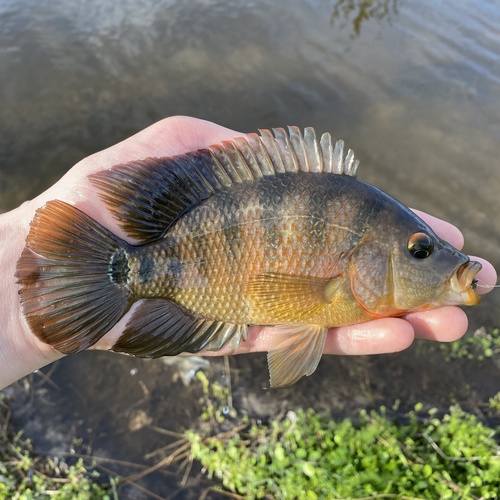
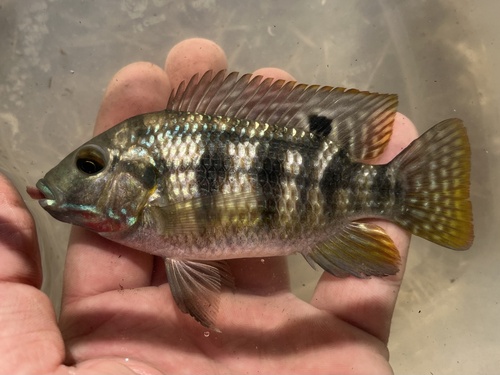
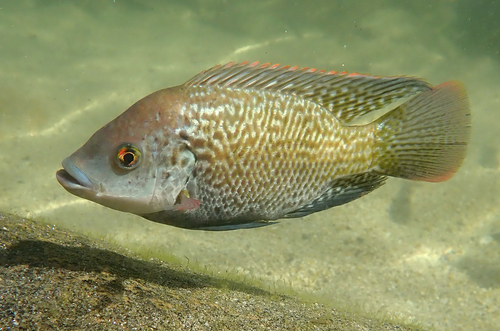
Description: The native, wild-type Mozambique tilapia (Oreochromis mossambicus) is laterally compressed and deep-bodied. It has long dorsal fins, with spines on the front portion. Native individuals have a dull greenish or yellowish base color, and may show weak banding. Adults can reach up to 39 cm (15 in) in standard length, weigh up to 1.1 kg (2.4 lb), and live up to 11 years. Size and coloration can vary in captive and naturalized populations due to environmental and breeding pressures. Distribution and habitat: This species is native to inland and coastal waters in southeastern Africa, ranging from the Zambezi basin (covering Mozambique, Malawi, Zambia and Zimbabwe) to the Bushman River in South Africa's Eastern Cape province. Within its native home range, it is threatened by the introduced Nile tilapia. The two species compete for the same resources and hybridize readily. This hybridization has already been documented in the Zambezi and Limpopo Rivers, and pure Mozambique tilapia are expected to eventually disappear from both rivers. Otherwise, the Mozambique tilapia is a remarkably robust and fecund fish that can readily adapt to available food sources and breed even under suboptimal conditions. It occurs in a wide range of water bodies including rivers, streams, canals, ponds, lakes, swamps and estuaries, though it typically avoids fast-flowing waters, high-altitude waters, and the open sea. It inhabits waters with temperatures ranging from 17 to 35 °C (63–95 °F). Reproduction: The reproductive cycle of Mozambique tilapia begins when males excavate a nest for a female to lay her eggs. After the female lays her eggs, the male fertilizes them. The female then holds the eggs in her mouth until the fry hatch; this behavior is called mouthbrooding. Competition for access to reproductive mates is the main driver of aggressive behavior in Mozambique tilapia. This species' status as an invasive species stems from its life-history traits: it provides high levels of parental care, and can produce multiple broods over an extended reproductive season, both of which help it successfully establish in varied environments. Mozambique tilapia follow a lek mating system, where males congregate and display to attract females for mating. Mating success is heavily skewed toward dominant males, which are typically larger, more aggressive, and more effective at defending territories. Dominant males also build larger nests for spawning. During courtship, males widely use acoustic communication to attract females. Studies show females prefer dominant males that produce lower peak frequencies and higher pulse rates. After mating, males guard the nest while the female takes both eggs and sperm into her mouth. This mouthbrooding allows Mozambique tilapia to occupy many different niches during spawning, as the young can be transported in the female's mouth. These effective reproductive strategies may explain the species' invasive tendencies. Male Mozambique tilapia synchronize their breeding behavior (including courtship activity and territoriality) to match the synchronized spawning of females. A cost of this synchronization is increased competition among males already near the top of the dominance hierarchy. As a result, alternative mating tactics have evolved in the species. Smaller or non-dominant males may mimic females and sneak mating attempts when the dominant male is occupied. Another alternative tactic is to be a floater, travelling between different male territories to search for an available mate. Even with these alternative tactics, dominant males still hold the greatest reproductive advantage. Use in aquaculture: Mozambique tilapia are hardy, easy to raise and easy to harvest, making them a good species for aquaculture. They have mild, white flesh that is popular with consumers. This species makes up about 4% of total global tilapia aquaculture production, and is more commonly hybridized with other tilapia species. Tilapia as a group are very susceptible to diseases such as whirling disease and ich, but Mozambique tilapia are resistant to a wide range of poor water quality conditions and pollution levels. Because of this hardiness, they have been used as bioassay organisms to generate metal toxicity data for risk assessments of local freshwater species in South African rivers. Mozambique tilapia were one of the species flown on the Bion-M No.1 spacecraft in 2013, but all individuals died due to an equipment failure.