About Oreobolus pectinatus Hook.f.
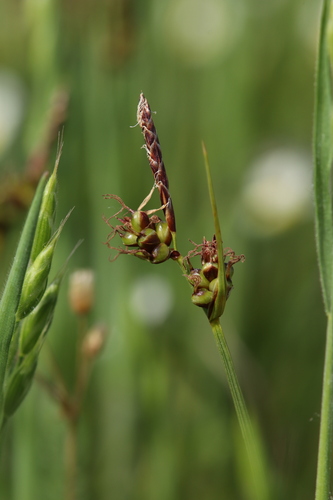
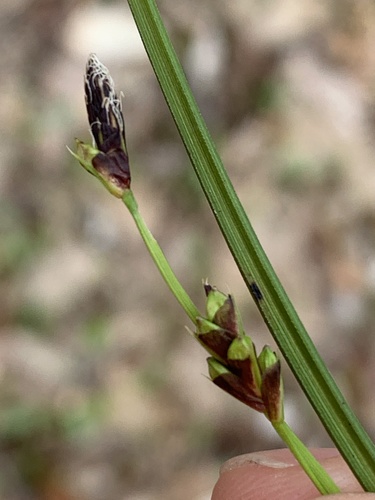
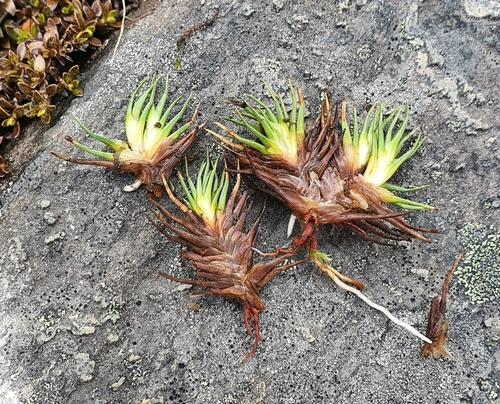
Oreobolus pectinatus Hook.f. is a perennial sedge that forms dense cushions between 10 and 100 millimeters in height. Its stems are densely packed, heavily branched at the base, and leafy. At the widest section of the leaf blade, the median nerve and two lateral nerves are visible; on the adaxial surface, only the median nerve is prominent. Abundant stomata are present on both surfaces of the leaf blade. The leaf sheath is not lobed at its apex, and has 5 to 7 nerves. Spikelets are usually solitary, and mature peduncles are usually longer than the leaves. This species typically produces 3 glumes, sometimes 4; when a fourth glume occurs, it is smaller than the others. Its fruit is a nut that starts out colorless, and matures to a red-brown, almost black shade. The fruit is longer than 1 millimeter, with a diameter of less than 1 millimeter. It flowers from October through December, and produces fruit from November through April. This plant is native to New Zealand, occurring on the Antipodean Islands, as well as the North and South Islands of New Zealand. It is a coastal to alpine species found up to 1500 meters above sea level. It only grows at sea level in the southern South Island, and on Stewart, Auckland and Campbell Islands. It is common in cushion bogs, alpine seepages, and mires.