About Orectolobus ornatus (De Vis, 1883)
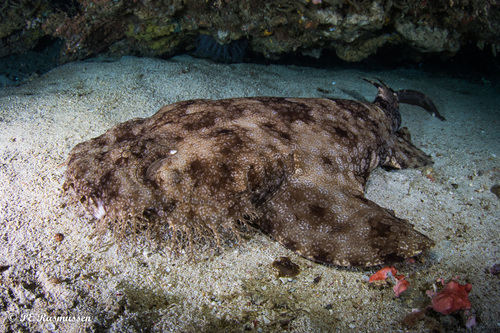
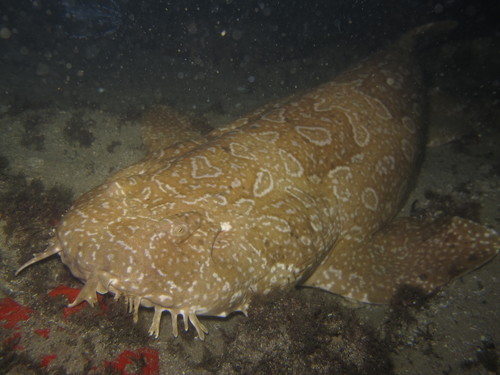
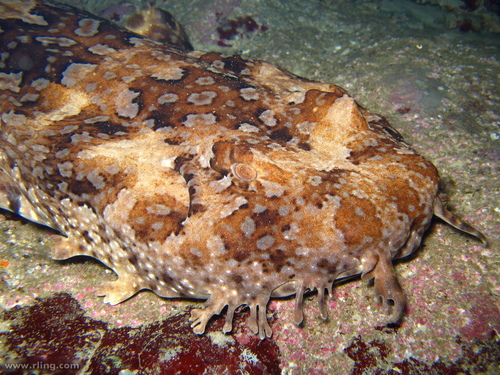
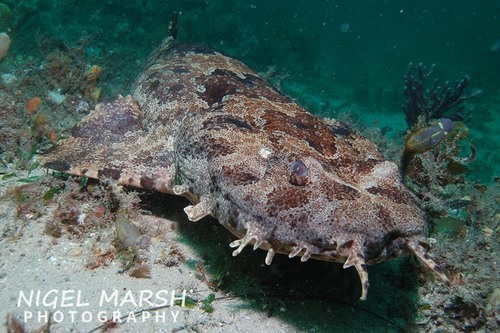
The ornate wobbegong (Orectolobus ornatus (De Vis, 1883)) has a golden brown upperside marked with blueish-grey patches, and a yellow-green underside. It has two dorsal fins, a large flat head, small eyes, and flaps of skin covering its mouth and the lower part of its head. Newly hatched juveniles measure 20 centimetres (7.9 in) in total length. Individuals reach sexual maturity at 79 centimetres (2.6 ft), and the maximum reported size for adult individuals is 120 centimetres (3.9 ft).
This species shares a similar appearance with the gulf wobbegong and the spotted wobbegong (Orectolobus maculatus). It is smaller than the gulf wobbegong, and lacks the distinctive O-shaped spots that characterize the spotted wobbegong. It can also be differentiated from the spotted wobbegong by its markings, which have black edges. Its distinct color pattern provides effective camouflage, making it barely visible when it rests among sea floor plants. This pattern becomes less prominent as individuals age.
Ornate wobbegongs inhabit tropical and warm temperate waters at depths of no more than 100 metres (330 ft). They are native to eastern Australia in the western Pacific Ocean, with confirmed populations reported at Port Stephens and Sydney. While the species has also been reported to occur in Indonesia, Japan, and Papua New Guinea, the International Union for Conservation of Nature (IUCN) considers these reports likely to be misidentifications of other species, meaning the ornate wobbegong would be endemic to Australia. However, the Florida Museum of Natural History lists the species as occurring in Indonesia and Papua New Guinea; this claim has yet to be verified. The overall size and trend of the ornate wobbegong population are unknown. The main threat to this species in eastern Australia is commercial fishing. A survey conducted from May 2000 to April 2001 recorded 5,174 total wobbegongs (including other species) caught and retained across New South Wales, Queensland, South Australia, and Western Australia. This species is targeted for human consumption because its flesh is edible, and its skin has previously been used for decoration. It is not currently considered threatened, as it is only caught in parts of its range and not caught frequently. As of 20 February 2015, it is listed as a least-concern species on the IUCN Red List, following two previous assessments as near threatened in 2003 and 2009.
The ornate wobbegong is a nocturnal species, carrying out most of its activity and feeding at night. While it has occasionally been observed hunting during the day, it generally stays in a somewhat sleepy state, resting in the open or under caves and ledges, most often on sand or weed bottoms. Its habitats include algae-covered sea floors, coral reefs, and bays. It typically inhabits clearer waters than the spotted wobbegong. Its diet consists of crustaceans, fish, and octopuses. A diet study of specimens from Port Jackson found that fish, primarily luderick, moray eels, and snappers, made up 86.5% of the species' diet, while cephalopods made up the remaining 13.5%.
Ornate wobbegong reproduction is ovoviviparous, with over 12 pups born per litter. Gestation lasts almost a year, and hatching of young occurs in September or October. Naturalist Neville Coleman observed a one-day-old specimen that already had a full set of teeth and was capable of defending itself. The species is usually not aggressive toward humans, but it will bite when disturbed. It uses its sharp anterior teeth to inflict shallow but painful wounds. Because its camouflage is so effective, divers often fail to notice the species even when they are close by, and some divers are bitten. It has also bitten people entering tide pools, including fishers and waders. It will sometimes swim toward nearby divers, possibly with hostile intent. The International Shark Attack File has recorded 32 total attacks from wobbegong species as a group, since accurate species-level identification of wobbegong bites is difficult.